Pressure and Pascal's principle (part 1) | Fluids | Physics | Khan Academy
TL;DR
Fluids, such as liquids and gases, take the shape of their container. Liquids are incompressible, while gases are compressible.
Transcript
Let's learn a little bit about fluids. You probably have some notion of what a fluid is, but let's talk about it in the physics sense, or maybe even the chemistry sense, depending on in what context you're watching this video. So a fluid is anything that takes the shape of its container. For example, if I had a glass sphere, and let's say that I co... Read More
Key Insights
- 🫢 Fluids, such as liquids and gases, take the shape of their container.
- 🫢 Liquids are incompressible, while gases are compressible.
- 🫢 Liquids can be turned into gases through evaporation, and gases can be turned into liquids through condensation.
- 💦 Work in physics is defined as the force applied to an object multiplied by the distance over which the force is exerted.
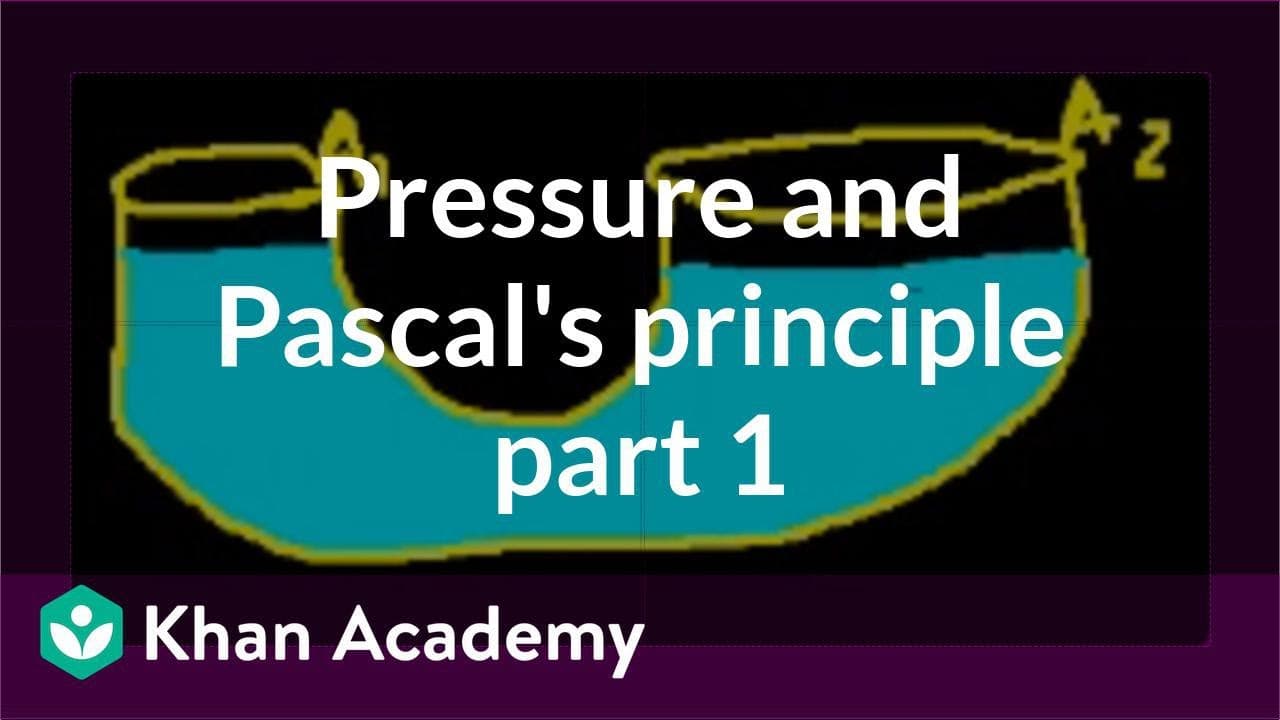
- 🫗 The volume of a liquid is determined by the area and distance of the container through which it is displaced.
- 🫗 Fluid motion and liquid motion can be studied using principles of force, pressure, and volume displacement.
- 🫗 The volume of a liquid displaced is equal to the volume of the liquid that rises in another part of the container.
Install to Summarize YouTube Videos and Get Transcripts
Explore YouTube Video Summarizer or Get YouTube Transcript Extractor
Questions & Answers
Q: What is the difference between a liquid and a gas?
The main difference is that gases are compressible, while liquids are incompressible. This means that the volume of a gas can be decreased by applying pressure, but the volume of a liquid remains constant.
Q: Can liquids be changed into gases and vice versa?
Yes, liquids can be turned into gases through a process called evaporation, and gases can be turned into liquids through a process called condensation. These phase changes occur when the temperature and pressure conditions are altered.
Q: What is the definition of work in physics?
In physics, work is defined as the force applied to an object multiplied by the distance over which the force is exerted. It represents the energy transferred to or from an object.
Q: How is the volume of a liquid related to the area and distance of a container?
The volume of a liquid is equal to the product of the area and distance of the container through which it is displaced. For example, if a liquid is pushed down a certain distance in a container with a specific area, the volume of the liquid displaced is equal to the area multiplied by that distance.
Summary & Key Takeaways
-
Fluids refer to substances that take the shape of their container, such as liquids and gases.
-
Liquids are incompressible, meaning their volume cannot be changed by applying pressure.
-
Gases are compressible, and their volume can be decreased by increasing pressure.
Read in Other Languages (beta)
Share This Summary 📚
Summarize YouTube Videos and Get Video Transcripts with 1-Click
Try YouTube Summary with ChatGPT & Claude or YouTube Transcript Generator
Explore More Summaries from Khan Academy 📚



Summarize YouTube Videos and Get Video Transcripts with 1-Click
Try YouTube Summary with ChatGPT & Claude or YouTube Transcript Generator