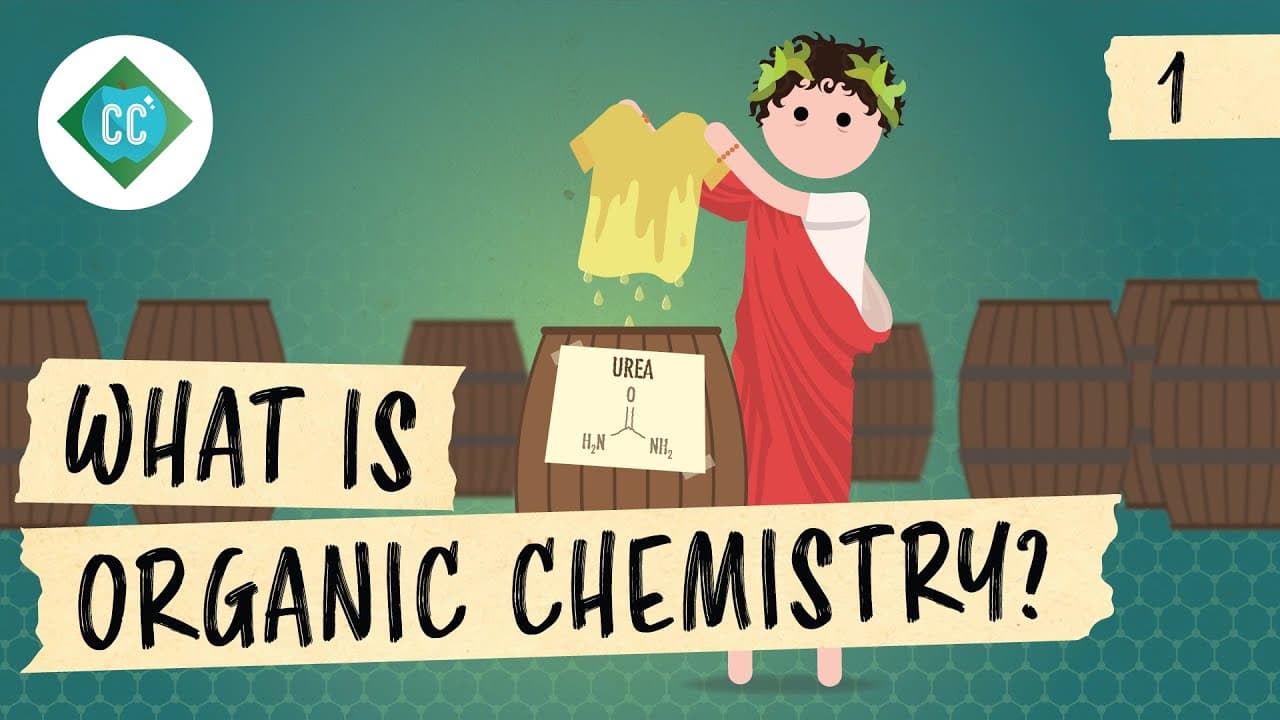
What Is Organic Chemistry?: Crash Course Organic Chemistry #1
TL;DR
Organic chemistry is the study of carbon-based molecules and their properties, reactions, and structures.
Transcript
Hi! I’m Deboki Chakravarti and welcome to Crash Course Organic Chemistry! The science of chemistry is pretty incredible because it’s the science of… everything. Stars and computer hard drives and desks and our bodies are all made up of different arrangements of atoms that are bonded together, breaking apart, or reacting with each other all the time... Read More
Key Insights
- ⚾ Organic chemistry focuses on carbon-based molecules and their properties, reactions, and structures.
- 👻 Carbon's ability to form four bonds allows for diverse organic compounds.
- ❓ Organic compounds are found in various substances, including medications, dyes, and polymers.
- 🖐️ Historical discoveries, such as the synthesis of urea, played a significant role in the development of modern organic chemistry.
- ❓ Different representations, such as Lewis structures and skeletal formulas, are used to depict organic molecules.
- 👥 Functional groups and heteroatoms contribute to the diversity and reactivity of organic compounds.
- 🖐️ Organic chemistry plays a crucial role in the development of materials like plastics and electronics.
Install to Summarize YouTube Videos and Get Transcripts
Explore YouTube Video Summarizer or Get YouTube Transcript Extractor
Questions & Answers
Q: What is organic chemistry and what does it study?
Organic chemistry is the branch of chemistry that focuses on carbon-based molecules and their properties, reactions, and structures.
Q: Why are carbon atoms important in organic chemistry?
Carbon atoms are essential in organic chemistry because they can form four bonds, allowing them to create diverse compounds and structures.
Q: What are some everyday examples of organic compounds?
Everyday examples of organic compounds include medications derived from plants, dyes used in fabrics and food, and polymers used in electronic devices and plastics.
Q: How do Lewis structures, condensed structures, and skeletal formulas represent organic molecules?
Lewis structures provide a detailed representation of the bonds and electrons in an organic molecule, condensed structures group hydrogens together, and skeletal formulas use lines and bends to simplify the structure.
Summary & Key Takeaways
-
Organic chemistry focuses on molecules that contain carbon atoms and their arrangements.
-
The study of organic chemistry involves understanding the logic behind molecular structures and chemical reaction mechanisms.
-
Organic compounds are found in various substances, including plants, medications, dyes, plastics, and everyday items like coffee and electronics.
Read in Other Languages (beta)
Share This Summary 📚
Summarize YouTube Videos and Get Video Transcripts with 1-Click
Try YouTube Summary with ChatGPT & Claude or YouTube Transcript Generator
Explore More Summaries from CrashCourse 📚






Summarize YouTube Videos and Get Video Transcripts with 1-Click
Try YouTube Summary with ChatGPT & Claude or YouTube Transcript Generator