Salient Features of VBT - Co-Ordination Compounds - Chemistry Class 12
TL;DR
This video discusses the salient features of valence bond theory in metal complexes, including the utilization of vacant metal orbitals, coordination number, hybridization, lone pairs of electrons in ligands, and spin pairing of metal ion electrons.
Transcript
click the bell icon to get latest videos from equator hellofax is the Prius topic we have discussed about the optical isomerism as far as the geometric lines open itself and now in this topic we are going to talk about the salient features of the valance bond theory and based on that we are going to talk about what is the application of valence bon... Read More
Key Insights
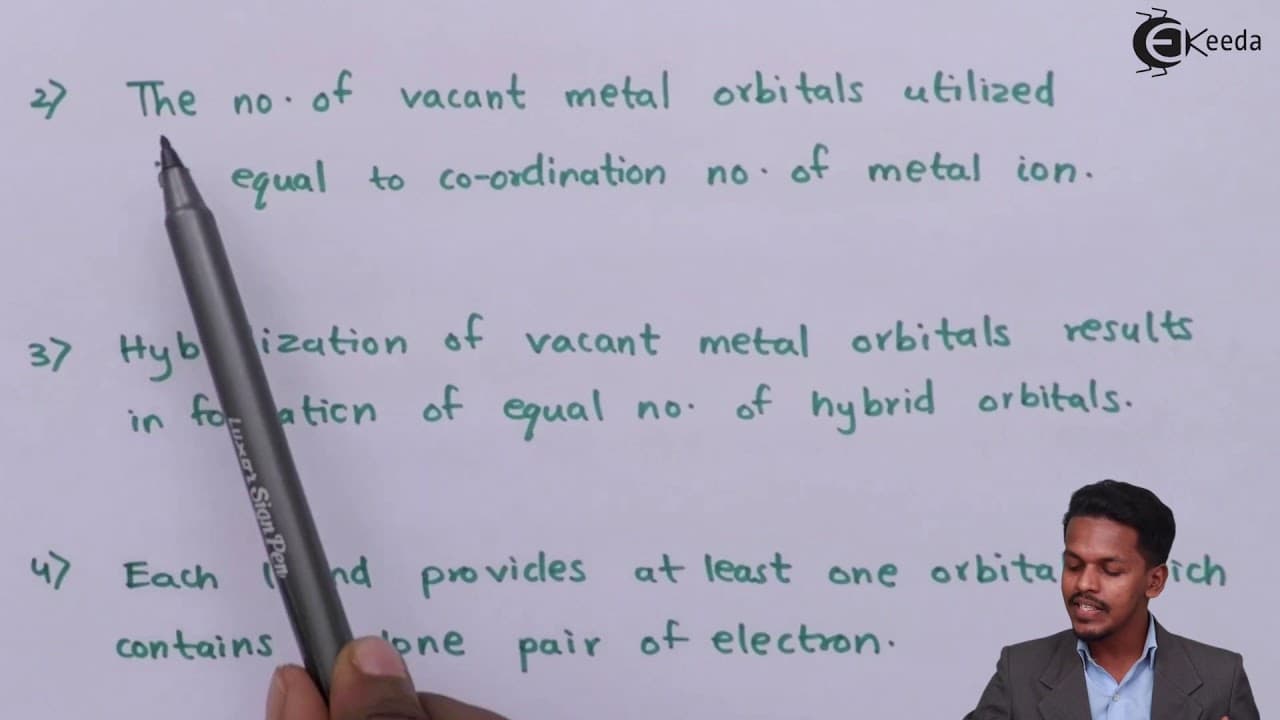
- 🤘 Salient features of valence bond theory in metal complexes include the utilization of vacant metal orbitals, coordination number, hybridization, lone pairs of electrons in ligands, and spin pairing of metal ion electrons.
- 🤘 The number of vacant metal orbitals determines the number of ligand molecules that can approach the metal ion for bond formation.
- 💁 The coordination number corresponds to the number of bonds formed by the metal ion with ligands.
- 🤘 Hybridization of metal orbitals results in hybrid orbitals that determine the shape and strength of the metal-ligand interaction.
- 💁 Ligands contribute at least one orbital with a lone pair of electrons towards bond formation.
- 💁 Inner complexes are formed by hybridization of (n-1)d orbitals, while outer complexes are formed by hybridization of nd orbitals.
Install to Summarize YouTube Videos and Get Transcripts
Explore YouTube Video Summarizer or Get YouTube Transcript Extractor
Questions & Answers
Q: How do vacant metal orbitals affect the formation of coordination bonds in metal complexes?
Vacant metal orbitals, such as sp3 orbitals, provide sites for the formation of coordination bonds with ligands. The more vacant orbitals available, the greater the number of ligand molecules that can approach the metal ion.
Q: What is the relationship between coordination number and the formation of bonds in metal complexes?
The coordination number of a metal ion is equal to the number of bonds it forms with ligands. A higher coordination number means more bonds are formed between the metal and ligand molecules.
Q: How does hybridization of metal orbitals influence the strength and shape of metal-ligand interactions?
Hybridization of metal orbitals results in the formation of hybrid orbitals, which overlap with the orbitals of ligands. The extent of this overlap determines the strength of the bond and the resulting shape of the complex.
Q: Why does each ligand provide at least one orbital with a lone pair of electrons?
Ligands, regardless of their type (monodentate, bidentate, tridentate), contribute at least one orbital with a lone pair of electrons. This lone pair interacts with the metal ion, contributing to the bond formation.
Summary & Key Takeaways
-
Valence bond theory states that a definite number of vacant metal orbitals are utilized for coordination bonds with ligands in metal complexes.
-
The coordination number of the metal ion corresponds to the number of bonds formed with the ligands.
-
Hybridization of metal orbitals leads to the formation of hybrid orbitals, determining the strength and shape of the metal-ligand interaction.
Read in Other Languages (beta)
Share This Summary 📚
Summarize YouTube Videos and Get Video Transcripts with 1-Click
Try YouTube Summary with ChatGPT & Claude or YouTube Transcript Generator
Explore More Summaries from Ekeeda 📚





Summarize YouTube Videos and Get Video Transcripts with 1-Click
Try YouTube Summary with ChatGPT & Claude or YouTube Transcript Generator