Angle bisector theorem examples | Geometry | Khan Academy
TL;DR
Using the angle bisector theorem to find missing side lengths in triangles.
Transcript
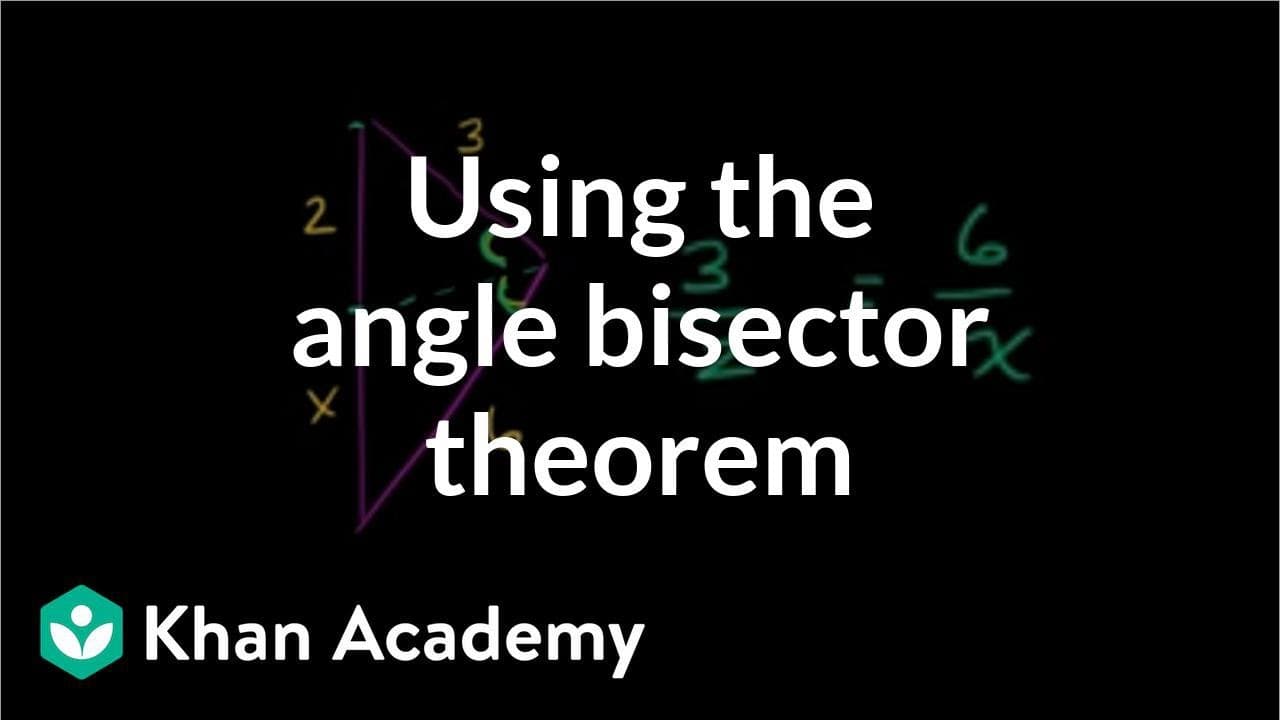
I thought I would do a few examples using the angle bisector theorem. So in this first triangle right over here, we're given that this side has length 3, this side has length 6. And this little dotted line here, this is clearly the angle bisector, because they're telling us that this angle is congruent to that angle right over there. And then they ... Read More
Key Insights
- 🔺 The angle bisector theorem can be used to find missing side lengths in triangles by setting up and solving ratios.
- 🔺 An isosceles triangle may not appear isosceles at first glance if the angle bisector is not explicitly shown.
- 🔺 The length of the angle bisector can be calculated using the angle bisector theorem and the difference between the known side length and the whole triangle's side length.
Install to Summarize YouTube Videos and Get Transcripts
Explore YouTube Video Summarizer or Get YouTube Transcript Extractor
Questions & Answers
Q: How can the angle bisector theorem be used to find missing side lengths?
The angle bisector theorem states that the ratio of two sides of a triangle is equal to the ratio of the corresponding side lengths that the angle bisector divides. By setting up and solving an equation using this ratio, we can find missing side lengths.
Q: What is the significance of a triangle being isosceles?
An isosceles triangle has two sides of equal length. In the first example, it is revealed that the triangle is actually isosceles, with side lengths of 6 and a base length of 3, despite not appearing so at first glance.
Q: How is the length of the angle bisector calculated in the second example?
The angle bisector theorem is again used, with the ratio of 5 to the unknown length being equal to the ratio of 7 to the difference between 10 and the unknown length. By setting up and solving an equation using this ratio, the length of the angle bisector is found to be 4 and 1/6.
Q: Can the angle bisector theorem be applied to any triangle?
Yes, the angle bisector theorem can be applied to any triangle, as long as the length of the angle bisector and at least one other side length are known. It allows for the determination of missing side lengths.
Summary & Key Takeaways
-
In the first example, given side lengths of 3 and 6, and an angle bisector of length 2, the missing side length is found to be 4.
-
In the second example, with side lengths of 5, 7, and 10, the length of the angle bisector is calculated to be 4 and 1/6.
Read in Other Languages (beta)
Share This Summary 📚
Summarize YouTube Videos and Get Video Transcripts with 1-Click
Try YouTube Summary with ChatGPT & Claude or YouTube Transcript Generator
Explore More Summaries from Khan Academy 📚



Summarize YouTube Videos and Get Video Transcripts with 1-Click
Try YouTube Summary with ChatGPT & Claude or YouTube Transcript Generator