Task Simplification, Simplexity & Further Evidence Against the Need for Fundamentals
TL;DR
Simplexity aids complex skills without fundamentals first approach.
Transcript
Hi everyone, this is Rob Gray from ASU in the perception action podcast back with another article review. Today I want to look at a new article addressing the concept of task simplification which I've talked about many times on the podcast. It's going to connect it with a new term a new concept called simplexity which I'll talk about in a second. I... Read More
Key Insights
- Simplexity combines simplicity and complexity, allowing simple constraints to produce complex behaviors in skill learning.
- Task simplification involves reducing complexity without decomposing tasks, maintaining complexity while easing difficulty for learners.
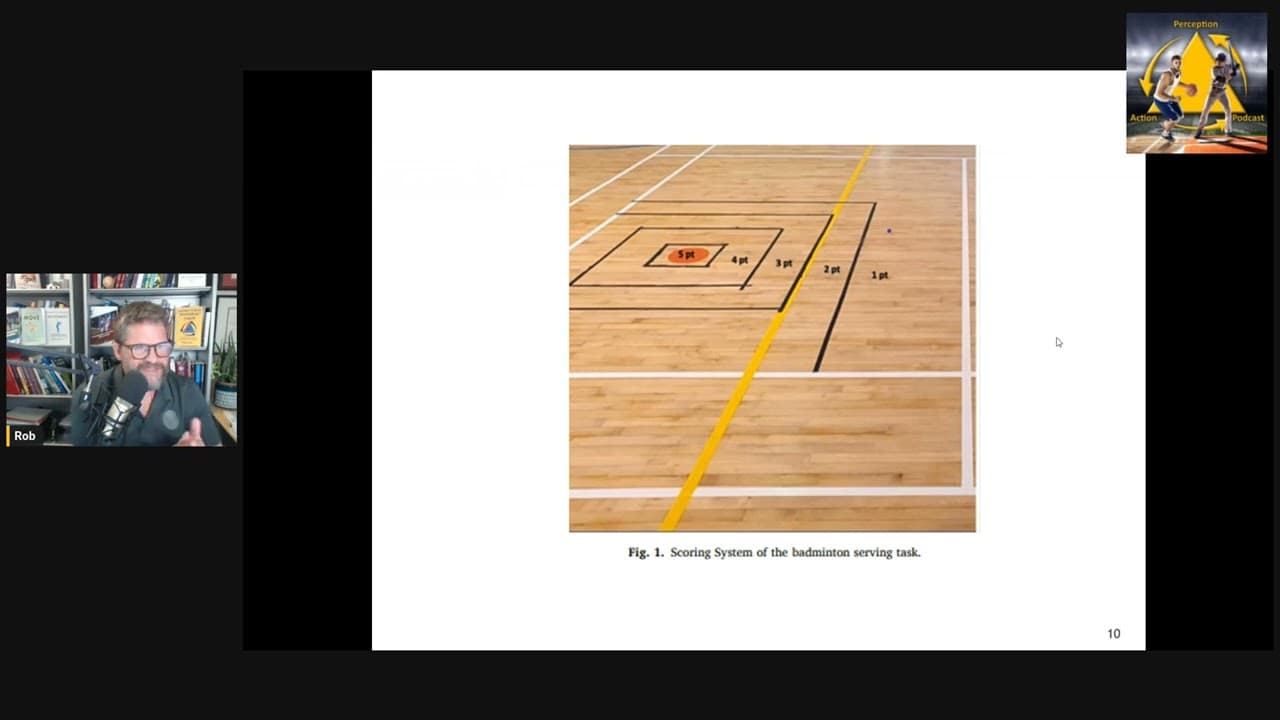
- The study compared linear and nonlinear pedagogy in badminton, finding no significant performance difference between approaches.
- Nonlinear pedagogy encourages exploration and adaptation, leading to diverse movement solutions and matching performance with prescriptive methods.
- The study challenges the fundamentals-first approach, showing effective learning without prescribed techniques.
- Simplexity promotes degeneracy, enabling multiple movement solutions for the same task, enhancing adaptability.
- The study used constraints-led methods, manipulating variables like target size and racket length to encourage exploration.
- Future research should evaluate advantages of nonlinear methods in complex, opponent-based scenarios to fully understand benefits.
Install to Summarize YouTube Videos and Get Transcripts
Explore YouTube Video Summarizer or Get YouTube Transcript Extractor
Questions & Answers
Q: What is the main concept discussed in the video?
The main concept discussed is 'simplexity,' which combines simplicity and complexity in skill acquisition. Simplexity involves using simple constraints to facilitate the learning of complex movements without focusing on fundamentals first. This approach challenges traditional pedagogy by promoting exploration and adaptability in learners.
Q: How does the study challenge traditional teaching methods?
The study challenges traditional teaching methods by demonstrating that learners can achieve similar performance outcomes through simplexity and task simplification without relying on a fundamentals-first approach. By encouraging exploration and adaptation, learners discover diverse movement solutions, questioning the necessity of prescriptive, technique-focused instruction.
Q: What methods were used in the study to encourage exploration?
The study used a constraints-led approach to encourage exploration, manipulating variables such as target size, racket length, and serving distance. These adjustments provided learners with simple constraints, allowing them to explore and adapt their movements to find effective solutions, promoting diverse skill acquisition without prescriptive guidance.
Q: What were the main findings regarding performance outcomes?
The main findings indicated no significant performance differences between groups using linear and nonlinear pedagogy. Both groups achieved similar performance levels, suggesting that simplexity and task simplification can effectively facilitate skill acquisition without the need for fundamentals-first instruction. This supports the potential of nonlinear methods in education.
Q: How does simplexity relate to task simplification?
Simplexity relates to task simplification by using simple constraints to facilitate complex skill learning. Task simplification reduces complexity while maintaining essential elements, allowing learners to explore and adapt. Simplexity promotes this by enabling learners to discover multiple movement solutions, enhancing adaptability and skill acquisition.
Q: What are the implications of the study for educational practices?
The study's implications for educational practices include reconsidering the necessity of a fundamentals-first approach. By adopting simplexity and task simplification, educators can encourage exploration and adaptability, leading to diverse skill acquisition. This approach could enhance learning outcomes and adaptability in complex environments, supporting a shift towards more flexible teaching methods.
Q: What limitations did the study have?
One limitation of the study was its focus on a controlled environment without opponents, which may not fully represent real-world conditions. Additionally, the study did not explore long-term advantages of nonlinear methods in complex scenarios. Future research should address these limitations to better understand the benefits of simplexity in diverse contexts.
Q: What future research directions does the study suggest?
Future research should evaluate the advantages of nonlinear pedagogy in complex, opponent-based scenarios to fully understand its benefits. Exploring long-term outcomes and adaptability in diverse contexts would provide insights into the practical applications of simplexity and task simplification, potentially influencing educational practices and skill development strategies.
Summary & Key Takeaways
-
The study explores the concept of simplexity in skill acquisition, combining simplicity and complexity to enhance learning. By using simple constraints, learners can produce complex movements without needing to master fundamentals first. The research challenges traditional pedagogy by demonstrating effective learning through task simplification.
-
A comparison of linear and nonlinear pedagogy in badminton serving tasks showed no significant performance differences between groups. The nonlinear approach encouraged exploration and adaptation, allowing learners to discover diverse movement solutions. This finding questions the necessity of a fundamentals-first approach in skill development.
-
Simplexity promotes the idea of degeneracy, enabling multiple movement solutions for the same task. The study used constraints-led methods, such as varying target size and racket length, to encourage exploration. Future research should assess the advantages of nonlinear methods in complex, opponent-based scenarios.
Read in Other Languages (beta)
Share This Summary 📚
Summarize YouTube Videos and Get Video Transcripts with 1-Click
Try YouTube Summary with ChatGPT & Claude or YouTube Transcript Generator
Explore More Summaries from Rob Gray 📚
Summarize YouTube Videos and Get Video Transcripts with 1-Click
Try YouTube Summary with ChatGPT & Claude or YouTube Transcript Generator