Introduction to amino acids | Macromolecules | Biology | Khan Academy
TL;DR
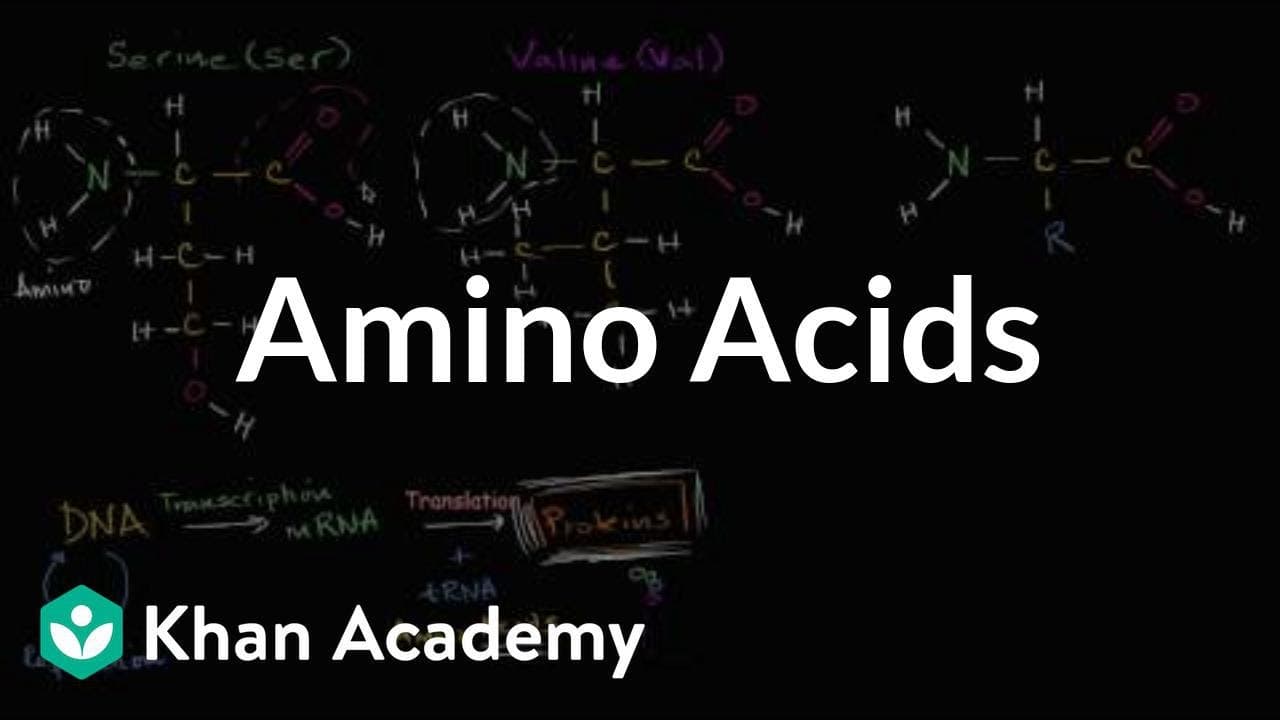
DNA replication produces messenger RNA (mRNA) which is used along with tRNA and amino acids to construct proteins, which are the building blocks of organisms.
Transcript
- DNA gets a lot of attention as the store of our genetic information, and it deserves that. If we didn't have DNA, there would be no way of keeping the information that makes us us, and other organisms what those organisms are. And DNA has some neat properties, it can replicate itself, and we go into a lot of depth on that in other videos. So DNA ... Read More
Key Insights
- 💁 DNA replication is necessary to maintain genetic information, but protein synthesis is required to produce the structures and molecules that carry out the functions of organisms.
- 🖐️ Proteins, composed of amino acids, play a crucial role in various biological processes.
- ⛓️ Amino acids have different side chains that influence protein structure and function.
- ♻️ The properties of amino acids, such as hydrophilicity and hydrophobicity, impact how proteins interact with their environment.
- 🙏 Peptide bonds link amino acids together to form polypeptides, which can then fold into functional proteins.
- 😥 Physiological conditions in the body, such as pH, affect the ionization states of amino acids, resulting in zwitterions.
- 🧑🏭 mRNA acts as the intermediary between DNA and protein synthesis, carrying the instructions for protein production.
Install to Summarize YouTube Videos and Get Transcripts
Explore YouTube Video Summarizer or Get YouTube Transcript Extractor
Questions & Answers
Q: What is the role of mRNA in protein synthesis?
mRNA carries the genetic information from DNA to the ribosomes, where it serves as a template for protein synthesis.
Q: How are amino acids involved in protein synthesis?
Amino acids, carried by tRNA, are brought to the ribosomes and joined together based on the mRNA sequence to form proteins.
Q: What determines the properties and functions of different proteins?
The specific sequence of amino acids in a protein, along with their interactions and overall structure, determines its properties and functions.
Q: How do hydrophilic and hydrophobic amino acids affect protein structure?
Amino acids with hydrophilic side chains interact with water and are typically found on the surface of proteins, while amino acids with hydrophobic side chains tend to be buried in the interior.
Summary & Key Takeaways
-
DNA stores genetic information and can replicate itself, but the production of proteins, which do the work of organisms, requires the conversion of DNA to mRNA through transcription.
-
mRNA is then used by ribosomes, tRNA, and amino acids to construct proteins, which are composed of chains of amino acids.
-
Proteins have various functions in the organism, including immune response, enzyme activity, signaling, muscle contraction, and oxygen transport.
Read in Other Languages (beta)
Share This Summary 📚
Summarize YouTube Videos and Get Video Transcripts with 1-Click
Try YouTube Summary with ChatGPT & Claude or YouTube Transcript Generator
Explore More Summaries from Khan Academy 📚



Summarize YouTube Videos and Get Video Transcripts with 1-Click
Try YouTube Summary with ChatGPT & Claude or YouTube Transcript Generator