Agile Supply Chain Management- Agile Manufacturing - Industrial Engineering and Management
TL;DR
Agile supply chain management is a practical approach to managing supply networks and developing flexible capabilities to meet changing customer demands effectively.
Transcript
hello students today we are going to see the topic ajay supply chain management and prospective to handle the session for you so agile supply chain is a practical approach to managing supply networks and developing flexible capabilities to satisfy the fast changing customer demand supply chain is a concept where right from the production still to t... Read More
Key Insights
- 👻 Agile supply chain management integrates customer demands into the production process, allowing for modifications or changes to be incorporated promptly.
- 🏬 Virtual integration and process integration are essential components of agile supply chain management, ensuring coordination and collaboration between departments and stakeholders.
- ⛓️ Agility in supply chain management improves customer satisfaction, adaptability to market changes, and overall operational efficiency.
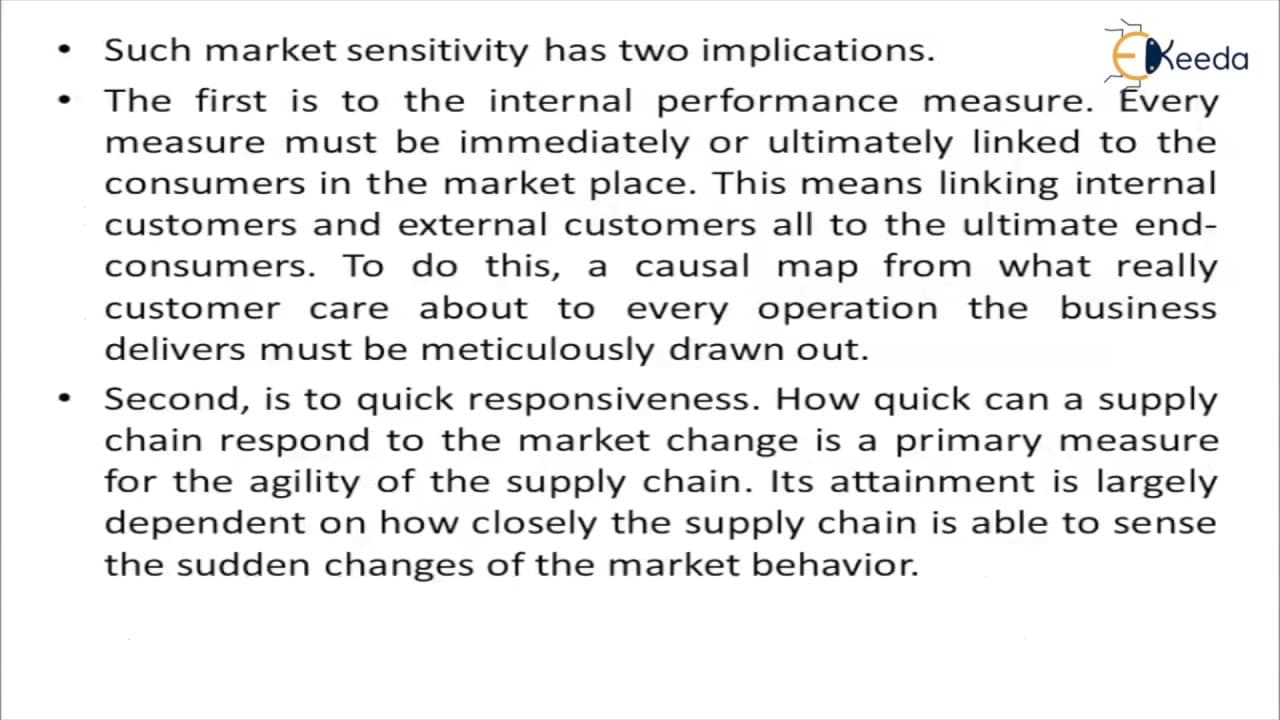
- 👨💼 Effective market sensitivity enables businesses to align internal supply chain measures with external market performance measures, ensuring competitiveness.
- ⚾ Network-based collaboration in agile supply chain management facilitates effective communication and coordination between suppliers and customers.
- 🖐️ Sophisticated information systems play a crucial role in agile supply chain management, ensuring efficient sharing of ideas and coordination among stakeholders.
- ⛓️ Agile supply chain management requires a commitment to integrating resources and obtaining continuous improvement.
Install to Summarize YouTube Videos and Get Transcripts
Explore YouTube Video Summarizer or Get YouTube Transcript Extractor
Questions & Answers
Q: What is agile supply chain management?
Agile supply chain management is a practical approach that focuses on managing supply networks and adapting to changing customer demands effectively.
Q: What are the key components of agile supply chain management?
The key components of agile supply chain management include virtual integration, process integration, market sensitivity, and network-based collaboration.
Q: How does agile supply chain management improve customer satisfaction?
Agile supply chain management allows for quick responsiveness to customer demands, ensuring that modifications or changes in the product can be incorporated promptly to meet their needs.
Q: How does agile supply chain management adapt to market changes?
Agile supply chain management emphasizes market sensitivity, which involves sourcing and linking internal supply chain measures with external market performance measures and business assessments.
Q: How does process integration play a role in agile supply chain management?
Process integration ensures that all departments involved in the operational process are integrated and coordinated, allowing for quick responses to any problems or corrective changes.
Q: How does agile supply chain management handle forecasting?
Rather than relying solely on business unit forecasting, agile supply chain management encourages collaboration between internal stakeholders and external sources to improve forecasting capabilities.
Q: What are the benefits of network-based collaboration in agile supply chain management?
Network-based collaboration allows for stable or dynamic networks, where suppliers and customers can communicate and collaborate effectively, leading to improved coordination and the incorporation of customer ideas.
Q: How does agile supply chain management utilize information systems?
Agile supply chain management requires sophisticated information systems to share ideas and coordinate activities among stakeholders, improving communication and decision-making.
Summary & Key Takeaways
-
Agile supply chain management is about managing supply networks and integrating customer demands into the production process.
-
The key components of agile supply chain management are virtual integration, process integration, market sensitivity, and network-based collaboration.
-
Implementing agile supply chain management helps improve customer satisfaction, adapt to market changes quickly, and effectively coordinate operations between departments.
Read in Other Languages (beta)
Share This Summary 📚
Summarize YouTube Videos and Get Video Transcripts with 1-Click
Try YouTube Summary with ChatGPT & Claude or YouTube Transcript Generator
Explore More Summaries from Ekeeda 📚






Summarize YouTube Videos and Get Video Transcripts with 1-Click
Try YouTube Summary with ChatGPT & Claude or YouTube Transcript Generator