Problem 2 on Grammar and DCFL
TL;DR
LL(k) grammars are a type of grammar that can predict which production to use based on a look-ahead symbol.
Transcript
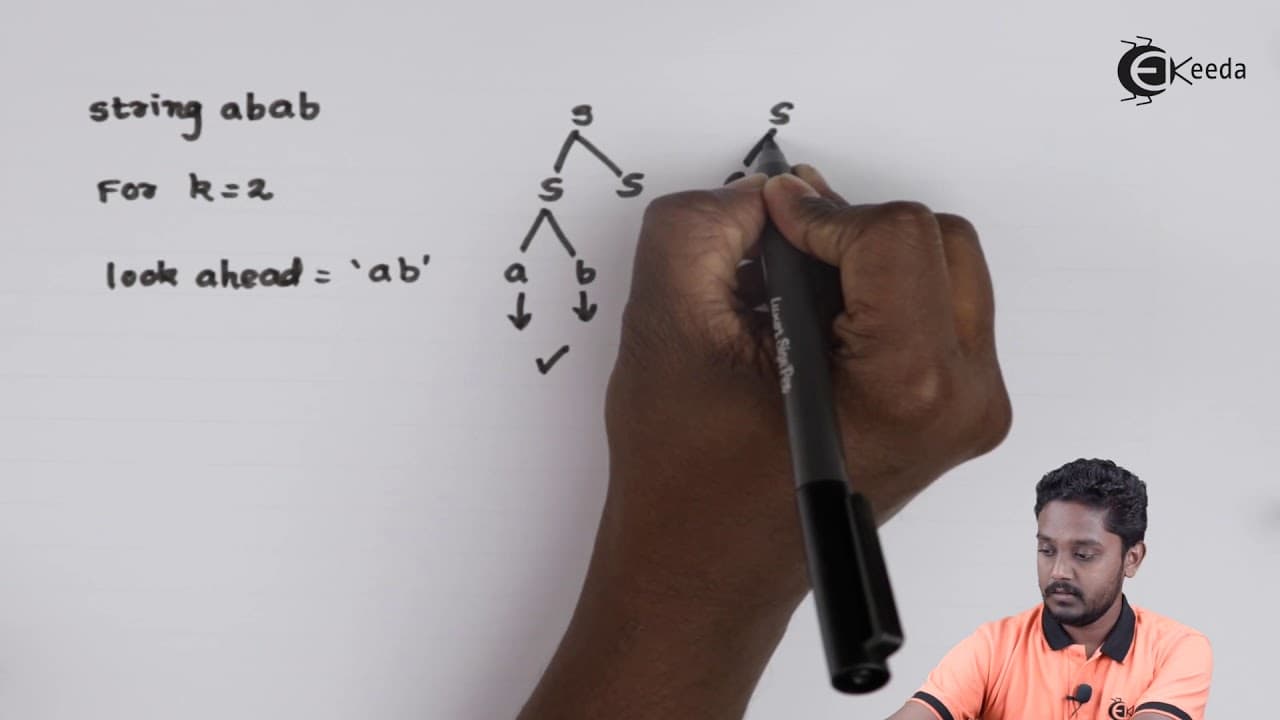
click the bell icon to get latest videos from akira hello friends in the previous video we have solved a question in which we have taken up a grammar and we saw that that particular grammar is ll 2 that means looking at to look ahead symbol we can predict which production to be used over here we have taken the same grammar and we applied a positive... Read More
Key Insights
- 😒 LL(k) grammars can predict the production to use based on a look-ahead symbol.
- ❓ The predictability of a grammar is determined by finding a grammar that can correctly predict the production for any value of k.
- 🎮 The example grammar provided in the video is not LL(k) for any value of k.
- ❓ If a grammar cannot be found that is LL(k) for a language, it is considered not LL(k).
Install to Summarize YouTube Videos and Get Transcripts
Explore YouTube Video Summarizer or Get YouTube Transcript Extractor
Questions & Answers
Q: What are LL(k) grammars?
LL(k) grammars are a type of grammar that can predict the production to use based on a look-ahead symbol. The value of k represents the number of symbols to consider for prediction.
Q: How is the predictability of a grammar determined?
The predictability of a grammar is determined by checking if, for any value of k, there exists a grammar that can predict the correct production to use based on k look-ahead symbols.
Q: Is the example grammar LL(1)?
No, the example grammar is not LL(1) because there exists a string where the production cannot be determined based on only one look-ahead symbol.
Q: Can the example grammar be considered LL(2)?
No, the example grammar is not LL(2) either because there exists a string where the production cannot be determined based on two look-ahead symbols.
Summary & Key Takeaways
-
The video discusses LL(1), LL(2), and LL(k) grammars and their predictability.
-
The presenter provides an example grammar and analyzes whether it is LL(1) or LL(2).
-
It is concluded that the grammar in question is not LL(k) for any value of k.
-
The importance of finding an LL(k) grammar for a language is emphasized.
Read in Other Languages (beta)
Share This Summary 📚
Summarize YouTube Videos and Get Video Transcripts with 1-Click
Try YouTube Summary with ChatGPT & Claude or YouTube Transcript Generator
Explore More Summaries from Ekeeda 📚






Summarize YouTube Videos and Get Video Transcripts with 1-Click
Try YouTube Summary with ChatGPT & Claude or YouTube Transcript Generator