AP® Chemistry: Bonding, Hybridization, Intermolecular Forces, Enthalpy
TL;DR
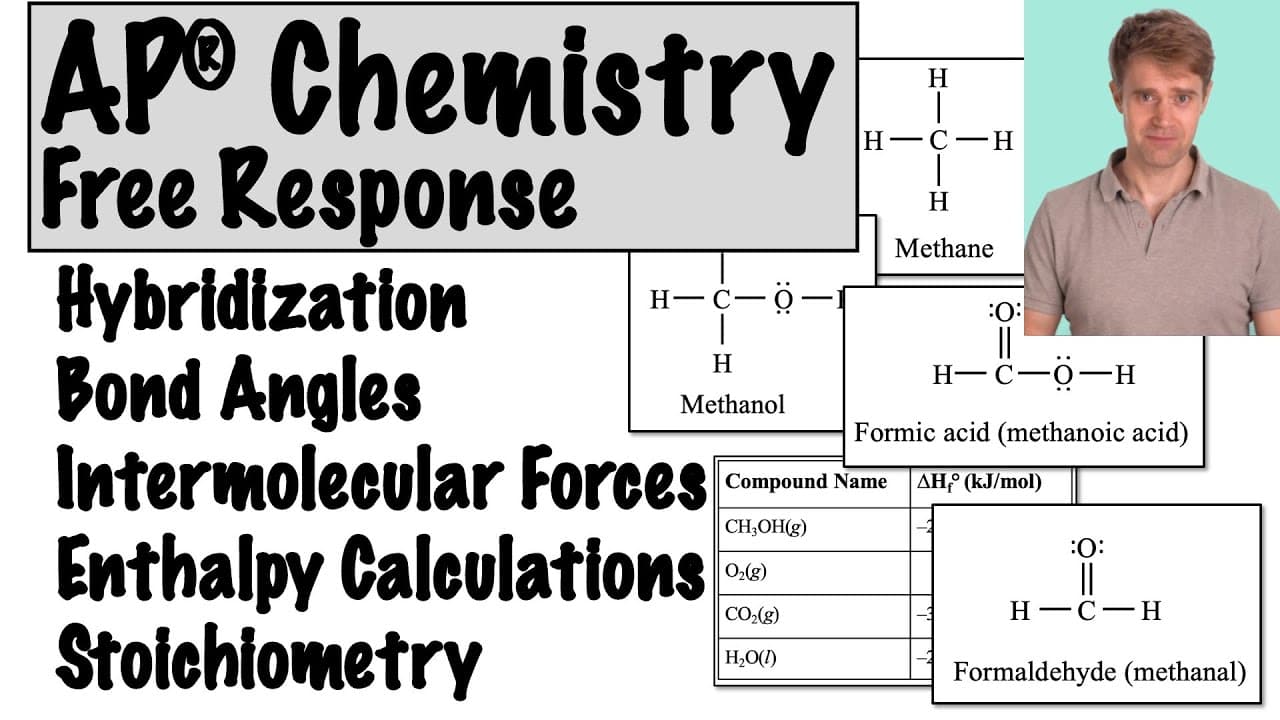
This video analyzes a long AP Chemistry free response question, covering topics such as hybridization, bond angles, intermolecular forces, and stoichiometry.
Transcript
Here we're going to look at a longer free response question that covers a variety of skills and concepts that you've learned in AP chemistry. Now, because this item is so long, we'll take the questions one part at a time. You can download a mini test. Here, you can practice, try it yourself, and then you can follow along with this video.... Read More
Key Insights
- 🫀 Hybridization can be determined by counting effective electron pairs in an atom.
- 🔺 Bond angles can be determined based on the molecular geometry, using common bond angles for linear, trigonal planar, and tetrahedral shapes.
- 😥 Methanol has a higher boiling point than formaldehyde due to the presence of hydrogen bonding.
- ❓ Methane experiences London dispersion forces, the weakest intermolecular forces.
- 💁 Enthalpies of formation can be used to calculate the standard enthalpy change for a reaction.
- 🥵 Methanol combustion releases heat, showcasing an exothermic reaction.
- 💆 Density and volume can be used to calculate the mass of a substance.
Install to Summarize YouTube Videos and Get Transcripts
Explore YouTube Video Summarizer or Get YouTube Transcript Extractor
Questions & Answers
Q: How can hybridization be determined based on effective electron pairs?
Hybridization can be determined by counting the effective electron pairs (single bonds, double bonds, triple bonds, and lone pairs) around an atom. For example, if there are four effective electron pairs, the atom adopts an sp3 hybrid orbital scheme.
Q: Why does methanol have a higher boiling point than formaldehyde?
Methanol has a higher boiling point due to its stronger intermolecular forces of attraction. It can form hydrogen bonds between the hydrogen atom bonded to oxygen and the lone pairs of oxygen on another methanol molecule, increasing the energy required to break these bonds compared to formaldehyde with only dipole-dipole attractions.
Q: Are there any intermolecular forces experienced by methane?
Yes, methane experiences London dispersion forces. These arise from the random movements of electrons at any given instant, creating temporary dipoles. While London dispersion forces are the weakest intermolecular forces, all particles, including nonpolar ones like methane, experience them.
Q: How can the standard enthalpy change for the combustion of methanol be calculated?
The standard enthalpy change can be calculated using the equation ΔH = Σ(ΔHf of products) - Σ(ΔHf of reactants). The enthalpies of formation for the products and reactants should be included, with proper coefficients from the balanced chemical equation.
Summary & Key Takeaways
-
Part A requires identification of the hybridization of the carbon atom in formaldehyde, using an effective electron pair count.
-
Part B involves determining the approximate bond angle of the C-O-H bond in methanol, based on its geometry.
-
Part C asks for an explanation of why methanol has a higher boiling point than formaldehyde, focusing on intermolecular forces.
-
Part D evaluates a student's claim that methane experiences no intermolecular forces, discussing London dispersion forces.
-
Part E involves calculating the standard enthalpy change for the combustion of methanol using an enthalpies of formation table.
-
Part F requires the calculation of the amount of heat released when a given volume of methanol is combusted, using the enthalpy change and dimensional analysis.
Read in Other Languages (beta)
Share This Summary 📚
Summarize YouTube Videos and Get Video Transcripts with 1-Click
Try YouTube Summary with ChatGPT & Claude or YouTube Transcript Generator
Explore More Summaries from Tyler DeWitt 📚

Summarize YouTube Videos and Get Video Transcripts with 1-Click
Try YouTube Summary with ChatGPT & Claude or YouTube Transcript Generator