The Nernst equation | Applications of thermodynamics | AP Chemistry | Khan Academy
TL;DR
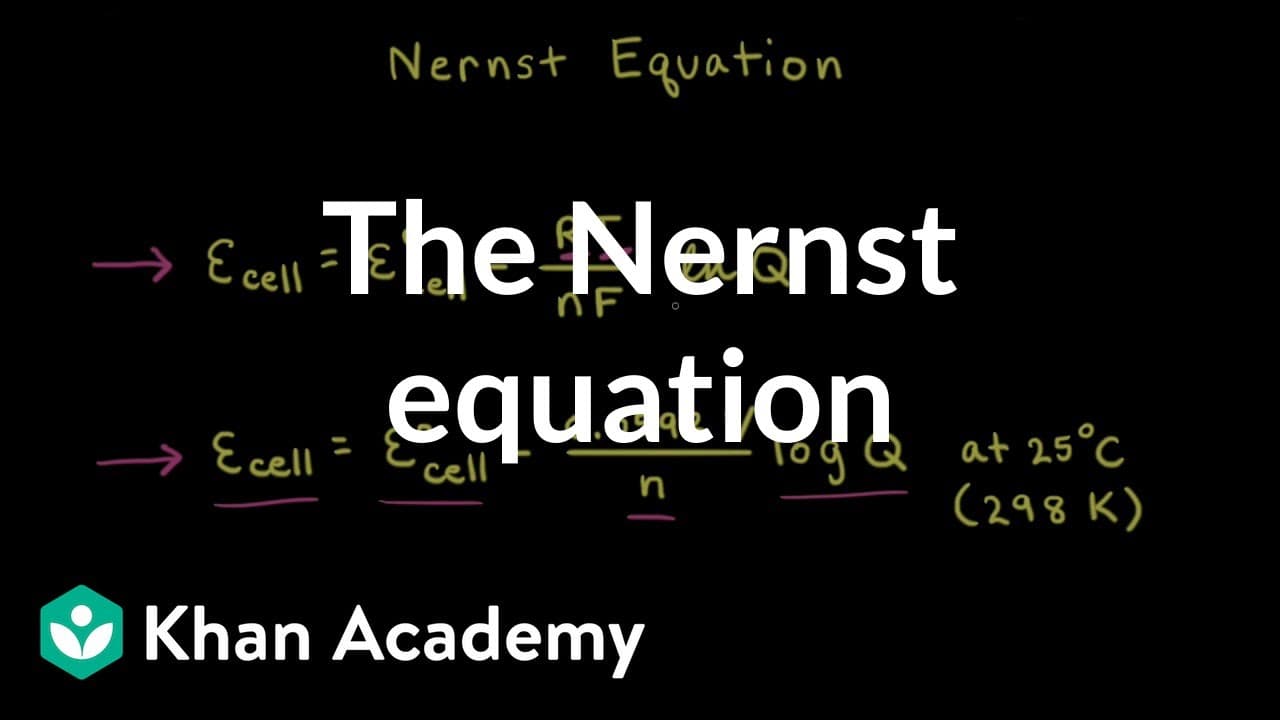
The Nernst Equation allows us to calculate the instantaneous cell potential by considering factors like temperature, number of electrons transferred, and reaction quotient.
Transcript
- [Instructor] We already know how to calculate cell potential when the reactants and products are in their standard states. However, what if that's not the case? We can find cell potential when reactants and products are not in their standard states by using the Nernst equation, which is shown here. And we're gonna call that cell potential the ins... Read More
Key Insights
- 👻 The Nernst Equation allows for the calculation of the instantaneous cell potential.
- 😑 The instantaneous cell potential can be greater or lesser than the standard cell potential, depending on the values of the reaction quotient.
- 🥺 As the reaction progresses, the concentration of reactants decreases and products increases, leading to changes in the reaction quotient and a decrease in the instantaneous cell potential.
Install to Summarize YouTube Videos and Get Transcripts
Explore YouTube Video Summarizer or Get YouTube Transcript Extractor
Questions & Answers
Q: What does the Nernst Equation help us calculate?
The Nernst Equation helps us calculate the instantaneous cell potential, which is the cell potential at a specific moment in time when the reactants and products are not in their standard states.
Q: How does the standard cell potential differ from the instantaneous cell potential?
The standard cell potential is the cell potential when the reactants and products are in their standard states. The instantaneous cell potential, on the other hand, is the cell potential at a specific moment in time, considering the current conditions.
Q: How does the Nernst Equation differ from the simplified form?
The Nernst Equation includes various constants and factors like temperature, number of electrons transferred, and reaction quotient. The simplified form, however, only uses the standard cell potential, the number of electrons transferred, and the logarithm of the reaction quotient.
Q: What happens to the instantaneous cell potential as the reaction progresses?
As the reaction progresses and the reactants turn into products, the concentrations of the reactants and products change. This affects the reaction quotient, and consequently, the instantaneous cell potential decreases over time.
Summary & Key Takeaways
-
The Nernst Equation is used to find the instantaneous cell potential when reactants and products are not in their standard states.
-
The equation includes variables like temperature, number of electrons transferred, and reaction quotient.
-
The instantaneous cell potential can be greater or lesser than the standard cell potential, depending on the values of the reaction quotient.
Read in Other Languages (beta)
Share This Summary 📚
Summarize YouTube Videos and Get Video Transcripts with 1-Click
Try YouTube Summary with ChatGPT & Claude or YouTube Transcript Generator
Explore More Summaries from Khan Academy 📚



Summarize YouTube Videos and Get Video Transcripts with 1-Click
Try YouTube Summary with ChatGPT & Claude or YouTube Transcript Generator