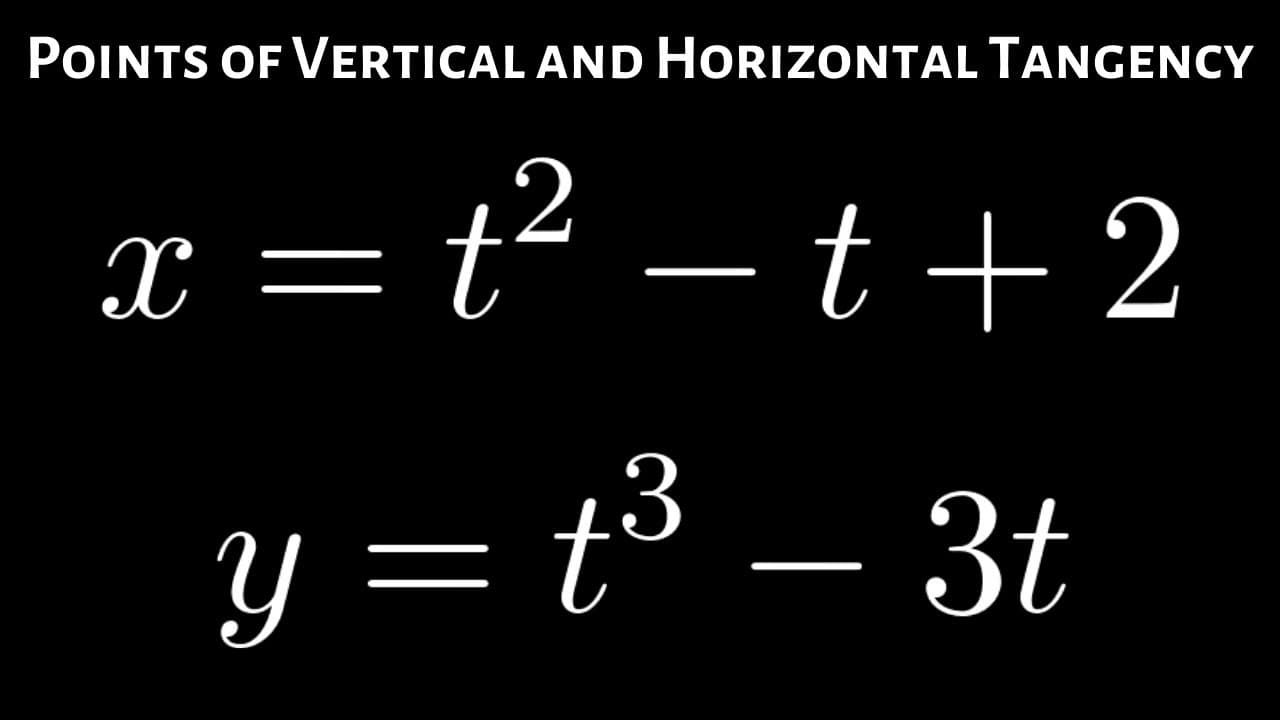
Find the Points at which there are Vertical and Horizontal Tangent Lines given Parametric Equations
TL;DR
Understanding parametric equations to find horizontal and vertical tangent lines by examining slopes and values of variables.
Transcript
hey what's up and this problem we have some parametric equations and we have to find the points at which we have horizontal and vertical tangent lines solution the easiest way to remember how to do problems like this is to think about the formula for dy DX so dy DX is dy DT over DX DT and if you just think about it and you think about what this mea... Read More
Key Insights
- 🫥 Understanding parametric equations aids in solving calculus problems involving tangent lines.
- 0️⃣ Horizontal tangent lines necessitate dy DT to be zero for zero slopes.
- 0️⃣ Vertical tangent lines require DX DT to be zero without leading to a zero-over-zero scenario.
- 🫥 Parametric equations offer a systematic method to pinpoint points with tangent lines.
- 🫥 Utilizing T values derived from derivative conditions enables locating specific points on tangent lines.
- 🫥 Horizontal and vertical tangent lines in parametric equations can be identified by scrutinizing slope behaviors.
- 🫥 Dy DT and DX DT play crucial roles in determining the availability of tangent lines at specific points.
Install to Summarize YouTube Videos and Get Transcripts
Explore YouTube Video Summarizer or Get YouTube Transcript Extractor
Questions & Answers
Q: How do parametric equations help in determining horizontal and vertical tangent lines?
Parametric equations facilitate identifying the slopes related to tangent lines by manipulating dy DT and DX DT values derived from the parameter T.
Q: What conditions need to be met for a point to have a horizontal tangent line?
For a point to possess a horizontal tangent line, dy DT must equal zero, ensuring a slope of zero, while DX DT must not be zero to avoid undefined results.
Q: Why is it crucial to check both dy DT and DX DT for vertical tangent lines?
Checking both dy DT and DX DT values is pivotal in locating points associated with vertical tangent lines, ensuring a zero denominator for DX DT and a non-zero numerator for dy DT.
Q: How do parameter T values translate into specific points for tangent lines in parametric equations?
Calculating T values from dy DT and DX DT conditions allows for plugging them into X and Y equations to identify the precise coordinates of points with horizontal and vertical tangent lines.
Summary & Key Takeaways
-
Parametric equations provide a method to find horizontal and vertical tangent lines in calculus.
-
Horizontal tangent lines have slopes of zero, equating to dy DT = 0 and checking for non-zero DX DT.
-
Vertical tangent lines require DX DT = 0 and dy DT ≠ 0, where calculations yield T values that correspond to specific points.
Read in Other Languages (beta)
Share This Summary 📚
Summarize YouTube Videos and Get Video Transcripts with 1-Click
Try YouTube Summary with ChatGPT & Claude or YouTube Transcript Generator
Explore More Summaries from The Math Sorcerer 📚

Summarize YouTube Videos and Get Video Transcripts with 1-Click
Try YouTube Summary with ChatGPT & Claude or YouTube Transcript Generator