2015 AP Physics 1 free response 3d
TL;DR
Doubling compression results in more potential energy and stopping distance, but the stopping distance is four times as long, not two times as far.
Transcript
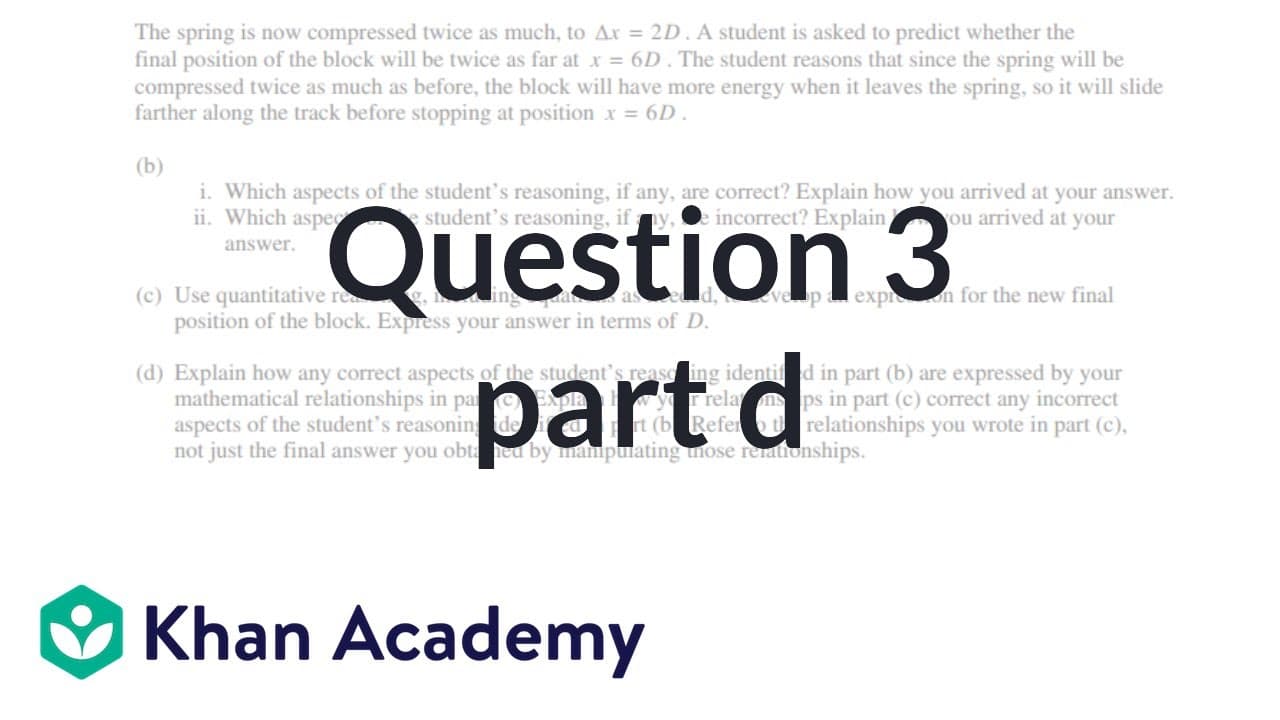
- [Voiceover] All right, part d. Explain how any correct aspects of the student's reasoning identified in part b are expressed by your mathematical relationships in part c, and explain how your relationship in part c correct, how your relationships in part c correct any incorrect aspects of the student's reasoning identified in part b. It's a bit o... Read More
Key Insights
- ✋ Doubling compression results in more potential energy and stopping distance.
- ⌛ The kinetic energy is four times greater when compression is doubled.
- ❓ The force of friction remains the same.
- ✋ The stopping distance is directly proportional to the kinetic energy.
- ⌛ The stopping distance is four times as long, not two times as far.
- 🥺 Part c supports the student's reasoning on more compression leading to more energy and stopping distance.
- ⌚ Part c corrects the student's incorrect assumption of the stopping distance being two times as far.
Install to Summarize YouTube Videos and Get Transcripts
Explore YouTube Video Summarizer or Get YouTube Transcript Extractor
Questions & Answers
Q: How does doubling compression affect potential energy and stopping distance?
Doubling compression increases both potential energy and stopping distance according to the relationships in part c. This means that more compression results in more energy and a longer stopping distance.
Q: Why is the stopping distance four times as long, not two times as far?
The kinetic energy is four times greater when compression is doubled. Since the force of friction remains the same, the stopping distance is directly proportional to the kinetic energy. Therefore, it is four times as long.
Q: What is the correct connection between part c and the student's reasoning in part b?
Part c supports the student's reasoning that more compression leads to more potential energy and stopping distance. However, the student incorrectly assumed that the stopping distance would be two times as far, when it is actually four times as long.
Q: Why is it important to reference the relationships in part c, not just the final answer?
Referencing the relationships in part c helps to explain the reasoning behind the results. It shows that the increase in energy is directly related to the doubling of compression, and also explains why the stopping distance is four times as long.
Summary & Key Takeaways
-
Part c shows that doubling compression results in more energy and stopping distance.
-
However, the stopping distance is four times as long, not two times as far, due to the kinetic energy being four times greater.
-
The student's reasoning was correct in that more compression leads to more energy and stopping distance, but they underestimated the increase in stopping distance.
Read in Other Languages (beta)
Share This Summary 📚
Summarize YouTube Videos and Get Video Transcripts with 1-Click
Try YouTube Summary with ChatGPT & Claude or YouTube Transcript Generator
Explore More Summaries from Khan Academy 📚



Summarize YouTube Videos and Get Video Transcripts with 1-Click
Try YouTube Summary with ChatGPT & Claude or YouTube Transcript Generator