Introduction to l'Hôpital's rule | Derivative applications | Differential Calculus | Khan Academy
TL;DR
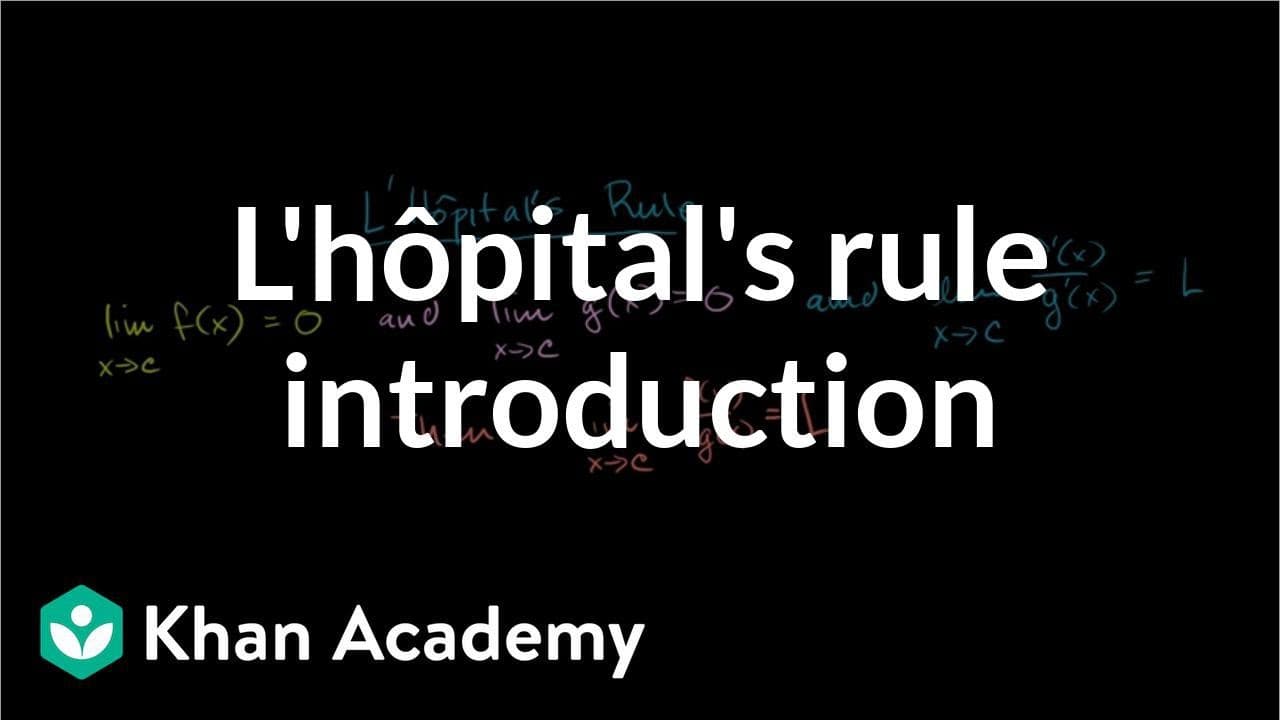
The video discusses using derivatives to find limits that end up in indeterminate form, introducing L'Hopital's rule for these cases.
Transcript
Most of what we do early on when we first learn about calculus is to use limits. We use limits to figure out derivatives of functions. In fact, the definition of a derivative uses the notion of a limit. It's a slope around the point as we take the limit of points closer and closer to the point in question. And you've seen that many, many, many time... Read More
Key Insights
- ⛔ Calculus often involves using limits to find derivatives, but limits can also be evaluated using derivatives.
- 💁 L'Hopital's rule is a valuable tool for simplifying the evaluation of limits in indeterminate form.
- 💼 The first case of L'Hopital's rule applies when the limit of f(x) and g(x) is 0/0, while the second case applies when the limit is infinity/infinity.
- ⛔ L'Hopital's rule allows us to take the derivative of both functions and evaluate the limit of the derivatives, providing a simplified solution to the original limit.
- 💁 Indeterminate forms can occur in various mathematical situations and require additional techniques to determine their values.
- 📏 L'Hopital's rule provides an effective approach for solving difficult limits, especially in math competitions or challenging calculus problems.
- 📏 The video provides an example of applying L'Hopital's rule to find the limit of sine(x) over x, illustrating how the rule simplifies the evaluation process.
Install to Summarize YouTube Videos and Get Transcripts
Explore YouTube Video Summarizer or Get YouTube Transcript Extractor
Questions & Answers
Q: What are indeterminate forms in calculus?
Indeterminate forms refer to situations where, upon evaluating a limit, we encounter expressions like 0/0, infinity over infinity, or infinity/infinity, which cannot be easily determined.
Q: When can L'Hopital's rule be applied?
L'Hopital's rule can be used when the limit as x approaches a certain value of a function f(x) and another function g(x) is 0/0 or infinity/infinity, and the limit of their derivatives exists.
Q: How does L'Hopital's rule simplify the evaluation of limits?
L'Hopital's rule allows us to take the derivative of both f(x) and g(x), and then evaluate the limit of the derivatives. If this limit exists, it is equal to the original limit.
Q: Are there other indeterminate forms besides 0/0 and infinity/infinity?
Yes, other indeterminate forms include infinity times zero, zero raised to the power of zero, and infinity minus infinity, among others.
Summary & Key Takeaways
-
Limits are often used in calculus to find derivatives, but the video focuses on using derivatives to find limits, specifically those that result in indeterminate forms.
-
L'Hopital's rule is introduced as a tool to simplify the evaluation of limits in indeterminate form.
-
L'Hopital's rule states that if certain conditions are met, the limit of the quotient of two functions is equal to the limit of the derivatives of those functions.
Read in Other Languages (beta)
Share This Summary 📚
Summarize YouTube Videos and Get Video Transcripts with 1-Click
Try YouTube Summary with ChatGPT & Claude or YouTube Transcript Generator
Explore More Summaries from Khan Academy 📚



Summarize YouTube Videos and Get Video Transcripts with 1-Click
Try YouTube Summary with ChatGPT & Claude or YouTube Transcript Generator