Structure of Sucrose - Biomolecules - Chemistry Class 12
TL;DR
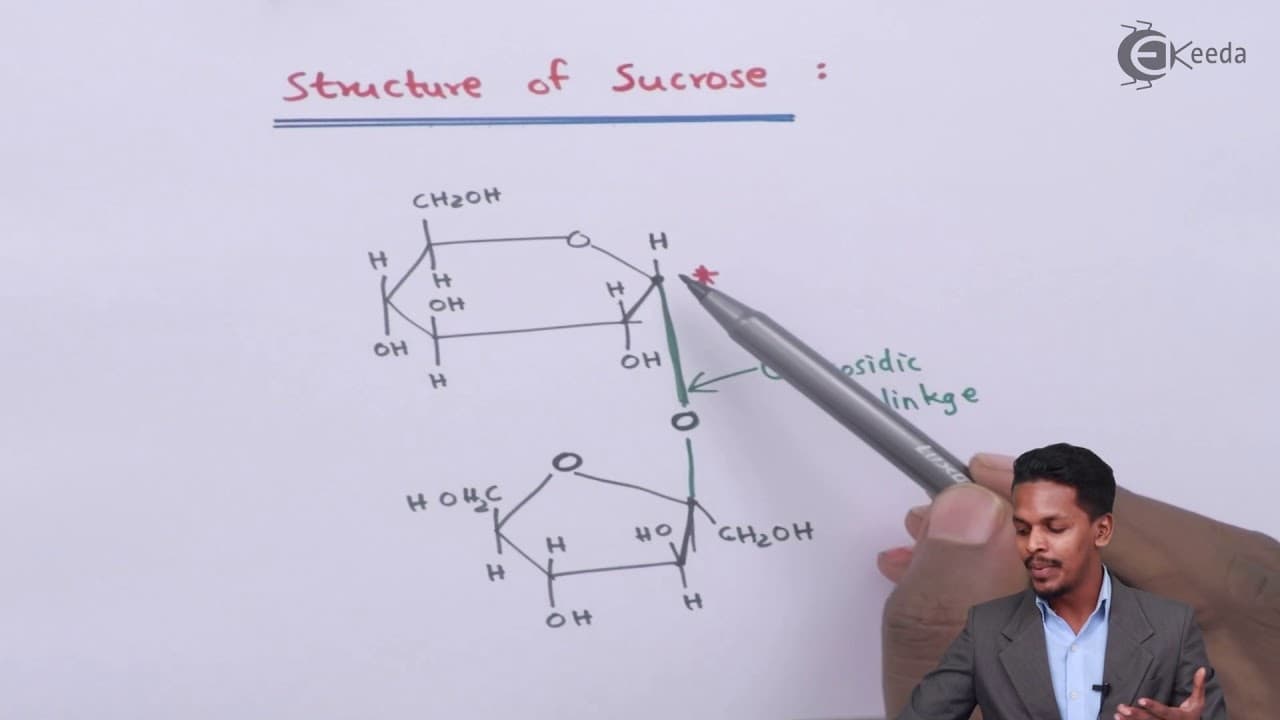
This video discusses the structure of sucrose, which is a combination of alpha D-glucopyranose and beta D-fructofuranose, connected by a glycosidic linkage.
Transcript
click the bell icon to get latest videos from akira helpful see the trail stopping we have discussed about the glycosidic linkage and now in this topic we are going to talk about the structure of sucrose so now let us understand that how we can draw the structure of sucrose and what are the information related to the structure of sucrose this is wh... Read More
Key Insights
- 🔚 Sucrose is a disaccharide composed of alpha D-glucopyranose and beta D-fructofuranose.
- ❓ The structure of sucrose includes a glycosidic linkage between the two monosaccharides.
- 🔚 Upon hydrolysis, sucrose yields alpha D-glucose and beta D-fructose.
- ❓ The mixture of invert sugars obtained from sucrose hydrolysis has a levorotatory effect.
- 😋 Invert sugars are often used in food processing and fermentation.
- 🖐️ The anomeric carbon atom in the structure of sucrose plays a crucial role in determining its configuration.
- 💁 The pyranose and furanose forms of glucose and fructose contribute to the structure of sucrose.
Install to Summarize YouTube Videos and Get Transcripts
Explore YouTube Video Summarizer or Get YouTube Transcript Extractor
Questions & Answers
Q: What is the structure of sucrose?
Sucrose consists of alpha D-glucopyranose and beta D-fructofuranose, connected by a glycosidic linkage.
Q: How is the glycosidic linkage formed?
The glycosidic linkage is formed when the anomeric carbon atom of one monosaccharide reacts with the hydroxyl group of the other monosaccharide, resulting in the formation of an oxygen bond.
Q: What happens when sucrose is hydrolyzed?
When sucrose is hydrolyzed, it breaks down into alpha D-glucose and beta D-fructose.
Q: Why are the products of sucrose hydrolysis called invert sugars?
The products of sucrose hydrolysis, alpha D-glucose and beta D-fructose, rotate light in different directions. The resulting mixture has a levorotatory effect and is therefore termed invert sugars.
Key Insights:
- Sucrose is a disaccharide composed of alpha D-glucopyranose and beta D-fructofuranose.
- The structure of sucrose includes a glycosidic linkage between the two monosaccharides.
- Upon hydrolysis, sucrose yields alpha D-glucose and beta D-fructose.
- The mixture of invert sugars obtained from sucrose hydrolysis has a levorotatory effect.
- Invert sugars are often used in food processing and fermentation.
- The anomeric carbon atom in the structure of sucrose plays a crucial role in determining its configuration.
- The pyranose and furanose forms of glucose and fructose contribute to the structure of sucrose.
- Understanding the structure of sucrose is important in various fields, including biochemistry and food science.
Summary & Key Takeaways
-
Sucrose is a disaccharide that can be hydrolyzed into alpha D-glucose and beta D-fructose.
-
The structure of sucrose is a combination of alpha D-glucopyranose and beta D-fructofuranose.
-
The glycosidic linkage connects the anomeric carbon atoms of the two monosaccharides.
Read in Other Languages (beta)
Share This Summary 📚
Summarize YouTube Videos and Get Video Transcripts with 1-Click
Try YouTube Summary with ChatGPT & Claude or YouTube Transcript Generator
Explore More Summaries from Ekeeda 📚






Summarize YouTube Videos and Get Video Transcripts with 1-Click
Try YouTube Summary with ChatGPT & Claude or YouTube Transcript Generator