Speed and precision of DNA replication | Biomolecules | MCAT | Khan Academy
TL;DR
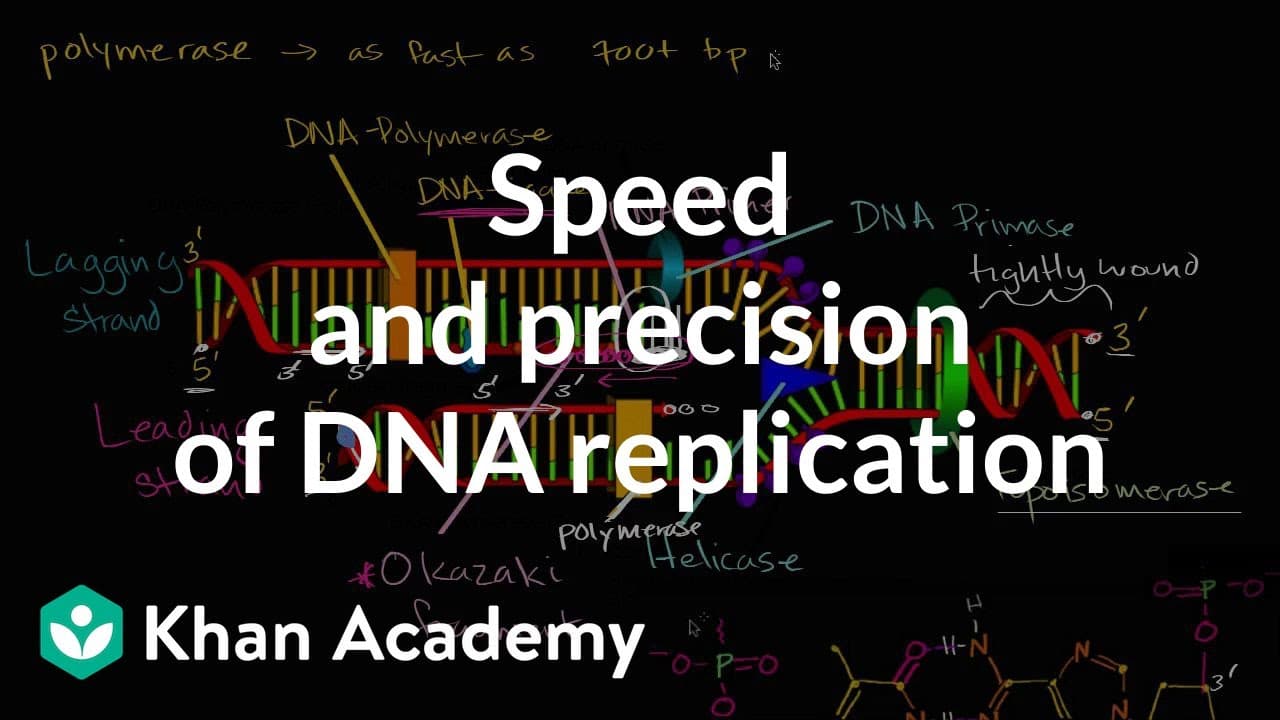
DNA replication occurs at an astonishingly fast pace of up to 1,000 base pairs per second, with an error rate of one mistake per billion nucleotides.
Transcript
- [Voiceover] In the earlier video on DNA replication, we go into some detail about leading strands and lagging strands and all of the different actors, all of these different enzymatic actors. But I left out what is probably the most mind-boggling aspect of all of this, and that's the speed and the precision with which this is actually happening. ... Read More
Key Insights
- 🧬 DNA replication is a complex process involving multiple enzymes and mechanisms.
- 💨 The speed of DNA polymerase during replication is incredibly fast, reaching up to 1,000 base pairs per second.
- 🚄 Despite the high speed, DNA replication is precise, with an error rate of approximately one mistake per billion nucleotides.
Install to Summarize YouTube Videos and Get Transcripts
Explore YouTube Video Summarizer or Get YouTube Transcript Extractor
Questions & Answers
Q: How fast does DNA polymerase work during replication?
DNA polymerase can work at a speed of up to 1,000 base pairs per second, making it a remarkably fast enzyme in cellular processes.
Q: Why is the precision of DNA replication crucial?
Any significant errors in DNA replication could lead to nonfunctional cells or genetic abnormalities. The precision ensures the accurate transfer of genetic information during cell division.
Q: What prevents the accumulation of replication errors?
DNA replication involves proofreading mechanisms that identify and correct errors. These mechanisms reduce the error rate to approximately one mistake per billion nucleotides.
Q: What is the significance of the 10 to the seventh and 10 to the ninth figures mentioned?
These figures represent the error rates before and after proofreading. Initially, there is one mistake for every 10 million nucleotides, but after proofreading, it becomes one mistake for every billion nucleotides.
Summary & Key Takeaways
-
DNA replication involves numerous enzymatic processes that work in a precise and coordinated manner.
-
Polymerase, the enzyme responsible for adding nucleotides, can operate at an incredible speed of 700-plus to 1,000 base pairs per second.
-
Despite the fast pace, DNA replication is remarkably accurate, with an error rate of approximately one mistake per billion nucleotides.
Read in Other Languages (beta)
Share This Summary 📚
Summarize YouTube Videos and Get Video Transcripts with 1-Click
Try YouTube Summary with ChatGPT & Claude or YouTube Transcript Generator
Explore More Summaries from Khan Academy 📚



Summarize YouTube Videos and Get Video Transcripts with 1-Click
Try YouTube Summary with ChatGPT & Claude or YouTube Transcript Generator