Starting to set up a Newtonian path–time diagram | Physics | Khan Academy
TL;DR
This content explains the concept of frames of reference and how to plot positions over time on a space-time diagram.
Transcript
- [Voiceover] Let's say this is me right over here, and I'm drifting through space at a constant velocity relative to any other inertial frame of reference, and so I am, I am in an inertial frame of reference myself, and in fact I'm going to define my frame of reference by me, I'm gonna say I'm at the origin of my frame of reference. So at all time... Read More
Key Insights
- 🖼️ Frames of reference are defined by an observer's position and are considered inertial if the observer experiences a constant velocity relative to other frames.
- ⌛ Time is commonly plotted on the vertical axis in space-time diagrams, although it can be interchanged with position.
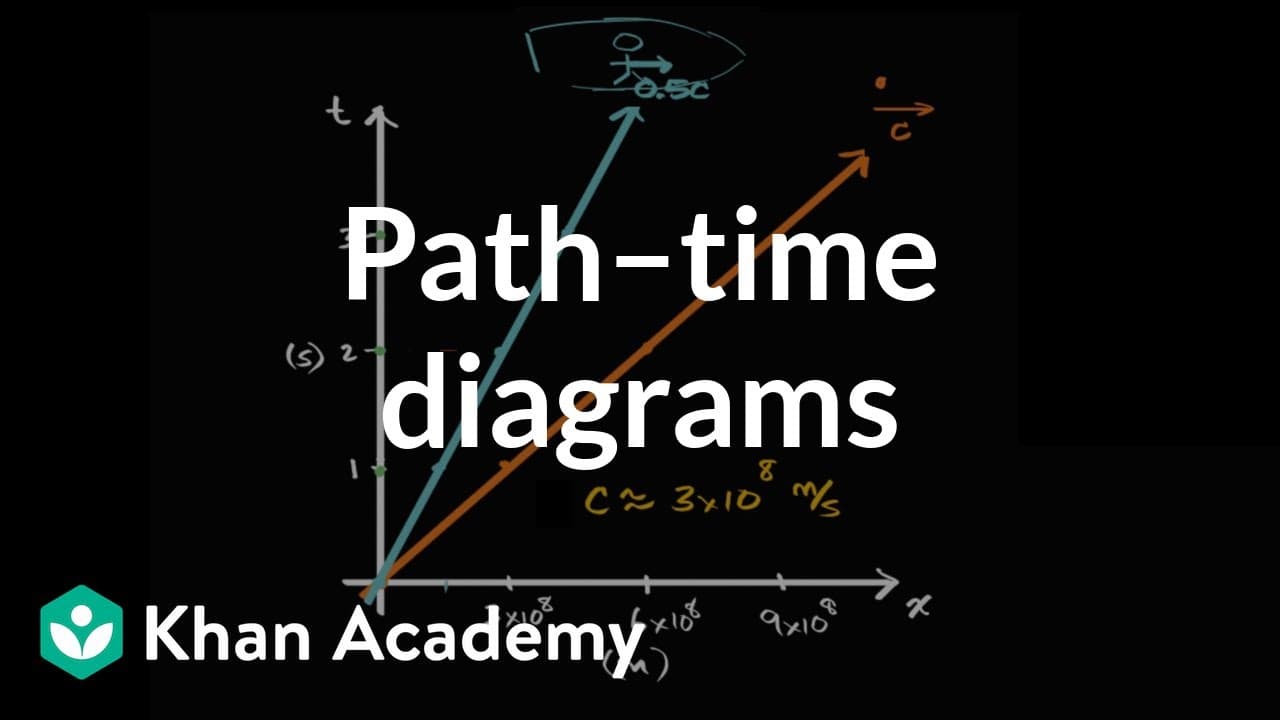
- 🧘 The position of a photon of light emitted from a stationary person's flashlight increases linearly over time.
Install to Summarize YouTube Videos and Get Transcripts
Explore YouTube Video Summarizer or Get YouTube Transcript Extractor
Questions & Answers
Q: How are frames of reference defined in relation to an inertial frame of reference?
Frames of reference are defined by an observer's position, and an inertial frame of reference is one in which an observer experiences a constant velocity relative to other frames.
Q: Why is time plotted on the vertical axis in a space-time diagram?
Time is often plotted on the vertical axis in a space-time diagram to show how it progresses and affects an object's position over time. It is a convention in mathematics, although the positions of time and space can be interchanged.
Q: How does the position of a photon of light emitted from a stationary person's flashlight change over time?
The position of the photon of light emitted from a stationary person's flashlight increases linearly over time. Each second, the photon's position moves 3x10^8 meters further in the positive x-direction.
Q: How does the position of a person in a spaceship moving at constant velocity change over time?
The position of a person in a spaceship moving at a constant velocity increases linearly over time. Their position moves at half the speed of light, so each second, their position moves 1.5x10^8 meters further in the positive x-direction.
Summary & Key Takeaways
-
The content introduces the concept of frames of reference and how to define them in relation to an inertial frame of reference.
-
It explains how to plot positions over time on a space-time diagram, with time on the vertical axis and position on the horizontal axis.
-
The content demonstrates the plotting of positions for a person stationary in their frame of reference and for a person in a spaceship moving at a constant velocity relative to the first person.
Read in Other Languages (beta)
Share This Summary 📚
Summarize YouTube Videos and Get Video Transcripts with 1-Click
Try YouTube Summary with ChatGPT & Claude or YouTube Transcript Generator
Explore More Summaries from Khan Academy 📚



Summarize YouTube Videos and Get Video Transcripts with 1-Click
Try YouTube Summary with ChatGPT & Claude or YouTube Transcript Generator