How to Calculate Standard Potential in Redox Reactions
TL;DR
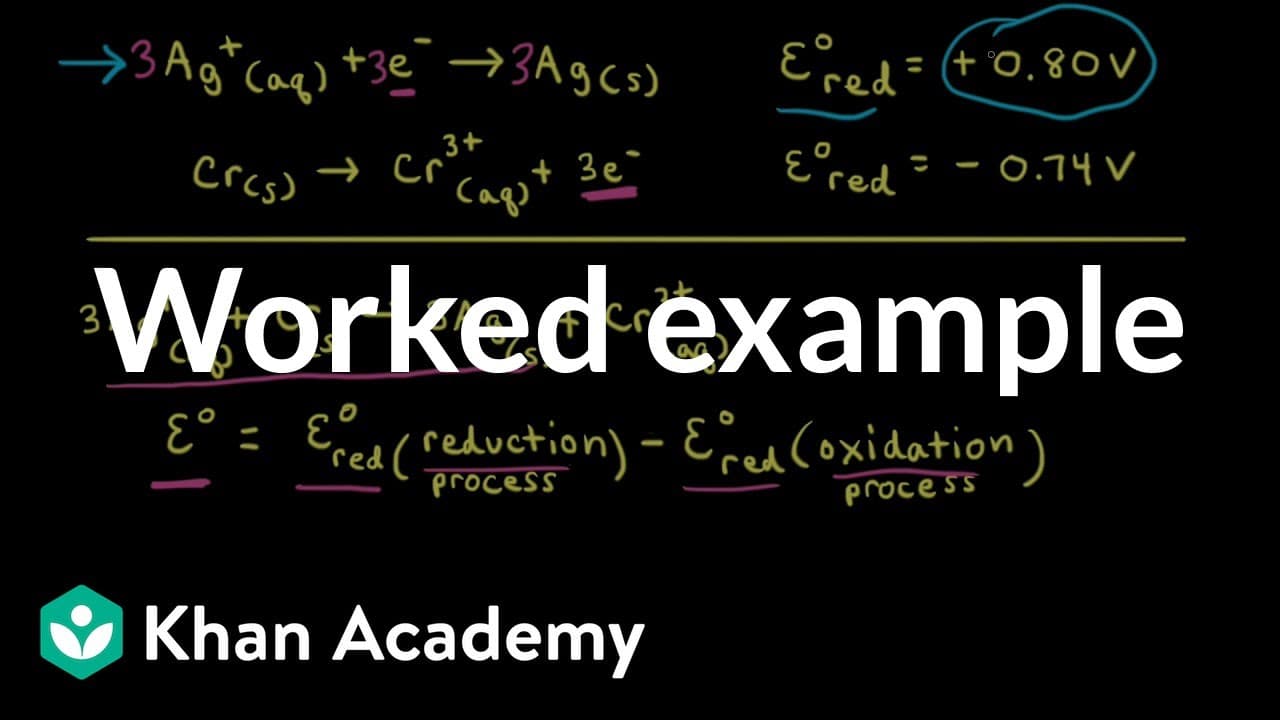
To calculate the standard potential for a redox reaction, identify the standard reduction potentials for both half reactions. After balancing electrons, add the potentials, yielding a standard potential of 1.54 volts for the example reaction involving silver and chromium.
Transcript
- [Instructor] Let's do a worked example where we calculate the standard potential at 25 degrees Celsius for this reaction. In this redox reaction, silver cations are reduced to form solid silver and solid chromium is oxidized to form the Cr3+ ion. The first step is to write down the half reactions that make up the overall redox reaction. So we sai... Read More
Key Insights
- ❓ To calculate the standard potential for a redox reaction, the standard reduction potential for the reduction process is subtracted from the standard reduction potential for the oxidation process.
- ⚖️ Balancing the number of electrons is crucial when adding the two half reactions together to obtain the overall redox reaction.
- ⚡ Voltage is an intensive property and remains unchanged regardless of the amount of substance involved in a reaction.
Install to Summarize YouTube Videos and Get Transcripts
Explore YouTube Video Summarizer or Get YouTube Transcript Extractor
Questions & Answers
Q: What is the purpose of writing down the half reactions for a redox reaction?
Writing down the half reactions helps us understand which species are oxidized and which are reduced, allowing us to balance the electron transfer and determine the standard potential.
Q: How do we determine the standard voltages for the half reactions?
The standard reduction potentials are obtained from a standard reduction potential table, where the reduction of H+ ions serves as the reference with a standard reduction potential of 0 volts.
Q: Why do we reverse the sign of the standard reduction potential when converting an oxidation half reaction to a reduction half reaction?
The standard reduction potential table presents half reactions as reductions. Reversing the half reaction requires changing the sign of the voltage to obtain the standard oxidation potential.
Q: Why don't we multiply the standard reduction potential by a factor of three when balancing the number of electrons?
Voltage is an intensive property and does not depend on the amount of substances involved. Therefore, we only need to multiply the coefficients in the half reactions, not the voltages.
Summary & Key Takeaways
-
The video demonstrates how to write down the half reactions for a redox reaction and find the standard voltages for each half reaction.
-
The standard reduction potential for the reduction of silver cations to solid silver is 0.80 volts, and the standard reduction potential for the oxidation of solid chromium to chromium 3+ ions is -0.74 volts.
-
The number of electrons is balanced in the half reactions, and when the two half reactions are added together, the standard potential of the redox reaction is found to be 1.54 volts.
Read in Other Languages (beta)
Share This Summary 📚
Summarize YouTube Videos and Get Video Transcripts with 1-Click
Try YouTube Summary with ChatGPT & Claude or YouTube Transcript Generator
Explore More Summaries from Khan Academy 📚



Summarize YouTube Videos and Get Video Transcripts with 1-Click
Try YouTube Summary with ChatGPT & Claude or YouTube Transcript Generator