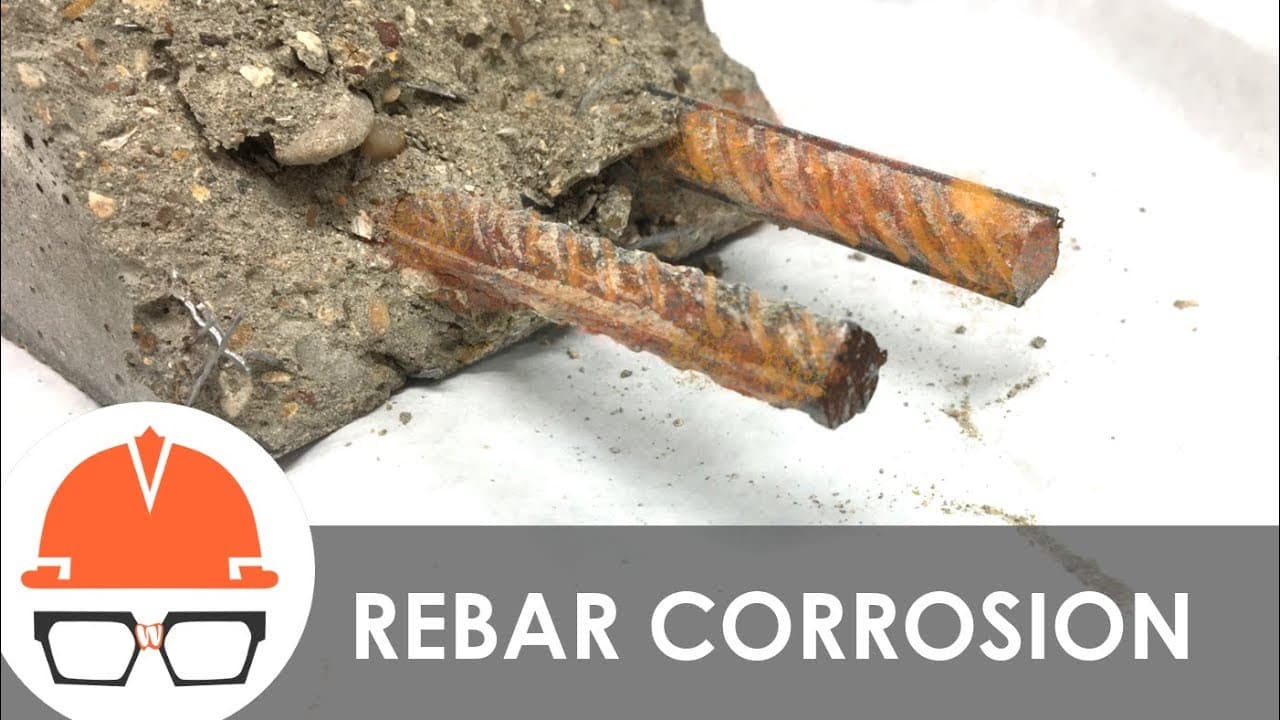
Does Rebar Rust?
TL;DR
Exploring methods to prevent rebar corrosion in concrete structures.
Transcript
Concrete reinforced with steel is the foundation of our modern society. Reinforcement within concrete creates a composite material, with the concrete providing strength against compressive stress while the reinforcement provides strength against tensile stress. But, while steel reinforcement solves one of concrete’s greatest limitations, it create... Read More
Key Insights
- Steel reinforcement in concrete addresses tensile stress but introduces corrosion issues, a major cause of concrete deterioration.
- Concrete's alkaline environment and impermeability generally protect steel rebar from corrosion, but salt exposure can breach these defenses.
- Concrete cover, the distance between rebar and the surface, is crucial for preventing contaminants from reaching the reinforcement.
- Cracks in concrete, caused by shrinkage or stress, allow contaminants to reach rebar, accelerating corrosion.
- Fiber-reinforced concrete, using materials like steel or glass fibers, helps control cracking and protects rebar.
- While fibers don't increase overall concrete strength, they significantly reduce cracks, aiding in corrosion prevention.
- Alternatives to steel rebar, like epoxy-coated or stainless steel and FRP bars, offer corrosion resistance but are costlier.
- Innovation in concrete reinforcement is slow due to high failure consequences, yet long-term durability is critical for public safety.
Install to Summarize YouTube Videos and Get Transcripts
Explore YouTube Video Summarizer or Get YouTube Transcript Extractor
Questions & Answers
Q: What is the primary issue with using steel rebar in concrete?
The primary issue with using steel rebar in concrete is corrosion. While steel reinforcement effectively addresses concrete's tensile stress limitations, it introduces a significant problem of corrosion. This occurs when contaminants, particularly chloride ions from salt exposure, penetrate the concrete and reach the rebar, leading to deterioration.
Q: How does concrete protect steel rebar from corrosion?
Concrete protects steel rebar from corrosion through its alkaline environment and impermeability. The high pH of concrete creates a thin oxide layer on the steel, providing a protective barrier. Additionally, the concrete's relatively impermeable nature prevents water and contaminants from reaching the rebar, thus reducing corrosion risks.
Q: What role does concrete cover play in preventing rebar corrosion?
Concrete cover plays a crucial role in preventing rebar corrosion by ensuring a minimum distance between the rebar and the surface. This cover acts as a protective barrier, preventing contaminants from reaching the reinforcement. Adequate cover is essential to maintaining the durability and longevity of concrete structures by minimizing corrosion risks.
Q: How do cracks in concrete affect rebar corrosion?
Cracks in concrete significantly affect rebar corrosion by providing pathways for water and contaminants to reach the steel reinforcement. These cracks, often caused by shrinkage, temperature changes, or stress, compromise the concrete's protective barrier, accelerating the corrosion process and leading to structural deterioration.
Q: What is fiber-reinforced concrete, and how does it help prevent corrosion?
Fiber-reinforced concrete incorporates materials like steel or glass fibers into the mix, providing small-scale reinforcement that controls cracking. By reducing the formation and size of cracks, fiber-reinforced concrete minimizes pathways for contaminants to reach the rebar, thus helping to prevent corrosion and prolonging the structure's lifespan.
Q: Why are alternatives to steel rebar not widely used despite their benefits?
Alternatives to steel rebar, such as epoxy-coated, stainless steel, or FRP bars, offer excellent corrosion resistance but are not widely used due to higher costs and limited adoption in the industry. Innovation in civil engineering is slow because of the high consequences of failure, and gaining confidence in new materials requires extensive testing and proven performance.
Q: What are the benefits of using FRP bars as reinforcement in concrete?
FRP bars, made from materials like basalt, offer significant benefits as reinforcement in concrete due to their excellent mechanical properties and corrosion resistance. Unlike steel, FRP bars do not corrode, making them ideal for use in highly corrosive environments. However, their higher cost and limited industry adoption are challenges to widespread use.
Q: How does long-term durability impact public safety in concrete structures?
Long-term durability is crucial for public safety in concrete structures because it ensures the integrity and reliability of infrastructure over time. Poor maintenance and inadequate durability can lead to structural failures, posing significant risks. Therefore, incorporating durable materials and innovative reinforcement methods is essential to maintaining safety and performance.
Summary & Key Takeaways
-
Concrete reinforced with steel rebar is essential for handling tensile stress but introduces corrosion issues, primarily due to salt exposure. Adequate concrete cover and fiber-reinforced concrete are explored as solutions to mitigate corrosion risks.
-
Cracks in concrete, often resulting from shrinkage or stress, allow contaminants to reach steel reinforcement, accelerating corrosion. Fiber-reinforced concrete, using materials like steel or glass fibers, significantly reduces cracking, thus protecting rebar.
-
While alternatives to steel rebar, such as FRP bars, offer corrosion resistance, they are more expensive. Innovation in concrete reinforcement is gradual due to high failure risks, but long-term durability remains a crucial consideration for public safety.
Read in Other Languages (beta)
Share This Summary 📚
Summarize YouTube Videos and Get Video Transcripts with 1-Click
Try YouTube Summary with ChatGPT & Claude or YouTube Transcript Generator
Explore More Summaries from Practical Engineering 📚


Summarize YouTube Videos and Get Video Transcripts with 1-Click
Try YouTube Summary with ChatGPT & Claude or YouTube Transcript Generator