Rise of Julius Caesar | World History | Khan Academy
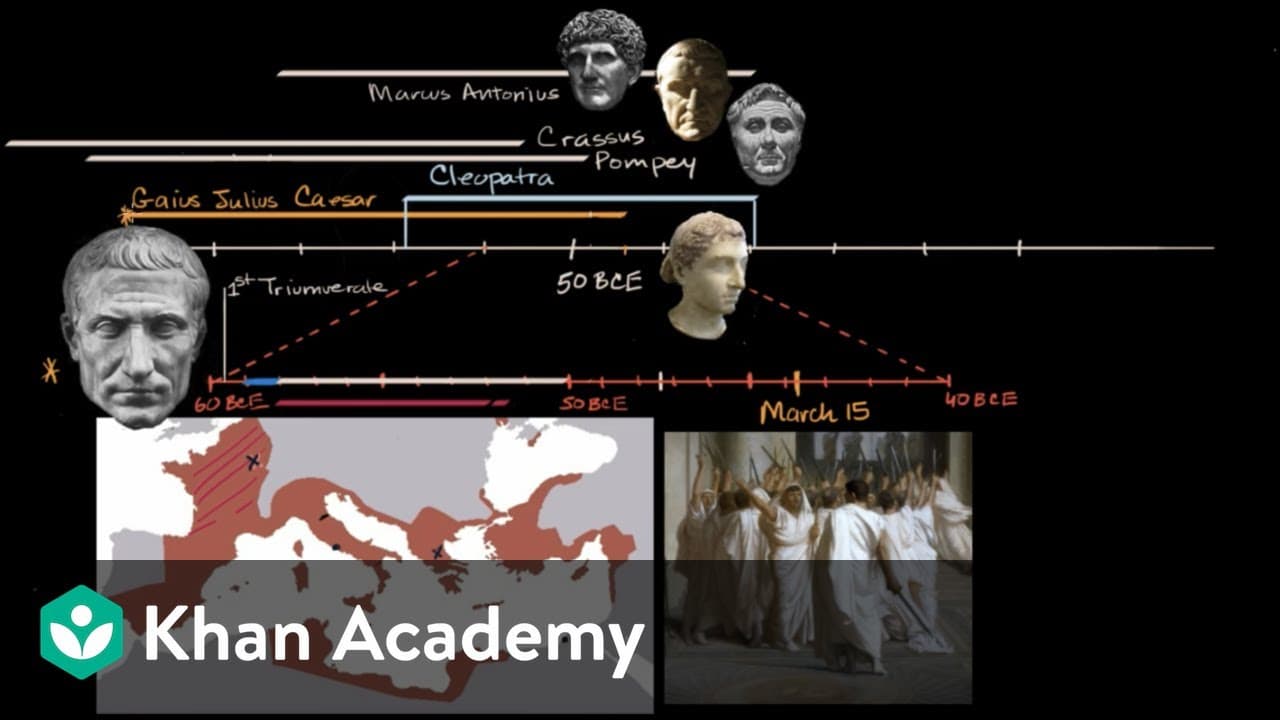
TL;DR
Julius Caesar's life marks the transition from the Roman Republic to the Roman Empire, highlighting the shift in power and the formation of alliances.
Transcript
- [Instructor] We're going to talk about one of the most significant figures in Western history, and that's Gaius Julius Caesar. Now, what we'll see is, his life really marks the transition from official Roman Republic to the Roman Empire. And I say official Roman Republic, because it's important to keep in mind, even at the time of Julius Caesar's... Read More
Key Insights
- 🇷🇴 Julius Caesar's life and actions were crucial in marking the transition from the Roman Republic to the Roman Empire.
- 🥹 The formation of alliances, such as the First Triumvirate, allowed Caesar to hold power and push for populist reforms.
- 🎖️ Caesar's conquest of Gaul demonstrated his military prowess and expanded Roman territories.
- ↩️ Crossing the Rubicon River was a bold and illegal move that symbolized a point of no return and led to a civil war with Pompey.
- ⛽ Tensions between populists and conservatives in the Senate further fueled the divisions within the Roman Republic.
- 🫱 The civil war between Caesar and Pompey highlighted the power struggle and ultimately resulted in the downfall of the Roman Republic.
Install to Summarize YouTube Videos and Get Transcripts
Explore YouTube Video Summarizer or Get YouTube Transcript Extractor
Questions & Answers
Q: How did Julius Caesar contribute to the transition from the Roman Republic to the Roman Empire?
Julius Caesar's rise to power, his alliances, and his conquests played a significant role in ushering in the transition from a republic to an empire. By forming the First Triumvirate and expanding Roman territories into Gaul, Caesar gained power and influence.
Q: What were some of the tensions between the populists and the conservatives in the Roman Republic?
Tensions arose in the Senate between the populists, led by Julius Caesar, who advocated for land redistribution and reforms for the people, and the conservatives who sought to maintain power within the aristocracy. These differing ideologies caused divisions within the Republic.
Q: Why was crossing the Rubicon River an important event?
Crossing the Rubicon River was a significant event because it marked the point of no return for Julius Caesar. It was illegal for a governor general to lead their armies into the Italian peninsula, and by doing so, Caesar defied the Senate and the laws of the Republic.
Q: How did Pompey's actions contribute to the civil war between him and Julius Caesar?
Pompey, originally an ally of Julius Caesar, switched sides to join the conservative Senators. This led to a conflict between Caesar, who had one legion, and Pompey, who controlled significant fractions of the navy and had support in Greece. This resulted in a civil war within the Roman Republic.
Summary & Key Takeaways
-
Julius Caesar, a significant figure in Western history, played a pivotal role in the transition from the Roman Republic to the Roman Empire.
-
Through his alliances, particularly the First Triumvirate with Crassus and Pompey, Caesar was able to hold power and push for populist reforms.
-
Caesar's conquest of Gaul and his decision to cross the Rubicon River signaled a point of no return and led to a civil war with Pompey.
Read in Other Languages (beta)
Share This Summary 📚
Summarize YouTube Videos and Get Video Transcripts with 1-Click
Try YouTube Summary with ChatGPT & Claude or YouTube Transcript Generator
Explore More Summaries from Khan Academy 📚



Summarize YouTube Videos and Get Video Transcripts with 1-Click
Try YouTube Summary with ChatGPT & Claude or YouTube Transcript Generator