Products
Features
YouTube Video Summarizer
Summarize YouTube videos
Web & PDF Highlighter
Highlight web pages & PDFs
Chat with PDF
Ask any PDF questions with AI
Ask AI Clone
Chat with your highlights & memories
Audio Transcriber
Transcribe audio files to text
Glasp Reader
Read and highlight articles
Kindle Highlight Export
Export your Kindle highlights
Idea Hatch
Hatch ideas from your highlights
Integrations
Obsidian Plugin
Notion Integration
Pocket Integration
Instapaper Integration
Medium Integration
Readwise Integration
Snipd Integration
Hypothesis Integration
Apps & Extensions
Chrome Extension
Safari Extension
Edge Add-ons
Firefox Add-ons
iOS App
Android App
Discover
Discover
Ideas
Discover new ideas and insights
Articles
Curated articles and insights
Books
Book recommendations by great minds
Posts
Essays and notes from readers
Quotes
Inspiring quotes collection
Videos
Curated videos and summaries
Explore Glasp
Glasp Newsletter
Weekly insights and updates
Glasp Talk
Interview series with great minds
Glasp Blog
Latest news and articles
Glasp Use Cases
Learn how others use Glasp
Build & Support
Glasp API
Access Glasp's API for developers
MCP Connector
Connect Glasp to Claude & ChatGPT
Community
Glasp Reddit Community
Students
Student discount and benefits
FAQs
Frequently Asked Questions
AboutPricing
DashboardLog inSign up

Calculating height using energy | Modeling Energy | High School Physics | Khan Academy
July 29, 2021
by
Khan Academy
YouTube video player
Calculating height using energy | Modeling Energy | High School Physics | Khan Academy

TL;DR

The maximum height of a ball launched by a compressed spring can be determined using the principle of conservation of energy.

Transcript

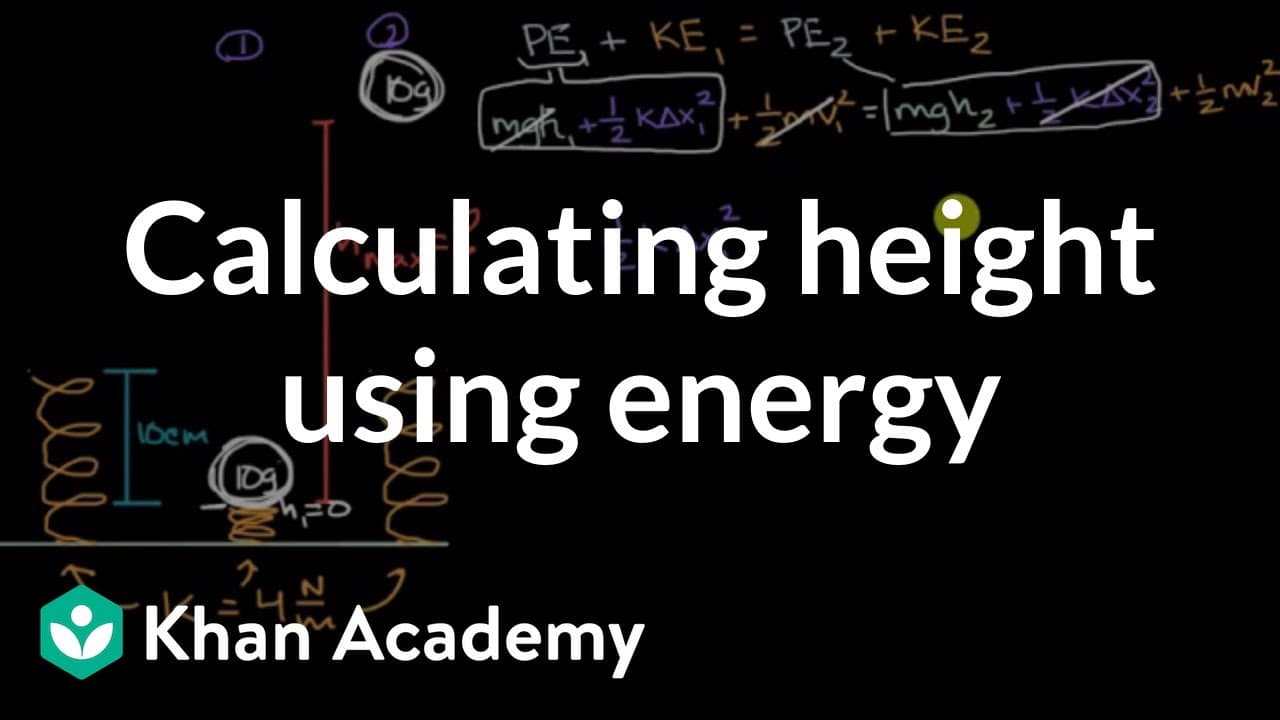
  • [Instructor] So I have an uncompressed spring here and the spring has a spring constant of four Newtons per meter. Then I take a 10 gram mass, a 10 gram ball, and I put it at the top of the spring and I push down to compress that spring by 10 centimeters. And so let's call that scenario one right over there, where our mass is on top of this compr... Read More

Key Insights

  • 💬 Conservation of energy is a fundamental principle that can be applied to determine the maximum height of a ball launched by a compressed spring.
  • ❓ The scenario involves both gravitational potential energy and elastic potential energy.
  • 🥵 Ignoring factors such as heat due to friction with the air can simplify the problem.

Install to Summarize YouTube Videos and Get Transcripts

Explore YouTube Video Summarizer or Get YouTube Transcript Extractor

Questions & Answers

Q: How can the maximum height of a ball launched by a compressed spring be determined?

The maximum height can be determined by applying the principle of conservation of energy, ensuring that the potential energy and kinetic energy in the initial scenario are equal to the potential energy and kinetic energy at maximum height.

Q: What are the types of potential energy involved in the scenario?

The scenario involves gravitational potential energy and elastic potential energy due to the compressed spring.

Q: Why is heat due to friction with the air ignored in this analysis?

Heat due to friction is ignored in order to simplify the problem. The analysis assumes the scenario is happening in a vacuum.

Q: How is the maximum height calculated using the conservation of energy principle?

The maximum height can be calculated by dividing the elastic potential energy in scenario one by the product of mass, gravitational field strength, and the spring constant, all multiplied by the compressed distance squared.

Summary & Key Takeaways

  • The content discusses a scenario where a mass is placed on top of a compressed spring and then launched into the air, reaching a maximum height.

  • The principle of conservation of energy is applied to determine the maximum height.

  • The potential energy and kinetic energy in the initial scenario must be equal to the potential energy and kinetic energy in the scenario of maximum height.


Read in Other Languages (beta)

English

Share This Summary 📚

Summarize YouTube Videos and Get Video Transcripts with 1-Click

Download browser extensions on:

Try YouTube Summary with ChatGPT & Claude or YouTube Transcript Generator

Explore More Summaries from Khan Academy 📚

Interview with Karina Murtagh thumbnail
Interview with Karina Murtagh
Khan Academy
Breakthrough Junior Challenge Winner Reveal! Homeroom with Sal - Thursday, December 3 thumbnail
Breakthrough Junior Challenge Winner Reveal! Homeroom with Sal - Thursday, December 3
Khan Academy
Classical Japan during the Heian Period | World History | Khan Academy thumbnail
Classical Japan during the Heian Period | World History | Khan Academy
Khan Academy

Summarize YouTube Videos and Get Video Transcripts with 1-Click

Download browser extensions on:

Try YouTube Summary with ChatGPT & Claude or YouTube Transcript Generator

Apps & Extensions

  • Chrome Extension
  • Safari Extension
  • Edge Add-ons
  • Firefox Add-ons
  • iOS App
  • Android App

Key Features

  • YouTube Video Summarizer
  • Web & PDF Summarizer
  • Web & PDF Highlighter
  • Chat with PDF
  • Ask AI Clone
  • Audio Transcriber
  • Glasp Reader
  • Kindle Highlight Export
  • Idea Hatch

Integrations

  • Obsidian Plugin
  • Notion Integration
  • Pocket Integration
  • Instapaper Integration
  • Medium Integration
  • Readwise Integration
  • Snipd Integration
  • Hypothesis Integration

More Features

  • APIs
  • MCP Connector
  • Blog & Post
  • Embed Links
  • Image Highlight
  • Personality Test
  • Quote Shots

Company

  • About us
  • Blog
  • Community
  • FAQs
  • Job Board
  • Newsletter
  • Pricing
Terms

•

Privacy

•

Guidelines

© 2026 Glasp Inc. All rights reserved.

