High-throughput screening of synthetic costimulatory domains to modulate CAR T cell function
TL;DR
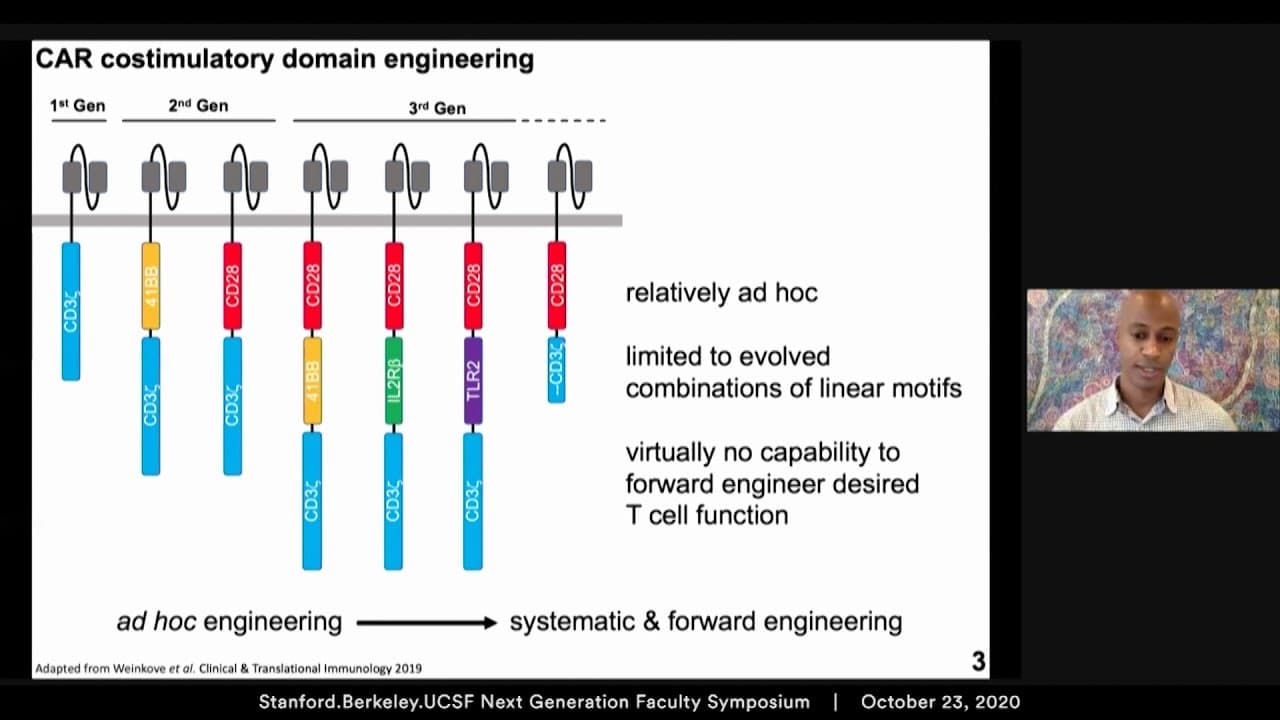
Researchers are using synthetic biology and artificial intelligence to create novel co-stimulatory domains for CAR T cell therapy, aiming to improve efficacy and control over T cell function.
Transcript
i'd like to introduce the chair of our next session uh professor tajel desai uh professor and chair of the department of bioengineering and therapeutic sciences uh at ucsf great thank you erin so i'm excited to introduce our next session with a focus on translational engineering and today we're going to hear from talks from a biochemist as well as ... Read More
Key Insights
- 💅 CAR T cell therapy has shown promise in treating cancer, but there is a need to improve and control T cell function.
- 🤠 Synthetic biology and AI offer a new approach for creating novel co-stimulatory domains to modulate CAR T cell function.
- 👻 Combinatorial CAR libraries and screening methods allow for the identification of synthetic domains with desired phenotypes.
- 🥶 Positional dependence and the syntax of linear motif signaling influence the function of synthetic co-stimulatory domains.
- 💅 Machine learning enables the prediction of novel synthetic domain function, leading to forward engineering of CAR T cell therapies.
Install to Summarize YouTube Videos and Get Transcripts
Explore YouTube Video Summarizer or Get YouTube Transcript Extractor
Questions & Answers
Q: What is CAR T cell therapy and what are some challenges associated with it?
CAR T cell therapy involves genetically modifying T cells to express chimeric antigen receptors (CARs) for targeting and killing cancer cells. Challenges include the need to optimize T cell function, such as proliferation and persistence, for different cancer applications.
Q: How are researchers using synthetic biology and AI to improve CAR T cell therapy?
Researchers are using synthetic biology to create novel co-stimulatory domains by combining short linear motifs from natural signaling domains. AI is employed to predict the function of these synthetic domains and enable forward engineering of effective CAR T cell therapies.
Q: What is the strategy for creating synthetic co-stimulatory domains?
Instead of using entire signaling domains, researchers take short linear motifs that bind to specific signaling proteins and combine them to make synthetic signaling domains. This approach allows for more systematic and controlled engineering of CAR T cell function.
Q: How do researchers evaluate the function of the synthetic co-stimulatory domains?
A combinatorial CAR library is constructed with receptors containing various motif combinations. The library is screened in primary human T cells, and cells with desired phenotypes are sorted and sequenced. Enrichment assays are performed to quantify the function of synthetic domains.
Summary & Key Takeaways
-
CAR T cell therapy is a powerful immunotherapy approach that modifies T cells to recognize and kill cancer cells, but there is room for improvement in modulating their function.
-
Researchers are using synthetic biology and AI to create synthetic co-stimulatory domains by combining short linear motifs from natural signaling domains.
-
A combinatorial CAR library is constructed, screened, and sequenced to identify receptors with desired phenotypes, and machine learning is employed to predict the function of novel combinations.
Read in Other Languages (beta)
Share This Summary 📚
Summarize YouTube Videos and Get Video Transcripts with 1-Click
Try YouTube Summary with ChatGPT & Claude or YouTube Transcript Generator
Explore More Summaries from Stanford 📚


Summarize YouTube Videos and Get Video Transcripts with 1-Click
Try YouTube Summary with ChatGPT & Claude or YouTube Transcript Generator