How to Prove the Series Expansion of Sine Inverse
TL;DR
The sine inverse of x can be expressed as a series expansion: x + x³/6 + 3x⁵/40 + ... by differentiating and integrating the general form of the expression. This approach utilizes the series for 1 - x² to the power of -1/2, allowing the derivation of sine inverse in terms of powers of x.
Transcript
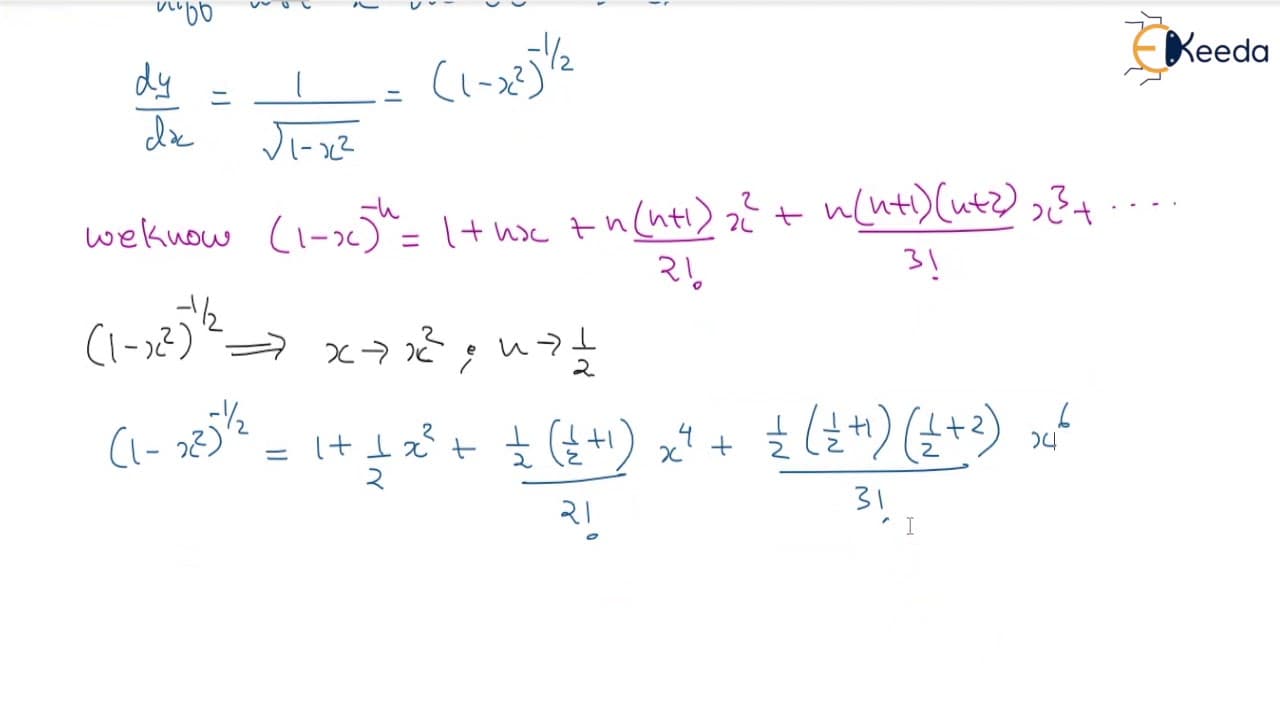
hello everyone so in this session we'll see another question on expansion using differentiation and integration so it says prove that sine inverse of x can be given as x plus x cube by 6 plus 3 by 40 x to the power of 5 5 by 112 x to the power of 7 and so on so let's say y is equal to sine inverse of x and of this if we differentiate with respect t... Read More
Key Insights
- ☺️ The video provides a step-by-step proof of the series expansion for sine inverse of x using differentiation and integration.
- 😑 The comparison of the general form of 1 minus x to the power of minus n helps derive the specific expression for sine inverse of x.
- ☺️ The series expansion includes terms with increasing powers of x, with coefficients determined through integration.
- ❓ This proof showcases the mathematical techniques of differentiation and integration in solving expansion problems.
- ☺️ The derived expansion provides a convenient way to approximate the value of sine inverse of x for different values of x.
- 🆘 Understanding series expansions for trigonometric functions helps in solving complex mathematical problems.
- 👨💼 The proof highlights the relationship between the inverse trigonometric function sine inverse and its series representation.
Install to Summarize YouTube Videos and Get Transcripts
Explore YouTube Video Summarizer or Get YouTube Transcript Extractor
Questions & Answers
Q: How is the expansion of sine inverse of x derived using differentiation and integration?
The expansion is derived by first differentiating sine inverse of x, which gives us 1 by under root of 1 minus x square. Then, the general form of 1 minus x to the power of minus n is compared, leading to the specific expansion expression for sine inverse of x.
Q: What are the terms in the series expansion for sine inverse of x?
The series expansion for sine inverse of x includes terms like x, x cubed by 6, 3 by 40 x to the power of 5, 5 by 112 x to the power of 7, and so on. These terms are obtained by integrating the expression derived through differentiation.
Q: How is the proof concluded in the video?
The proof is concluded by showing the final series expansion for sine inverse of x, which is x plus x cubed by 6 plus 3 by 40 x to the power of 5 and so on. This demonstrates that sine inverse of x can be represented using the derived series expansion.
Summary & Key Takeaways
-
The video proves that sine inverse of x can be represented as a series expansion using differentiation and integration.
-
The expansion starts with the expression 1 minus x square to the power of minus 1 by 2 and is compared to a general form of expansion.
-
By differentiating and integrating the expression, the video shows that sine inverse of x can be expressed as x plus x cubed by 6 plus 3 by 40 x to the power of 5, and so on.
Read in Other Languages (beta)
Share This Summary 📚
Summarize YouTube Videos and Get Video Transcripts with 1-Click
Try YouTube Summary with ChatGPT & Claude or YouTube Transcript Generator
Explore More Summaries from Ekeeda 📚






Summarize YouTube Videos and Get Video Transcripts with 1-Click
Try YouTube Summary with ChatGPT & Claude or YouTube Transcript Generator