Worked example: Calculating molar mass and number of moles | AP Chemistry | Khan Academy
TL;DR
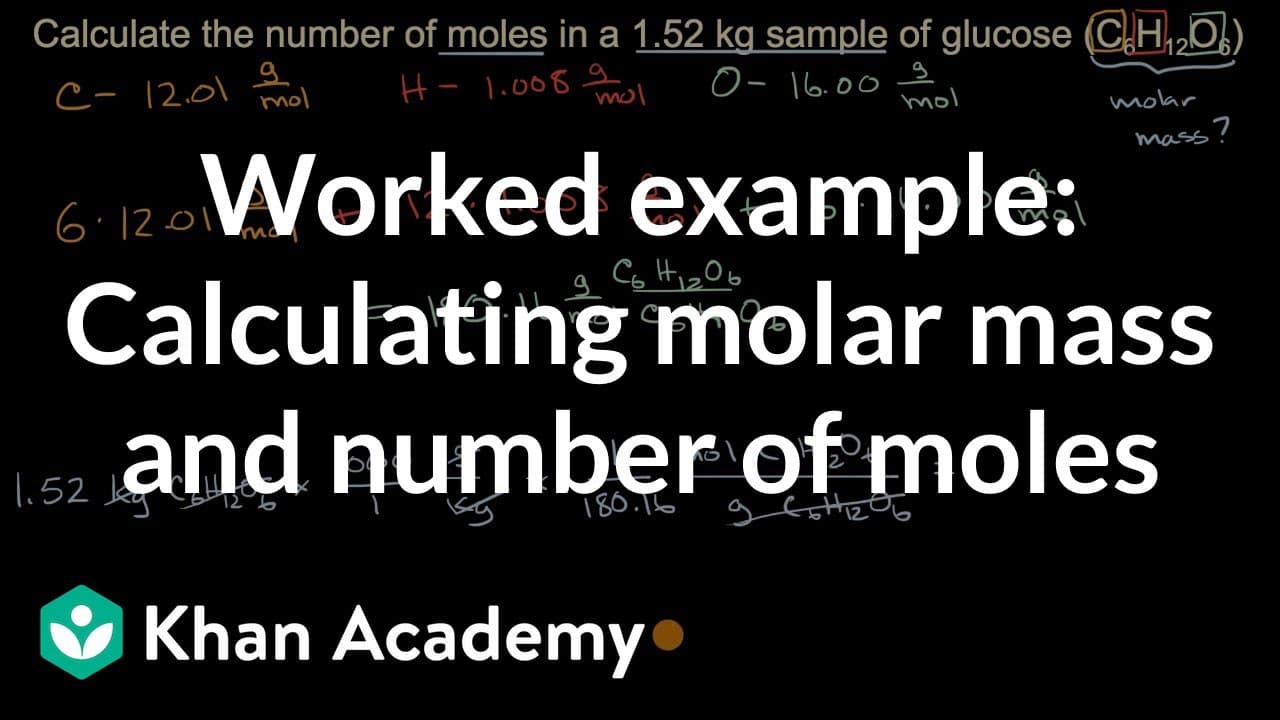
Calculate the number of moles in a 1.52 kg sample of glucose using its molar mass and conversion factors.
Transcript
- [Instructor] We are asked to calculate the number of moles in a 1.52 kilogram sample of glucose. So like always, pause this video and try to figure this out on your own and this periodic table of elements will prove useful. All right, now if we're trying to figure out the number of moles, remember, mole is really, you can view it as a quantity of... Read More
Key Insights
- 💆 The number of moles in a sample can be calculated using the sample's mass and the molar mass of the substance.
- 💆 Molar mass is the mass of one mole of a substance and is usually expressed in grams per mole.
- 💆 The molar mass of a compound can be determined by summing the molar masses of its constituent elements.
Install to Summarize YouTube Videos and Get Transcripts
Explore YouTube Video Summarizer or Get YouTube Transcript Extractor
Questions & Answers
Q: How can the number of moles in a sample of glucose be calculated?
The number of moles can be calculated by dividing the mass of the sample by the molar mass of glucose. In this case, the mass of the sample is 1.52 kg, and the molar mass of glucose is 180.16 g/mol. Therefore, the number of moles is 8.44 moles.
Q: What is the significance of the molar mass in mole calculations?
The molar mass represents the mass of one mole of a substance. By knowing the molar mass of a compound, one can convert the mass of a sample into the number of moles of that substance.
Q: How is the molar mass of glucose determined?
The molar mass of glucose is determined by summing the molar masses of its constituent elements. In this case, it is calculated as six times the molar mass of carbon plus 12 times the molar mass of hydrogen plus six times the molar mass of oxygen, resulting in a molar mass of 180.16 g/mol.
Q: What are the conversion factors used in this calculation?
The conversion factor used is 1,000 g/kg, which represents the number of grams per kilogram. By multiplying the mass in kilograms by this conversion factor, the mass is converted to grams before further calculations.
Summary & Key Takeaways
-
To calculate the number of moles in a sample of glucose, divide the mass of the sample by the molar mass of glucose.
-
The molar mass of glucose can be found by summing the molar masses of its constituent elements (carbon, hydrogen, and oxygen).
-
Convert the mass of the sample from kilograms to grams, and then divide it by the molar mass of glucose to obtain the number of moles.
Read in Other Languages (beta)
Share This Summary 📚
Summarize YouTube Videos and Get Video Transcripts with 1-Click
Try YouTube Summary with ChatGPT & Claude or YouTube Transcript Generator
Explore More Summaries from Khan Academy 📚



Summarize YouTube Videos and Get Video Transcripts with 1-Click
Try YouTube Summary with ChatGPT & Claude or YouTube Transcript Generator