Simple fractional reserve accounting (part 2) | The monetary system | Macroeconomics | Khan Academy
TL;DR
Fractional reserve lending allows banks to create money by lending out a portion of the deposits they receive.
Transcript
Voiceover: In the last video, we saw how a bank would account for fractional reserve lending on its balance sheet, and we did it with kind of the conceptual understanding that we've been talking about fractional reserve lending the entire time. Someone deposits 100 million in reserves, and 90 million of it gets lent out. Of course, the offsetting l... Read More
Key Insights
- 💵 Fractional reserve lending allows banks to create money by lending out a fraction of deposited funds.
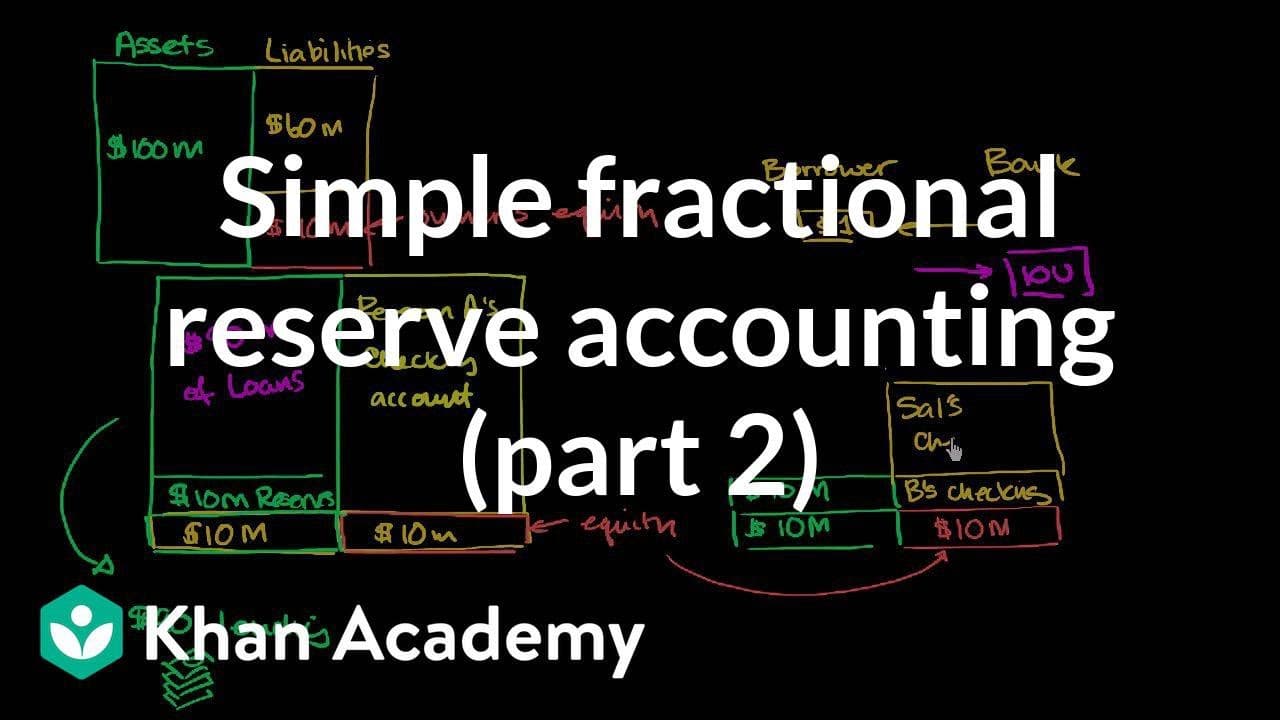
- 📼 Banks can expand their assets and liabilities by creating checking accounts for borrowers and holding IOUs as assets.
- 🛟 Reserve requirements set by regulators limit the amount of money banks can create through fractional reserve lending.
- 🛟 Both the conceptual understanding and practical implementation of fractional reserve lending involve creating money beyond the amount of reserves.
- 💵 Fractional reserve lending can lead to concerns about money creation by banks.
- 🏦 Banks must balance their lending with the need to maintain enough reserves to meet withdrawal demands.
- 💵 Reserve requirements vary by country and can be adjusted by central banks to control money supply.
Install to Summarize YouTube Videos and Get Transcripts
Explore YouTube Video Summarizer or Get YouTube Transcript Extractor
Questions & Answers
Q: How does fractional reserve lending work?
Fractional reserve lending allows banks to lend out more money than they have in reserves. They do this by creating checking accounts for borrowers and holding their IOUs as assets.
Q: What limits banks from continuously creating money through fractional reserve lending?
Reserve requirements set by regulators limit the amount of money banks can create. In the US, large banks must hold reserves equal to at least 10% of their checkable deposits.
Q: Are fractional reserve lending and the concept described in the video the same thing?
Yes, both the conceptual understanding and the practical implementation of fractional reserve lending involve creating money through lending out a fraction of deposits.
Q: What happens if a bank cannot meet a sudden demand for cash from depositors?
If a bank does not have enough reserves to cover withdrawals, it may need to borrow reserves from another bank or the central bank as a last resort.
Summary & Key Takeaways
-
Fractional reserve lending allows a bank to expand both its assets and liabilities, creating money with just a fraction of the reserves.
-
Banks can lend out more money than they have in reserves by creating checking accounts for borrowers and holding IOUs as assets.
-
Reserve requirements limit the amount of money banks can create through fractional reserve lending.
Read in Other Languages (beta)
Share This Summary 📚
Summarize YouTube Videos and Get Video Transcripts with 1-Click
Try YouTube Summary with ChatGPT & Claude or YouTube Transcript Generator
Explore More Summaries from Khan Academy 📚



Summarize YouTube Videos and Get Video Transcripts with 1-Click
Try YouTube Summary with ChatGPT & Claude or YouTube Transcript Generator