Properties of Limits
TL;DR
Learn how to evaluate limits using properties of limits, including moving constants to the front, combining limits of sums and products, and raising limits to powers and roots.
Transcript
now let's talk about how to evaluate limits using properties of limits for example let's say that the limit as x approaches a of the function f of x say that's equal to four and the limit as x approaches a of the function g of x let's say that's equal to negative 3. so using that information what is the limit as x approaches a of 4 f of x so what y... Read More
Key Insights
- ⛔ When evaluating limits, constants can be moved to the front using the property of limits.
- ⛔ Limits of sums and products can be evaluated by calculating the limits of individual functions and then performing the corresponding arithmetic operations.
- ✊ Powers and roots of functions can be evaluated by applying the respective operations to the limits of the functions.
- 💦 It is important to show your work when evaluating limits, as some teachers may require it.
- ⛔ The properties of limits help simplify the evaluation process and provide a systematic approach.
- 🪈 The order of operations can be applied to limits, just like in regular arithmetic.
- ⛔ Evaluating limits involves substituting the given limit values and performing calculations according to the properties of limits.
Install to Summarize YouTube Videos and Get Transcripts
Explore YouTube Video Summarizer or Get YouTube Transcript Extractor
Questions & Answers
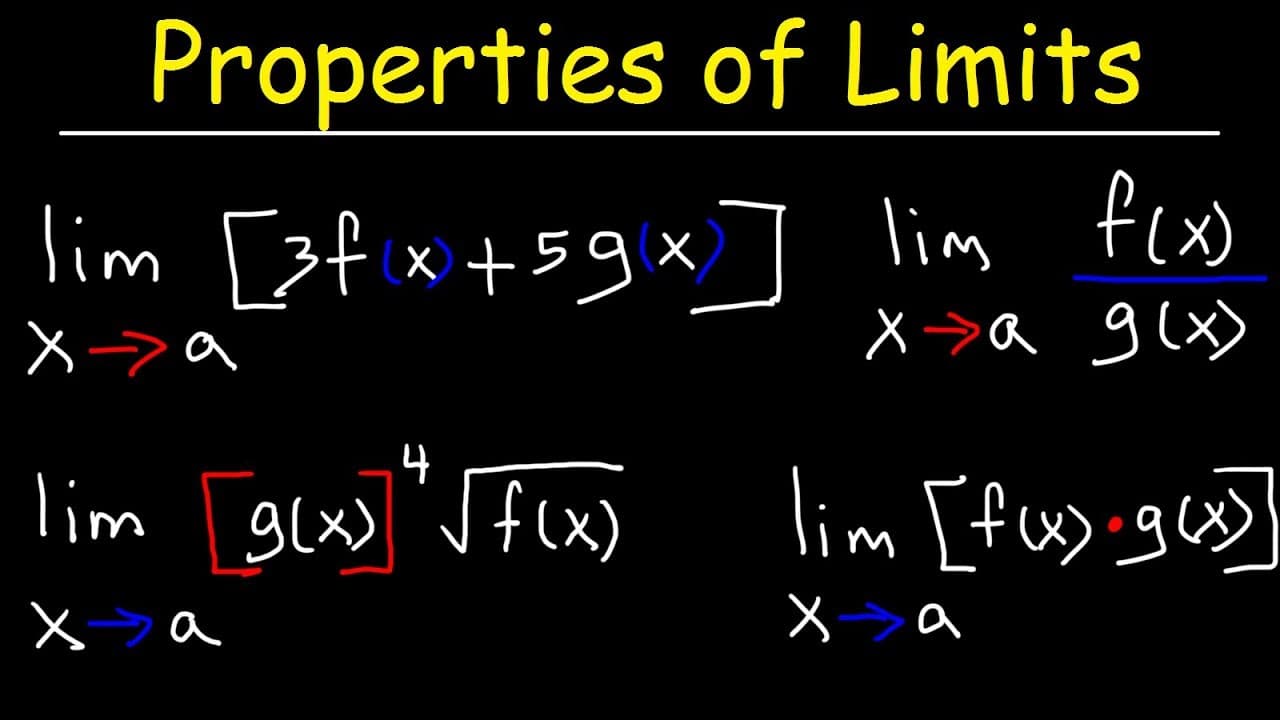
Q: How can you evaluate the limit as x approaches a of 4f(x)?
To evaluate the limit, move the constant (4) to the front and substitute the given value for the limit of f(x). The result will be 4 times the limit of f(x), which can be further simplified if necessary.
Q: What is the procedure for evaluating the limit of an expression like 3f(x) + 5g(x)?
To evaluate the limit, calculate the limit of each function individually (3 times the limit of f(x) and 5 times the limit of g(x)). Then, perform the respective operations as indicated by the expression. In this case, it would be 3 times the limit of f(x) plus 5 times the limit of g(x).
Q: How do you evaluate the limit of the expression f(x) times g(x)?
To evaluate the limit, separate the two functions (f(x) and g(x)) and substitute the given value for their individual limits. Then, perform the multiplication. In this example, it would be 4 times the limit of g(x), resulting in the overall limit of the expression.
Q: How can you evaluate the limit of g(x) raised to the fourth power times the square root of f(x)?
Rewrite the expression by taking the respective limits and applying the properties of limits. The limit of g(x) raised to the fourth power becomes the fourth power of the given limit of g(x), and the square root of f(x) becomes the square root of the given limit of f(x). Finally, perform the necessary calculations to find the overall limit of the expression.
Summary & Key Takeaways
-
The video explains how to evaluate limits using properties of limits for functions f(x) and g(x).
-
To evaluate the limit as x approaches a of 4f(x), move the constant to the front and substitute the given value to get the result.
-
Similarly, the video demonstrates evaluating limits of expressions involving sums, products, and powers of functions.
Read in Other Languages (beta)
Share This Summary 📚
Summarize YouTube Videos and Get Video Transcripts with 1-Click
Try YouTube Summary with ChatGPT & Claude or YouTube Transcript Generator
Explore More Summaries from The Organic Chemistry Tutor 📚



Summarize YouTube Videos and Get Video Transcripts with 1-Click
Try YouTube Summary with ChatGPT & Claude or YouTube Transcript Generator