Rotational Motion: An Explanation, Angular Displacement, Velocity and Acceleration
TL;DR
Learn all about rotational motion terms, equations, and definitions for physics studies.
Transcript
in today's video we're going to go over a complete introduction to all the terms definition and equations that you're going to need for your studies in rotational motion now before we get started please don't forget to subscribe to my channel step by step science get all my excellent physics chemistry and math videos when i look at my youtube analy... Read More
Key Insights
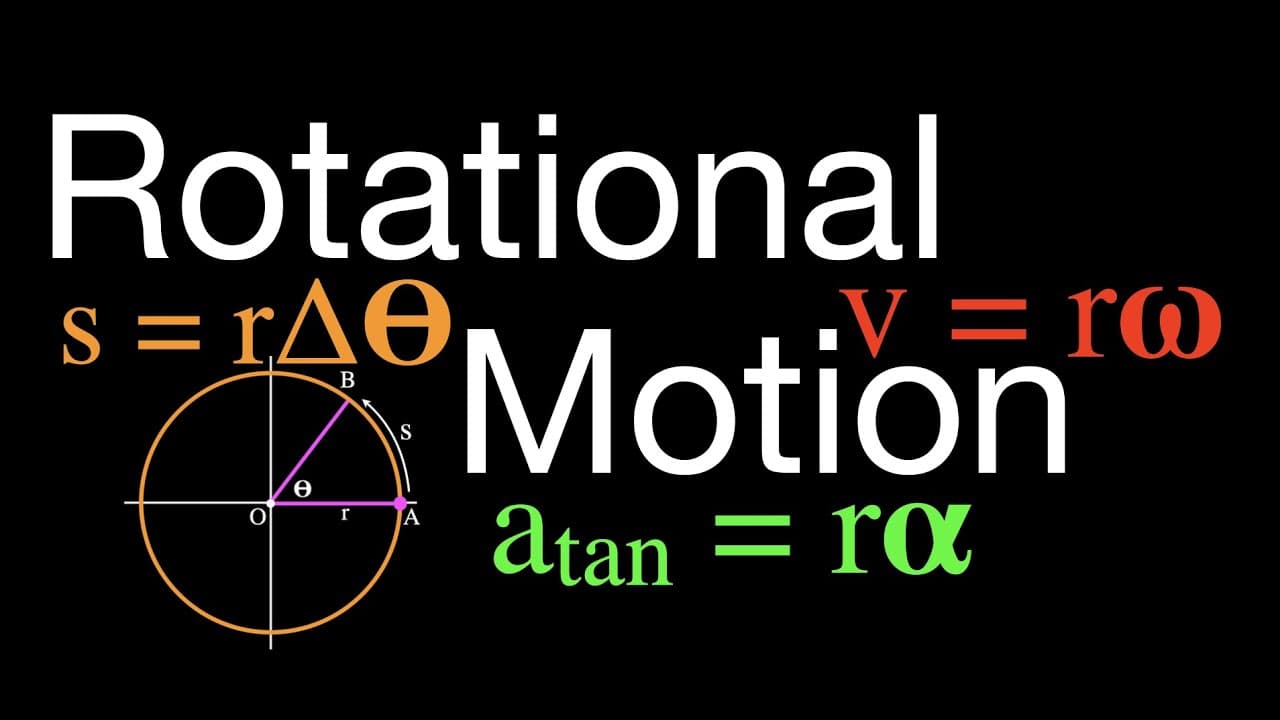
- 📐 Arc length is calculated by multiplying the radius by the angular displacement in radians.
- 🐎 Tangential velocity represents the speed of an object moving along a circular path.
- ❓ Centripetal acceleration keeps an object moving in a circular path.
- 🫚 Total acceleration is calculated as the square root of the sum of tangential and centripetal accelerations.
- 🏍️ Frequency is the number of cycles per second, while the period is the time for one cycle.
- 📐 Angular velocity can be calculated using the frequency or period.
- 🫠 Equations relate arc length, angular velocity, acceleration, and frequency in rotational motion studies.
Install to Summarize YouTube Videos and Get Transcripts
Explore YouTube Video Summarizer or Get YouTube Transcript Extractor
Questions & Answers
Q: What is the relationship between arc length and angular displacement?
The arc length is calculated by multiplying the radius by the angular displacement in radians.
Q: How is tangential velocity related to angular velocity?
Tangential velocity is equal to the radius times the angular velocity, representing the speed of the object moving along the circular path.
Q: What defines tangential and angular acceleration?
Tangential acceleration is the change in velocity over time, while angular acceleration is the change in angular velocity over time, both in meters per second squared.
Q: How are centripetal acceleration and total acceleration related?
Centripetal acceleration is r times angular velocity squared, while total acceleration is the sum of tangential and centripetal accelerations, found using the Pythagorean theorem.
Summary & Key Takeaways
-
Introduces arc length and angular displacement in circular motion.
-
Defines tangential velocity as distance traveled along a path.
-
Explains angular velocity and acceleration in rotational motion.
Read in Other Languages (beta)
Share This Summary 📚
Summarize YouTube Videos and Get Video Transcripts with 1-Click
Try YouTube Summary with ChatGPT & Claude or YouTube Transcript Generator
Explore More Summaries from Step by Step Science 📚


Summarize YouTube Videos and Get Video Transcripts with 1-Click
Try YouTube Summary with ChatGPT & Claude or YouTube Transcript Generator