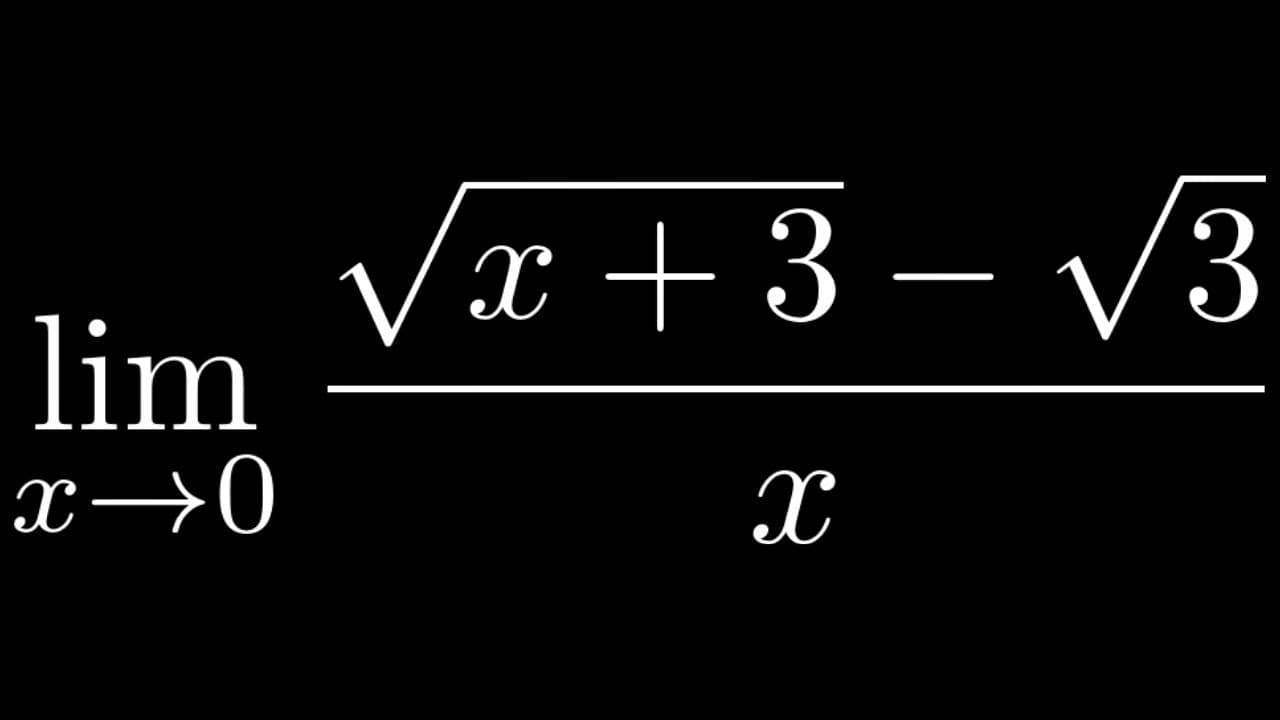
Computing a Limit by Rationalizing (sqrt(x + 3) - sqrt(3))/x as x approaches zero
TL;DR
Learn to calculate limits by rationalizing the numerator in the expression involving square roots.
Transcript
so we're being asked to compute the limit as X approaches zero of this quantity here so the first thing you should do whenever you have a limit is take the number and plug it in and see what happens so if we do that we get zero plus three we have a square root minus the square root of three over zero so that's zero over zero and that's undefined th... Read More
Key Insights
- 😑 Plugging in the value when calculating limits may result in an undefined expression like 0/0, indicating the need for a different approach.
- 😑 Rationalizing the numerator by multiplying with the conjugate of the expression helps simplify limit calculations involving square roots.
- ❎ Utilizing the difference of squares formula aids in simplifying expressions with square roots before evaluating the limit.
- 🫚 Recognizing patterns like square root minus another square root signals the application of specific strategies in limit calculations.
- ⛔ Limits involve approaching a value, not necessarily reaching it directly.
- 💁 Understanding how to handle indeterminate forms like 0/0 is crucial in limit calculations.
- 😑 Algebraic manipulations like simplifying expressions and factoring play a significant role in calculating limits.
Install to Summarize YouTube Videos and Get Transcripts
Explore YouTube Video Summarizer or Get YouTube Transcript Extractor
Questions & Answers
Q: Why does plugging in the value when computing a limit sometimes result in an undefined expression?
Plugging in the value in limit computations can lead to undefined expressions like 0/0 because direct evaluation at the limit point may not give a meaningful result due to limits being about approaching a value, not necessarily equaling it.
Q: How does rationalizing the numerator help in calculating limits involving square roots?
Rationalizing the numerator by multiplying with the conjugate of the expression eliminates the square root in the numerator, simplifying the expression and making it easier to calculate the limit without encountering indeterminate forms like 0/0.
Q: Why is the difference of squares formula used in simplifying the expression involving square roots in limit calculations?
The difference of squares formula is used to simplify expressions involving square roots because it enables us to eliminate the square roots by squaring the terms, making the calculation of limits more manageable and leading to the final result after plugging in the limit point.
Q: What is the significance of recognizing patterns like square root minus another square root in limit calculations?
Recognizing patterns like square root minus another square root in limit calculations allows us to apply suitable strategies such as rationalizing the numerator to simplify the expression and compute the limit effectively without getting stuck at indeterminate forms.
Summary & Key Takeaways
-
When approaching a limit, plugging in the value often results in an undefined expression like 0/0, prompting the need for a different approach.
-
Rationalizing the numerator by multiplying with the conjugate of the expression helps simplify the limit calculation.
-
Using the difference of squares formula to simplify the expression before plugging in the limit value yields the final result.
Read in Other Languages (beta)
Share This Summary 📚
Summarize YouTube Videos and Get Video Transcripts with 1-Click
Try YouTube Summary with ChatGPT & Claude or YouTube Transcript Generator
Explore More Summaries from The Math Sorcerer 📚


Summarize YouTube Videos and Get Video Transcripts with 1-Click
Try YouTube Summary with ChatGPT & Claude or YouTube Transcript Generator