Density curve worked example | Modeling data distributions | AP Statistics | Khan Academy
TL;DR
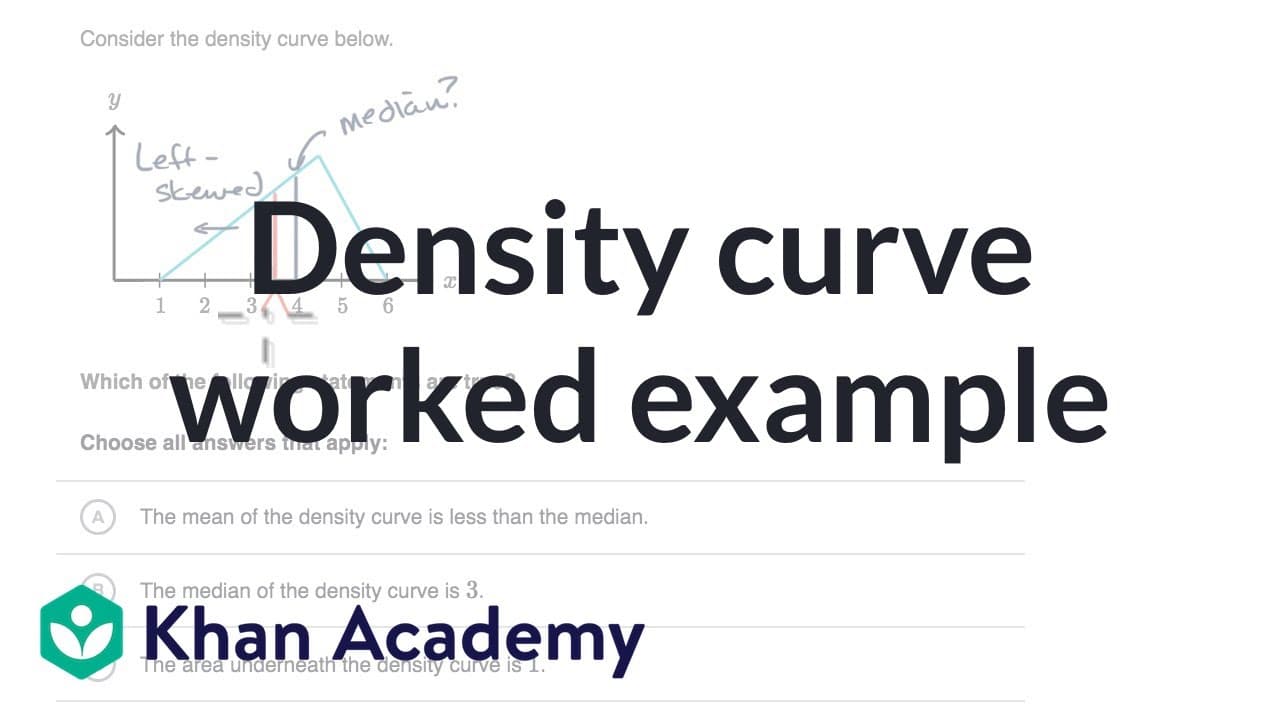
The video explains the properties of a triangle-shaped density curve and how to determine its mean, median, and area.
Transcript
- [Instructor] Consider the density curve below. It's depicted right over here. It's a little unusual looking. It's more like a triangle than our standard density curves, but it's valid. Which of the following statements are true? Choose all answers that apply. The mean of the density curve is less than the median. Pause this video and see if you c... Read More
Key Insights
- ↔️ The mean of a left skewed density curve is to the left of the median, and vice versa for a right skewed curve.
- 🟰 The area under any density curve, including a triangle-shaped curve, is always equal to one.
- 🙃 The median of a density curve represents the value where the area on both sides of the curve is equal.
Install to Summarize YouTube Videos and Get Transcripts
Explore YouTube Video Summarizer or Get YouTube Transcript Extractor
Questions & Answers
Q: How can you determine whether a density curve is left skewed or right skewed?
A density curve is left skewed if it has a longer tail on the left side, indicating that the mean is to the left of the median. Conversely, a density curve is right skewed if it has a longer tail on the right side, with the mean to the right of the median.
Q: What does it mean for the area underneath a density curve to be equal to one?
The area underneath a density curve represents the probability, and when it is equal to one, it means that the probability of any outcome occurring is 100%.
Q: Can the median of a density curve be any value within its range?
No, the median of a density curve is a specific value that represents the point where the area on both sides of the curve is equal. It is not necessarily located at the highest point of the curve or any other specific value within the range.
Q: How is the height of a point on a density curve determined?
The height of a point on a density curve can be calculated using the formula for the area of a triangle (1/2 base times height). By setting the area equal to one and knowing the length of the base, the height can be determined through simple algebraic calculations.
Summary & Key Takeaways
-
The video discusses a triangle-shaped density curve and its validity, indicating that it is left skewed, with the mean being to the left of the median.
-
The median of the density curve is not three, as confirmed by comparing the areas on each side of the curve.
-
The area underneath any density curve, including the triangle-shaped one, is always equal to one.
-
By using the information given, the height of the point on the density curve is calculated and found to be 2/5.
Read in Other Languages (beta)
Share This Summary 📚
Summarize YouTube Videos and Get Video Transcripts with 1-Click
Try YouTube Summary with ChatGPT & Claude or YouTube Transcript Generator
Explore More Summaries from Khan Academy 📚



Summarize YouTube Videos and Get Video Transcripts with 1-Click
Try YouTube Summary with ChatGPT & Claude or YouTube Transcript Generator