How did Russia begin? | 1450 - Present | AP US History | Khan Academy
TL;DR
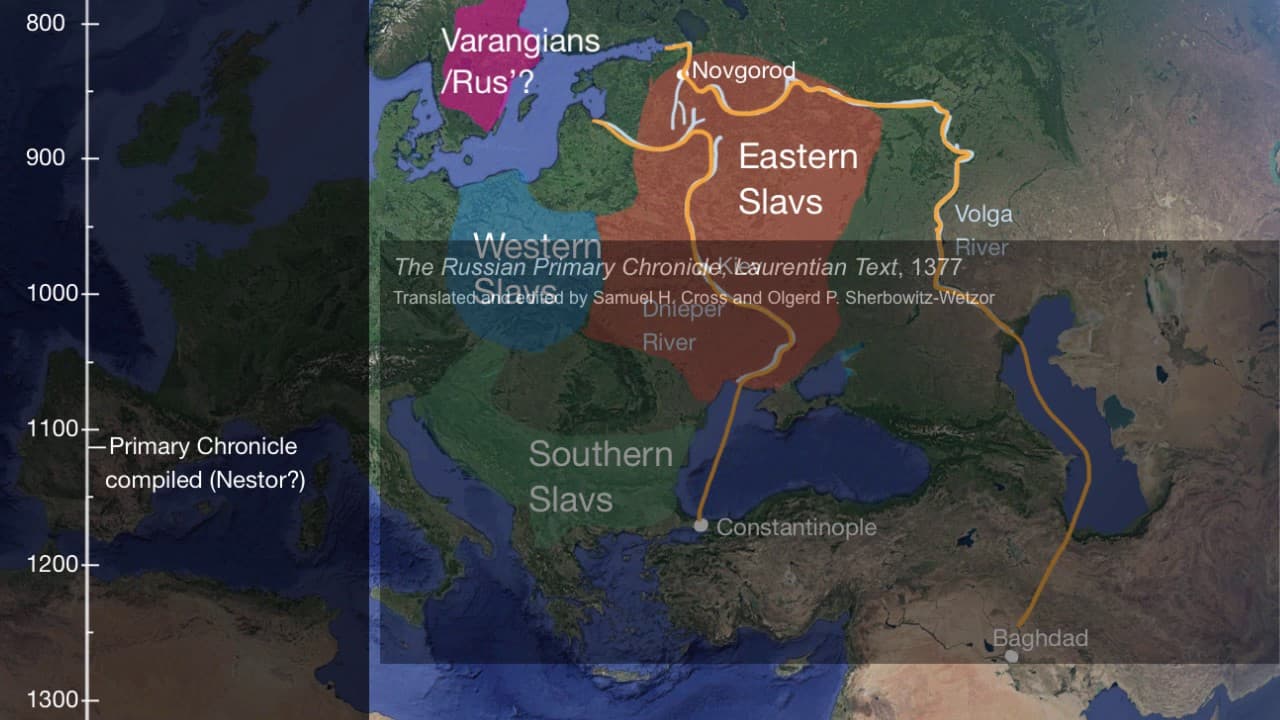
The early Russian people, including modern Russians, Ukrainians, and Belarusians, trace their origins to the Eastern Slavs who invited the Varangians (Vikings) to rule over them, leading to the formation of the Kievan state.
Transcript
- [Instructor] What we're going to talk about in this video are the origins of the Russian people. And in particular, we're going to talk about the eastern Slavs who not just modern Russians, but also Ukrainians and Belorussians view as their ancestors. So let's think about the world in the ninth century. The early ninth century, we see the reign o... Read More
Key Insights
- 👯 The Eastern Slavs sought the assistance of the Varangians to establish governance, reflecting a unique historical instance where people invited a foreign group to rule over them.
- 🇷🇺 The term "Rus" is believed to be the root of the words "Russia" and "Belarus" and is associated with the Eastern Slavs and their early state.
- 💱 The Kievan state expanded its territories and underwent significant change, including the conversion to Eastern Orthodox Christianity under Vladimir the Great.
Install to Summarize YouTube Videos and Get Transcripts
Explore YouTube Video Summarizer or Get YouTube Transcript Extractor
Questions & Answers
Q: Were the Varangians invited by the Eastern Slavs, or did they forcefully establish their rule?
According to the Russian Primary Chronicle, the Varangians were invited by the Eastern Slavs to establish governance and order in their land. However, some historians question whether this narrative was created by the Varangians themselves to legitimize their rule.
Q: What is the significance of the word "Rus" in relation to the Russian people?
The word "Rus" is believed to be the origin of the term "Russia" and "Belarus." It is unclear whether it refers to Sweden, a subgroup of Vikings, or those who rowed. Nevertheless, it became associated with the Eastern Slavs and the Kievan state.
Q: When did the Kievan state convert to Eastern Orthodox Christianity?
The conversion of the Kievan state, led by Vladimir the Great, occurred at the end of the 10th century. This conversion played a significant role in establishing Eastern Orthodox Christianity as a major religion in the region.
Q: How did the Mongol invasion impact the Kievan state?
In 1240, the Mongol invasion occurred, and many of the principalities within the Kievan state became tributaries to the Mongols. This period of Mongol rule lasted for approximately 200 years until Ivan the Great achieved independence for the Rus.
Summary & Key Takeaways
-
The ninth century was a period of various powerful kingdoms, including Charlemagne's reign in Western Europe, Otto the Great's rule over Germanic kingdoms, and the Tang Dynasty in China.
-
The Vikings, known as the Varangians in Eastern Europe, were not only raiders but also traders, establishing trade routes from the Baltic Sea to Constantinople and Baghdad.
-
The Slavic tribes, including the Eastern Slavs in Russia, Belarus, and Ukraine, sought help from the Varangians to establish order and governance, leading to the establishment of the Kievan state under Rurik and later Oleg.
Read in Other Languages (beta)
Share This Summary 📚
Summarize YouTube Videos and Get Video Transcripts with 1-Click
Try YouTube Summary with ChatGPT & Claude or YouTube Transcript Generator
Explore More Summaries from Khan Academy 📚



Summarize YouTube Videos and Get Video Transcripts with 1-Click
Try YouTube Summary with ChatGPT & Claude or YouTube Transcript Generator