Stanford CS229M - Lecture 10: Generalization bounds for deep nets
TL;DR
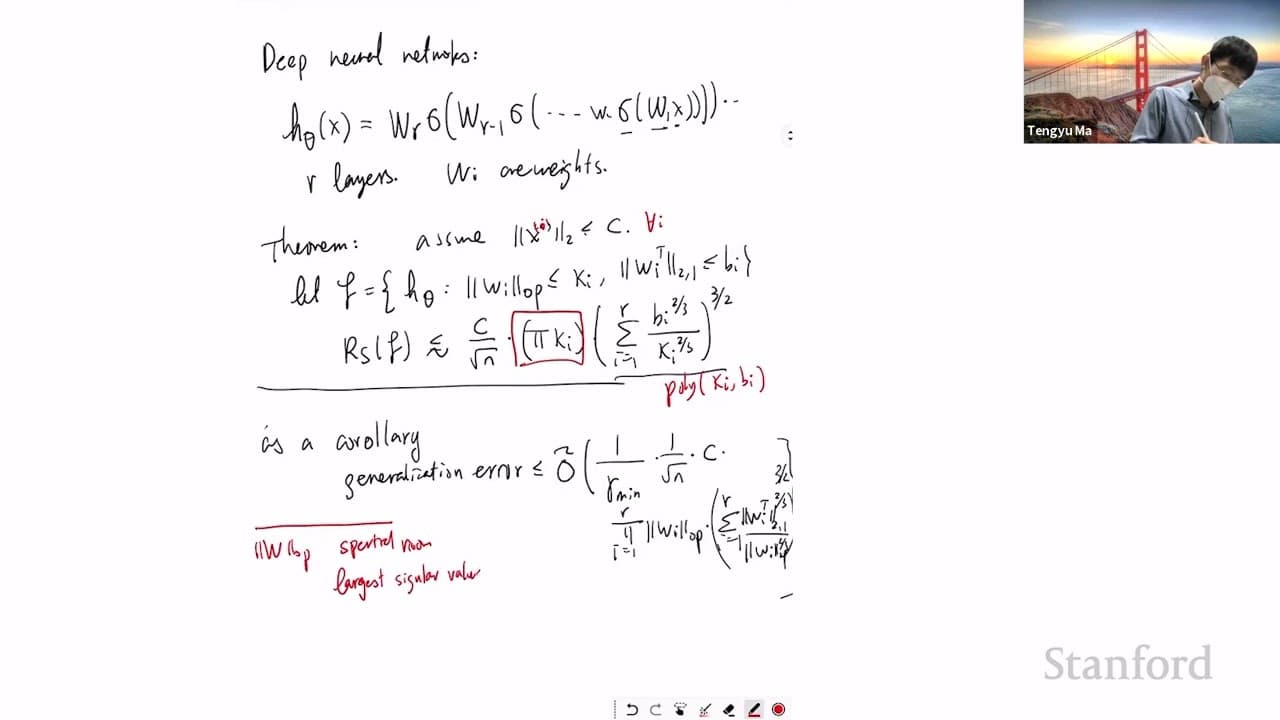
Generalization bounds for deep neural networks can be derived by considering the Lipschitzness of the models on empirical data, allowing for more accurate predictions and better regularization techniques.
Transcript
so last time we have talked about um cover number so cover number is upper Bound for the rather marginal complexity and then our goal is to bond cover numbers because this is a new tool for bonding around the market complexity and we have discussed what are the bounds for linear models I didn't show any of the proofs but there are some existing bon... Read More
Key Insights
- 🔠 Cover numbers provide an upper bound for the worst-case complexity of deep neural networks.
- ❓ Generalization bounds should consider Lipschitzness on empirical data for more accurate performance estimation.
- ❓ Lipschitzness ensures stability and consistency in deep neural network predictions.
Install to Summarize YouTube Videos and Get Transcripts
Explore YouTube Video Summarizer or Get YouTube Transcript Extractor
Questions & Answers
Q: How are cover numbers related to the worst-case complexity of deep neural networks?
Cover numbers provide an upper bound for the worst-case complexity of deep neural networks, considering the maximum number of coverings needed to approximate a function.
Q: Why is it important to consider Lipschitzness on empirical data in generalization bounds?
Lipschitzness on empirical data provides a more accurate estimation of the model's performance, allowing for better predictions and regularization techniques tailored to the specific dataset.
Q: How can generalization bounds be derived for deep neural networks?
By considering the Lipschitzness of the models on empirical data, generalization bounds for deep neural networks can be derived, providing more accurate predictions and better regularization techniques.
Q: What is the significance of Lipschitzness in deep neural networks?
Lipschitzness in deep neural networks ensures that the model's predictions do not vary drastically with small changes in the input, leading to more stable and consistent results.
Summary & Key Takeaways
-
Cover numbers provide an upper bound for the worst-case complexity of deep neural networks, but they do not capture the Lipschitzness of the models on empirical data.
-
Generalization bounds for deep neural networks should consider the Lipschitzness of the models on empirical data, rather than worst-case scenarios.
-
The use of Lipschitzness on empirical data can lead to more accurate predictions and better regularization techniques.
Read in Other Languages (beta)
Share This Summary 📚
Summarize YouTube Videos and Get Video Transcripts with 1-Click
Try YouTube Summary with ChatGPT & Claude or YouTube Transcript Generator
Explore More Summaries from Stanford Online 📚


Summarize YouTube Videos and Get Video Transcripts with 1-Click
Try YouTube Summary with ChatGPT & Claude or YouTube Transcript Generator