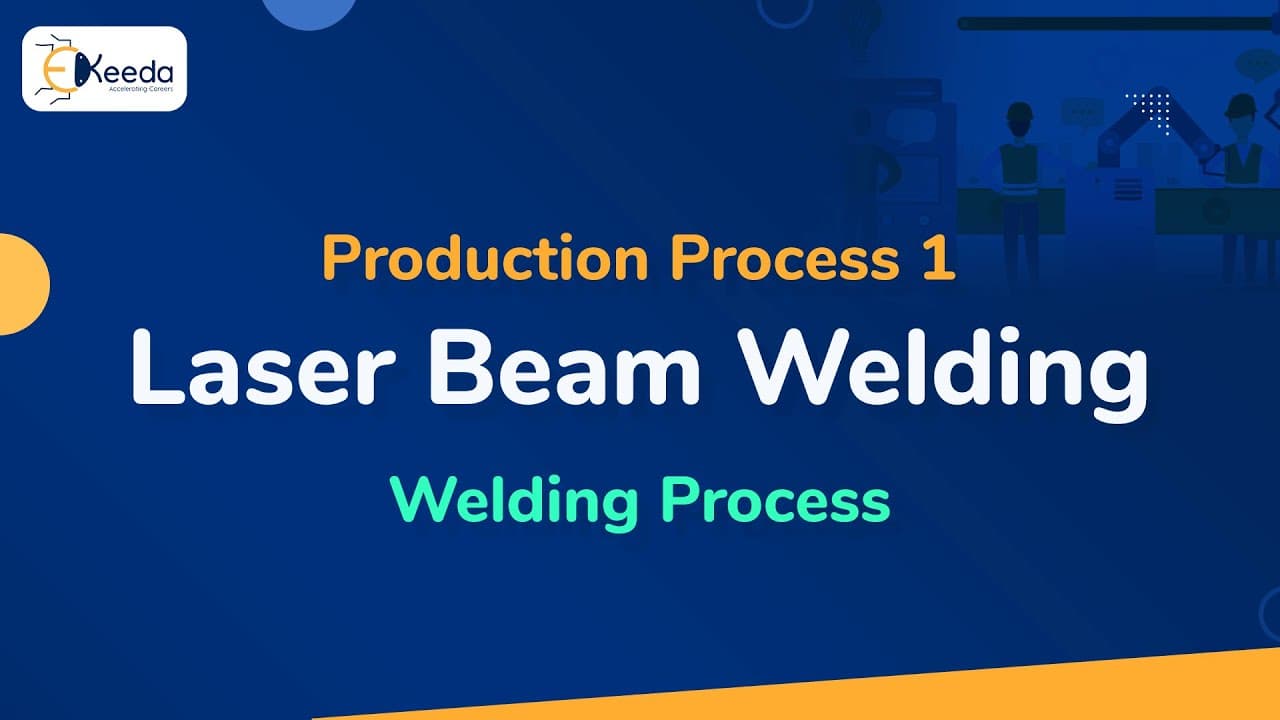
Laser Beam Welding - Welding Process - Production Process 1
TL;DR
Laser beam welding is a beneficial and clean welding process that utilizes a monochromatic and directional light source to generate heat and weld objects.
Transcript
click the bell icon to get latest videos from Ekeeda Hello friends today we are gonna see what is laser beam welding and how it is done unlike other welding processes it is a beneficial welding process and a plane welding process and how it is done we are going to see in this video so laser beam welding is used for metal vaporization it is not usin... Read More
Key Insights
- 😁 Laser beam welding is a clean welding process that does not require a vacuum and can be used for applications such as eye surgeries.
- 😁 The monochromatic and strictly directional nature of laser beams makes them ideal for precise and controlled welding.
- 😁 The process of laser beam welding involves the use of a flash tube, Ruby crystal, and mirrors to generate the laser beam.
- 😁 Unlike other welding processes, laser beam welding does not require a filler metal for the welding process.
- 😁 Laser beam welding has advantages such as the ability to easily weld dissimilar metals and directional welding in a single path.
- 😁 However, laser beam welding has limitations in terms of high capital costs, limited welding capabilities for thicker objects, and the potential for metal cracking with rapid cooling.
- 😁 Laser beam welding works by generating heat when the laser beam interacts with the surface to be welded, leading to heat conduction, vaporization, and joining of the objects.
Install to Summarize YouTube Videos and Get Transcripts
Explore YouTube Video Summarizer or Get YouTube Transcript Extractor
Questions & Answers
Q: How is laser beam welding different from other welding processes?
Laser beam welding differs from other welding processes as it utilizes a monochromatic and strictly directional light source to weld objects. It also does not require the use of a filler metal.
Q: What are the advantages of laser beam welding?
Laser beam welding has several advantages, including the ability to easily weld dissimilar metals, directional welding in a single path, and the possibility of being used in open air environments.
Q: What are the limitations of laser beam welding?
Laser beam welding has a high capital cost and can only be used to weld thinner objects as the laser beam cannot penetrate thicker materials. The maintenance cost is also relatively high and rapid cooling can lead to potential metal cracking.
Q: How does laser beam welding work?
Laser beam welding works by converting electrical energy into light, which is then focused on the object to be welded. The interaction of the laser beam with the base generates heat, followed by heat conduction, vaporization, and joining of the objects.
Summary & Key Takeaways
-
Laser beam welding is a clean and beneficial welding process that utilizes a monochromatic and directional light source to weld objects.
-
Unlike other welding processes, laser beam welding does not require a filler metal and can be used for metal vaporization.
-
The process of laser beam welding involves the interaction of the laser beam with the base, heat conduction, vaporization, and joining.
Read in Other Languages (beta)
Share This Summary 📚
Summarize YouTube Videos and Get Video Transcripts with 1-Click
Try YouTube Summary with ChatGPT & Claude or YouTube Transcript Generator
Explore More Summaries from Ekeeda 📚



Summarize YouTube Videos and Get Video Transcripts with 1-Click
Try YouTube Summary with ChatGPT & Claude or YouTube Transcript Generator