How to Prove Two Context-Free Grammars Are Equivalent
TL;DR
To prove two context-free grammars are equivalent, compare their productions by eliminating unnecessary variables and transforming the grammars into a standard form. By deriving the same strings from both grammars through specified rules, you can demonstrate that they produce the same language.
Transcript
click the bell icon to get latest videos from equator hello friends from the previous video we saw that we can transform a gamma to some standard form by eliminating epsilon productions unit production by eliminating certain useless symbols etc now we shall practice them in some of the new miracles in the same over here let us start with the first ... Read More
Key Insights
- 🤬 Transforming a grammar to a standard form involves eliminating epsilon productions, unit productions, and useless symbols.
- 👍 Proving equivalence between two grammars requires comparing their productions and replacing variables to show they produce the same language.
- 🪈 Deriving strings from productions can be done by applying the corresponding productions in a specific order.
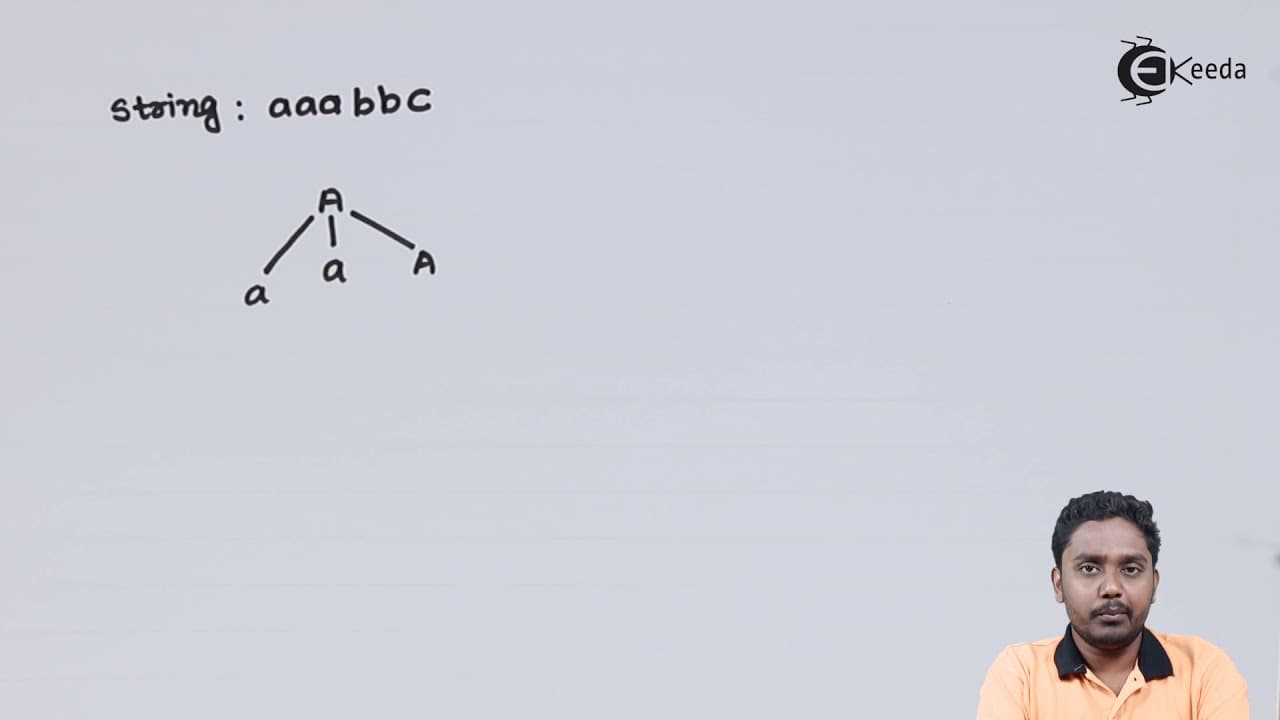
- 🌲 Path trees provide a visual representation of the derivation process, showcasing the applied productions and their resulting strings.
Install to Summarize YouTube Videos and Get Transcripts
Explore YouTube Video Summarizer or Get YouTube Transcript Extractor
Questions & Answers
Q: How can we transform a grammar to a standard form?
To transform a grammar to a standard form, we eliminate epsilon productions, unit productions, and useless symbols. We also replace non-terminal symbols with their corresponding right-hand side productions.
Q: How can we prove that two grammars are equivalent?
To prove that two grammars are equivalent, we compare their productions. By eliminating variables and replacing them with their productions, we can demonstrate that the two grammars are producing the same language.
Q: What is the role of path trees in deriving strings from productions?
Path trees help us visualize the derivation of strings from productions. They show the sequence of applied productions, starting from the root symbol, to generate the desired string.
Q: What are the key concepts covered in the video?
The video covers transforming grammars to a standard form, proving grammar equivalence, deriving strings from productions, and using path trees for visualization.
Summary & Key Takeaways
-
The video discusses the process of transforming a gamma (grammar) to a standard form by eliminating epsilon productions, unit productions, and useless symbols.
-
It demonstrates how to prove that two grammars, g1 and g2, are producing the same language by eliminating variables and comparing their productions.
-
The video also illustrates how to derive a string from given productions and showcases the use of paths trees.
Read in Other Languages (beta)
Share This Summary 📚
Summarize YouTube Videos and Get Video Transcripts with 1-Click
Try YouTube Summary with ChatGPT & Claude or YouTube Transcript Generator
Explore More Summaries from Ekeeda 📚






Summarize YouTube Videos and Get Video Transcripts with 1-Click
Try YouTube Summary with ChatGPT & Claude or YouTube Transcript Generator