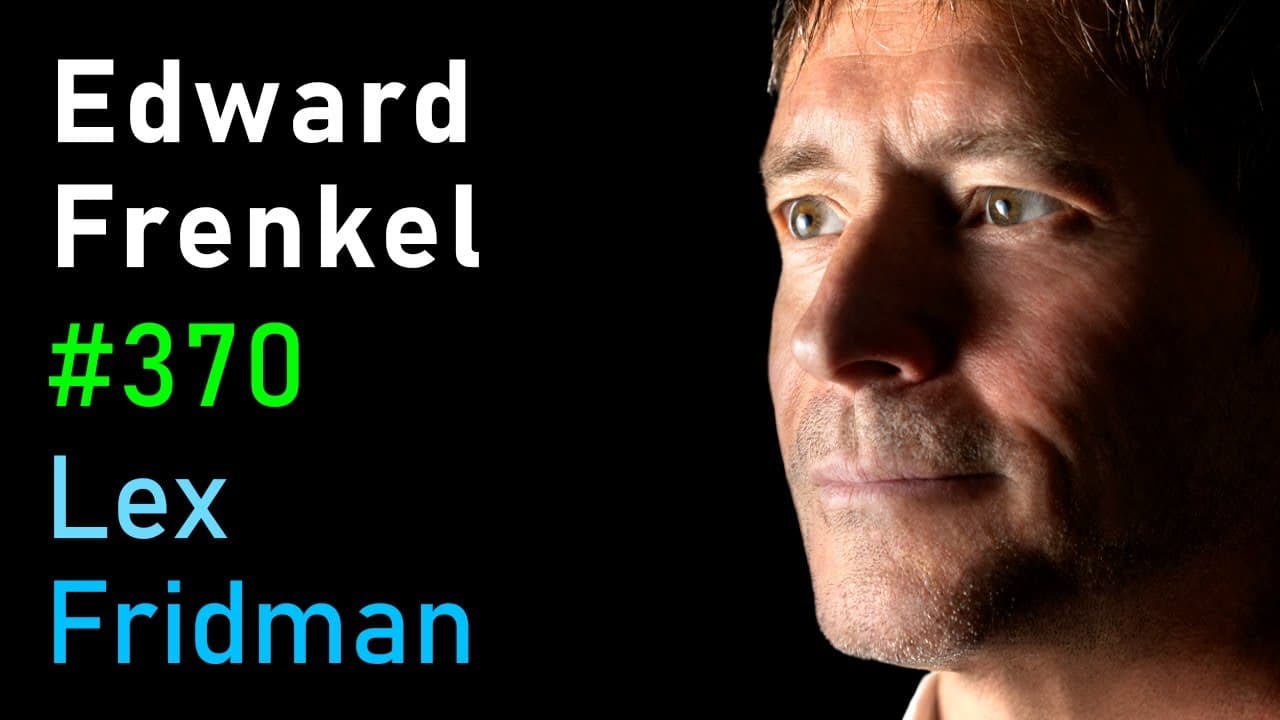
Edward Frenkel: Reality is a Paradox - Mathematics, Physics, Truth & Love | Lex Fridman Podcast #370
TL;DR
Mathematician Edward Frenkel discusses the paradoxical nature of mathematics and reality, exploring the ideas of creativity, imagination, and the limitations of knowledge. He calls for a deeper understanding of the subjective perspective and the importance of embracing mystery and paradox in our pursuit of knowledge.
Transcript
- There is a famous story about Einstein that he used to, you know, go, think, think, think, and then go for a walk. And like he would whistle sometimes. So I remember the first time I heard this story, I thought, hmm, how interesting. What coincidence that he, this came to him when he was whistling. But in fact it's not. This is how it works in so... Read More
Key Insights
- 🤔 The moment of discovery occurs when thinking stops, and one becomes deeply connected to the truth they seek.
- 😃 Creativity, imagination, and the joy of discovery play significant roles in the pursuit of knowledge.
- 🧡 Mathematics describes and underpins our understanding of the physical world, while exploring a broader range of mathematical possibilities.
- 🥺 Embracing mystery and paradox leads to new insights and a deeper understanding of reality.
- 🤪 Imagination and creativity are essential in the process of mathematical discovery, going beyond established knowledge.
- ❓ The limitations of our knowledge should be recognized, and the subjective perspective should be valued alongside objective observations.
- 🪛 There is an innate human drive to explore and understand the mysteries of the universe, including the role of consciousness and freewill.
Install to Summarize YouTube Videos and Get Transcripts
Explore YouTube Video Summarizer or Get YouTube Transcript Extractor
Questions & Answers
Q: How did Edward Frenkel's view of mathematics change over time?
Frenkel initially found mathematics boring and preferred physics. However, a chance encounter with a mathematician introduced him to the depth and beauty of mathematics, leading him to appreciate its connection to the fundamental structures of the universe.
Q: What is Frenkel's take on the role of imagination and creativity in mathematical discovery?
Frenkel believes that imagination and creativity are essential in the process of mathematical discovery. He emphasizes the joy of going deeper into the mysteries of the universe and the importance of thinking beyond established knowledge.
Q: Can mathematics be considered a self-imposed limitation?
Frenkel argues that mathematics can be seen as a self-imposed limitation when we rigidly adhere to established knowledge and fail to embrace the mystery and paradox inherent in the discipline. He advocates for a more open-minded approach to allow for new discoveries.
Q: How does Frenkel view the relationship between math and the physical world?
Frenkel sees mathematics as a language that underpins our understanding of the physical world. While physicists focus on describing this universe, mathematicians explore all possible mathematical universes, revealing connections and patterns.
Key Insights:
- The moment of discovery occurs when thinking stops, and one becomes deeply connected to the truth they seek.
- Creativity, imagination, and the joy of discovery play significant roles in the pursuit of knowledge.
- Mathematics describes and underpins our understanding of the physical world, while exploring a broader range of mathematical possibilities.
- Embracing mystery and paradox leads to new insights and a deeper understanding of reality.
- Imagination and creativity are essential in the process of mathematical discovery, going beyond established knowledge.
- The limitations of our knowledge should be recognized, and the subjective perspective should be valued alongside objective observations.
- There is an innate human drive to explore and understand the mysteries of the universe, including the role of consciousness and freewill.
- The human experience of the world involves paradoxes, and the acceptance of paradox is fundamental to understanding reality.
Summary
In this video, mathematician Edward Frenkel discusses various topics, including his journey into mathematics, the relationship between mathematics and physics, the nature of reality, and the limitations of artificial intelligence. He emphasizes the importance of preserving the childlike curiosity and wonder in scientific pursuits, and recognizes the significance of subjective experiences and perspectives in understanding the world. Frenkel challenges the notion that everything can be explained solely through computation, and highlights the value of paradoxes and ambiguity in deepening our understanding of reality.
Questions & Answers
Q: How did Frenkel become interested in mathematics?
Frenkel initially had a distaste for mathematics and was more interested in physics, especially quantum physics. However, a mathematician family friend introduced him to the mathematical explanations behind the theories he found fascinating, leading to his conversion and passion for mathematics.
Q: What is the difference between physics and mathematics?
Physicists focus on describing the universe, while mathematicians explore all possible mathematical universes. Although physics is rooted in mathematical theories, mathematicians are interested in studying diverse mathematical frameworks and concepts beyond what is observed in our universe.
Q: What is the significance of the observer in understanding reality?
Frenkel highlights how modern science has shown that observers play a crucial role in observations and measurements. He references examples from quantum mechanics, Gödel's incompleteness theorems, and Einstein's relativity theory to argue that subjective experiences and perspectives are intertwined with objective scientific endeavors.
Q: Can artificial intelligence capture the perspective and awe of a childlike mindset?
Frenkel challenges the notion that AI can replicate the genuine emotions and experiences of a child. He suggests that concepts such as inspiration and creativity cannot be reduced to computational algorithms, and that some aspects of human perception and understanding may not be encapsulated by AI frameworks.
Q: Is the universe purely explainable through mathematical computation?
Frenkel questions the tendency to explain the world solely through computation and mathematical frameworks. He argues that this approach may limit our understanding and fail to account for the mysteries and paradoxes that exist beyond our current knowledge.
Q: How does Frenkel view self-imposed limitations and the value of subjective experiences?
Frenkel encourages embracing paradoxes and ambiguity, noting that they can lead to a more sophisticated understanding of the world. He acknowledges the limitations of knowledge and the importance of recognizing subjective experiences in addition to objective observations.
Q: What does Frenkel gain from accepting mystery and complexity?
By embracing uncertainty and acknowledging the limitations of our knowledge, Frenkel gains a deeper appreciation for the beauty of paradoxes and the inherent complexity of the world. He recognizes the value of subjective perspectives and the capacity for genuine experiences beyond mere computational explanations.
Q: How does Frenkel address the role of the observer in scientific pursuits?
Frenkel emphasizes the significance of the observer's perspective and involvement in scientific observations. He challenges the notion that science can be detached from the observer, highlighting the implications of quantum mechanics and the subjective nature of measurements.
Q: How does Frenkel view the relationship between mathematics and physics?
Frenkel sees mathematics as the language that underpins physics. While physicists are primarily interested in describing the universe, mathematicians explore diverse mathematical theories and concepts, providing tools and a clear vision for understanding and appreciating the complexity of the physical world.
Q: What are the limitations of AI in capturing the intricacies of human experience?
Frenkel questions whether AI can fully capture the essence of human experience, including genuine emotions, inspiration, and creativity. He suggests that AI's ability to mimic human data does not equate to true understanding or the ability to explain the why behind subjective experiences and perspectives.
Takeaways
Frenkel's discussion highlights the importance of embracing mystery, complexity, and subjective experiences in scientific pursuits. He challenges the tendency to solely rely on computation and mathematical frameworks to explain the world, recognizing that there are aspects of human understanding that may go beyond objective observations. Frenkel encourages maintaining childlike curiosity and openness while navigating the intersection between mathematics, physics, and artificial intelligence.
Summary & Key Takeaways
-
Edward Frenkel grew up disliking mathematics but was fascinated by physics. Through a chance encounter with a mathematician, he discovered the beauty and depth of mathematics, delving into the fundamental structures of the universe.
-
He emphasizes the importance of creativity, imagination, and the joy of discovery in the pursuit of knowledge. Frenkel believes that the moment of discovery happens when thinking stops, and one becomes deeply connected to the truth they seek.
-
Frenkel argues that mathematics, as a language, underpins the understanding of the physical world. While physicists focus on describing and explaining our universe, mathematicians explore all possible mathematical universes.
-
He questions the idea that everything can be explained through computation and emphasizes the need to recognize the limitations of our knowledge. Frenkel suggests that there is more to life than what can be explained by current scientific theories and that embracing mystery and paradox can lead to new insights.
Read in Other Languages (beta)
Share This Summary 📚
Summarize YouTube Videos and Get Video Transcripts with 1-Click
Try YouTube Summary with ChatGPT & Claude or YouTube Transcript Generator
Explore More Summaries from Lex Fridman Podcast 📚



Summarize YouTube Videos and Get Video Transcripts with 1-Click
Try YouTube Summary with ChatGPT & Claude or YouTube Transcript Generator