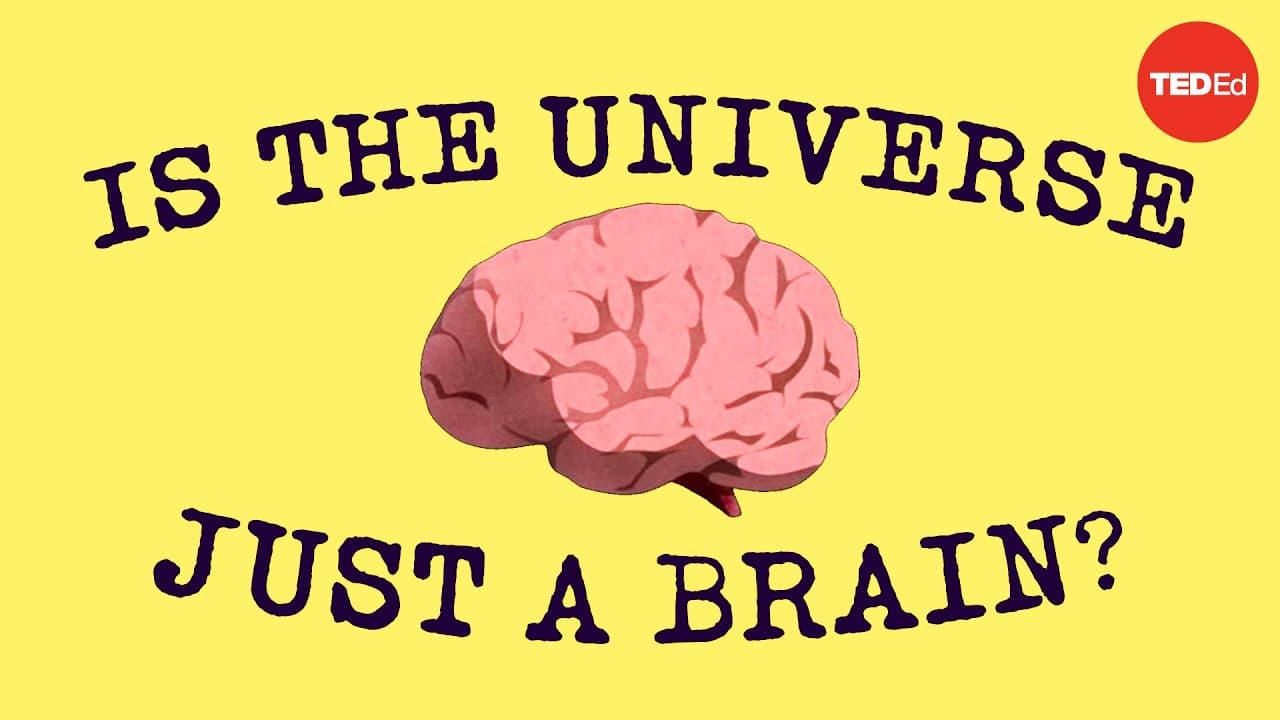
The Boltzmann brain paradox - Fabio Pacucci
TL;DR
The Boltzmann Brain Paradox questions whether our reality is just a result of random fluctuations and fake memories in an infinitely old universe, leading cosmologists to explore the origins of the Big Bang.
Transcript
How do you know you’re a person who has lived your life, rather than a just-formed brain full of artificial memories, momentarily hallucinating a reality that doesn't actually exist? That may sound absurd, but it’s kept several generations of top cosmologists up at night. They call it the Boltzmann brain paradox. Its namesake, Ludwig Boltzmann, w... Read More
Key Insights
- ❓ Ludwig Boltzmann's interpretation of entropy revolutionized thermodynamics and provided a foundation for understanding the disorder of systems.
- 🥶 In an infinitely old universe, incredibly unlikely events would occur, including the formation of complex structures or brains.
- 😌 The resolution to the Boltzmann Brain Paradox lies in the Big Bang theory, proposing that our universe began with an ordered and improbable state.
- ❓ Contemporary cosmologists are still exploring the origins of the universe, and the implications of the Boltzmann Brain Paradox have renewed interest in these studies.
- 🧠 Some argue that current cosmological models still suggest a higher likelihood of Boltzmann brains than human brains, indicating potential flaws in our understanding.
- 😘 Attempts to calculate the probability of a brain forming from random quantum fluctuations yielded incredibly low numbers, further questioning the likelihood of the paradox.
- 🛟 The Boltzmann Brain Paradox serves as a crucial benchmark for cosmological models, helping identify potential inaccuracies.
Install to Summarize YouTube Videos and Get Transcripts
Explore YouTube Video Summarizer or Get YouTube Transcript Extractor
Questions & Answers
Q: What is the Boltzmann Brain Paradox?
The Boltzmann Brain Paradox raises the question of whether our perception of reality is an illusion generated by a randomly formed brain full of false memories in an infinitely old universe.
Q: How did Ludwig Boltzmann contribute to the understanding of entropy?
Ludwig Boltzmann introduced statistical reasoning to explain why systems tend towards disorder, demonstrating that the evolution towards a more disordered state is more likely in closed systems.
Q: Why is the formation of a brain more likely than the creation of an entire universe?
Due to the complexity of a brain compared to the vast number of insta-brains possible, the probability of a brain forming through random fluctuations is significantly higher than the spontaneous creation of an entire universe.
Q: How does the Big Bang theory relate to the Boltzmann Brain Paradox?
The resolution to the paradox lies in the Big Bang theory, which suggests that our universe began with a singular event, contradicting the notion of an infinitely old universe.
Key Insights:
- Ludwig Boltzmann's interpretation of entropy revolutionized thermodynamics and provided a foundation for understanding the disorder of systems.
- In an infinitely old universe, incredibly unlikely events would occur, including the formation of complex structures or brains.
- The resolution to the Boltzmann Brain Paradox lies in the Big Bang theory, proposing that our universe began with an ordered and improbable state.
- Contemporary cosmologists are still exploring the origins of the universe, and the implications of the Boltzmann Brain Paradox have renewed interest in these studies.
- Some argue that current cosmological models still suggest a higher likelihood of Boltzmann brains than human brains, indicating potential flaws in our understanding.
- Attempts to calculate the probability of a brain forming from random quantum fluctuations yielded incredibly low numbers, further questioning the likelihood of the paradox.
- The Boltzmann Brain Paradox serves as a crucial benchmark for cosmological models, helping identify potential inaccuracies.
- The exploration of the origins of the universe and the resolution of the paradox continue to be a topic of study and debate among cosmologists.
Summary & Key Takeaways
-
Ludwig Boltzmann's insight into entropy and statistical reasoning revolutionized thermodynamics, explaining why closed systems tend towards disorder.
-
In an infinitely old universe, extremely unlikely events, like the formation of complex structures or brains, would eventually occur.
-
The resolution to the Boltzmann Brain Paradox is the Big Bang theory, suggesting that our universe began with a singular event rather than existing forever.
Read in Other Languages (beta)
Share This Summary 📚
Summarize YouTube Videos and Get Video Transcripts with 1-Click
Try YouTube Summary with ChatGPT & Claude or YouTube Transcript Generator
Explore More Summaries from TED-Ed 📚


Summarize YouTube Videos and Get Video Transcripts with 1-Click
Try YouTube Summary with ChatGPT & Claude or YouTube Transcript Generator