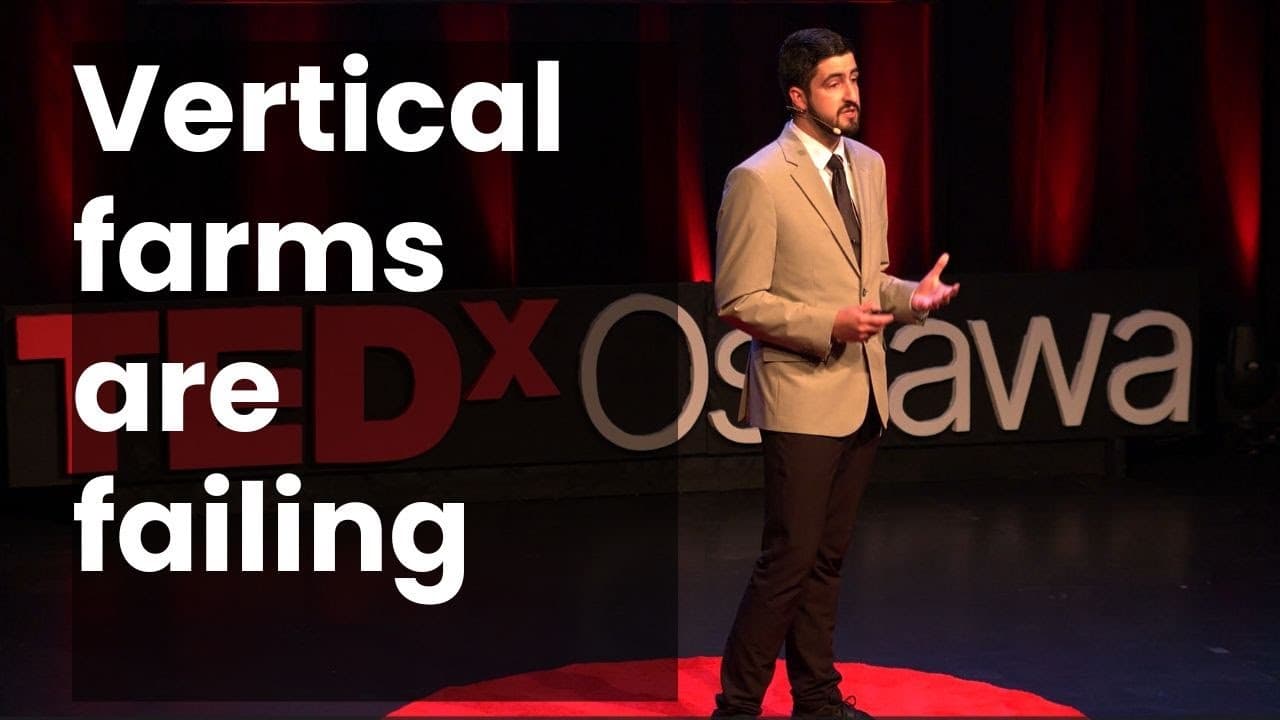
Vertical farms are failing - what we can learn from their mistakes | Nicholas Varas | TEDxOshawa
TL;DR
Vertical farming promises sustainable agriculture through innovative crop-growing techniques in controlled environments but faces profitability challenges due to high energy costs.
Transcript
[Applause] when I was a child farming or back in the early 2000s farming was a relatively simple Affair tractors plowed the field seeds were swn by hand or with simple machines and crops were harvested with sweat and hard work but As I Grew Older I saw the landscape of farming change machines became much more prevalent each one designed to make the... Read More
Key Insights
- 😋 Traditional farming faces challenges from climate change, population growth, and food security concerns.
- ✋ Vertical farming offers sustainable benefits but struggles with profitability due to high energy and labor costs.
- 🚦 Companies must focus on profitability, optimize operations, and invest in innovation and education for the future of vertical farming.
- 👨🔬 Collaborative efforts with government agencies, research institutions, and growers are vital for sustainable and profitable vertical farming solutions.
Install to Summarize YouTube Videos and Get Transcripts
Explore YouTube Video Summarizer or Get YouTube Transcript Extractor
Questions & Answers
Q: What is vertical farming and how does it differ from traditional farming?
Vertical farming involves growing crops in stacked layers in controlled environments, using less water and no pesticides, unlike traditional farming methods.
Q: What are the profitability challenges faced by vertical farming companies?
Vertical farming companies struggle with high energy costs, labor expenses, and the inability to command premium prices for crops, leading to financial difficulties.
Q: How can vertical farming companies overcome their profitability challenges?
By focusing on profitability, optimizing operations, diversifying crop selection, and embracing the principles of the green loop - innovation, collaboration, and education.
Q: What lessons can be learned from the failures of large-scale vertical farming companies?
Companies should prioritize profitability over rapid expansion, adapt technologies to reduce energy costs, collaborate with various stakeholders, and invest in educating the next generation of farmers.
Summary & Key Takeaways
-
Traditional farming methods faced challenges due to climate change, population growth, and food security concerns.
-
Vertical farming emerged as a sustainable solution with increased crop yields, reduced water usage, and pesticide-free production.
-
Profitability issues plague vertical farming companies due to high energy costs, labor expenses, and the inability to command premium crop prices.
Read in Other Languages (beta)
Share This Summary 📚
Summarize YouTube Videos and Get Video Transcripts with 1-Click
Try YouTube Summary with ChatGPT & Claude or YouTube Transcript Generator
Explore More Summaries from TEDx Talks 📚






Summarize YouTube Videos and Get Video Transcripts with 1-Click
Try YouTube Summary with ChatGPT & Claude or YouTube Transcript Generator