Buddhism: context and comparison | World History | Khan Academy
TL;DR
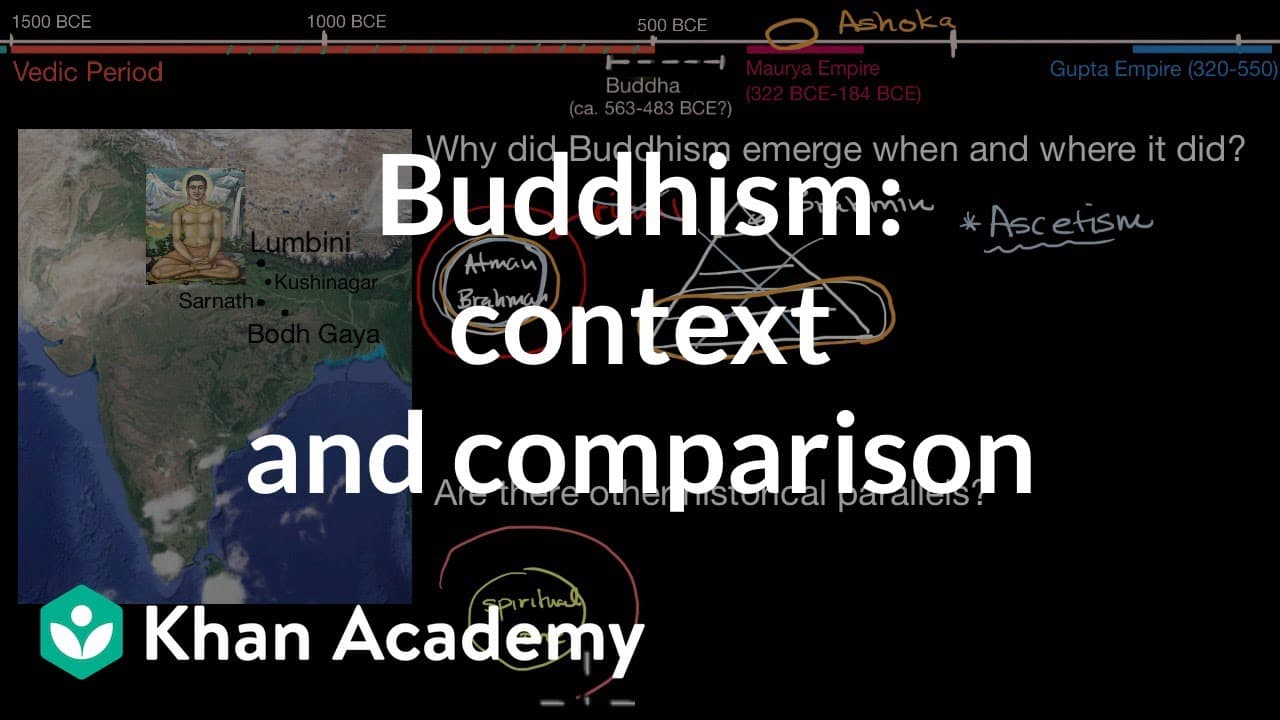
Buddhism emerged as a reformation of Hinduism in response to the ritualistic and stratified society of the time, offering a personal path to enlightenment and attracting marginalized individuals. Historical parallels, such as the rise of Christianity and the Protestant Reformation, suggest similar patterns of reform and the role of powerful rulers in spreading religious movements.
Transcript
- [Lecturer] We've already had many videos on Buddhism and its connections to Hinduism but what we want to do in this video is more explicitly answer an important question. Why did Buddhism emerge when and where it did? And this is a question that you should always be asking yourself as you study history. Why did something emerge, why did something... Read More
Key Insights
- 🚨 Buddhism emerged as a reformation of Hinduism, driven by dissatisfaction with the ritualistic and stratified society at the time.
- 🏛️ Buddha's privileged background and exposure to the suffering of marginalized individuals influenced his rejection of the ruling class's practices and pursuit of a personal path to enlightenment.
- 🎟️ The support of Emperor Ashoka and the spread of Buddhism through missions contributed to its establishment as a major religion.
- 😮 Historical parallels, such as the rise of Christianity and the Protestant Reformation, reveal recurring patterns of religious reform and the role of influential figures in spreading religious movements.
Install to Summarize YouTube Videos and Get Transcripts
Explore YouTube Video Summarizer or Get YouTube Transcript Extractor
Questions & Answers
Q: Why did Buddhism emerge when and where it did?
Buddhism emerged in response to the ritualistic and stratified society of Hinduism at the time, offering an alternative personal path to enlightenment that attracted the marginalized individuals.
Q: What role did the emperor Ashoka play in the spread of Buddhism?
Emperor Ashoka converted to Buddhism and became a major patron, sending missionaries throughout the world to spread the religion, which contributed to its significant expansion.
Q: Are there any parallels between the emergence of Buddhism and other religious movements?
Yes, there are parallels, such as the emergence of Jesus of Nazareth, who also sought to reform the ritualistic practices of Judaism and attract marginalized individuals. Both Buddha and Jesus saw the need to focus on the spiritual core and broke away from the ruling priesthood.
Q: How did societal stratification impact the emergence of Buddhism?
The caste system and a hierarchy within the ruling class led to the marginalization of certain groups. This, along with the rejection of the ruling class's focus on ritual, made Buddhism's emphasis on personal enlightenment and rejection of societal hierarchy appealing to many.
Summary & Key Takeaways
-
Buddhism emerged in northeast India at the end of the Vedic period, during a time when Hinduism was focused on rituals and stratification.
-
Buddha, coming from a ruling class but still marginalized in the caste system, sought answers to the suffering he witnessed and rejected the ritualistic approach of the ruling class.
-
Buddhism offered a personal path to enlightenment and became a major religion with the support of Emperor Ashoka and the spread of missions.
Read in Other Languages (beta)
Share This Summary 📚
Summarize YouTube Videos and Get Video Transcripts with 1-Click
Try YouTube Summary with ChatGPT & Claude or YouTube Transcript Generator
Explore More Summaries from Khan Academy 📚



Summarize YouTube Videos and Get Video Transcripts with 1-Click
Try YouTube Summary with ChatGPT & Claude or YouTube Transcript Generator