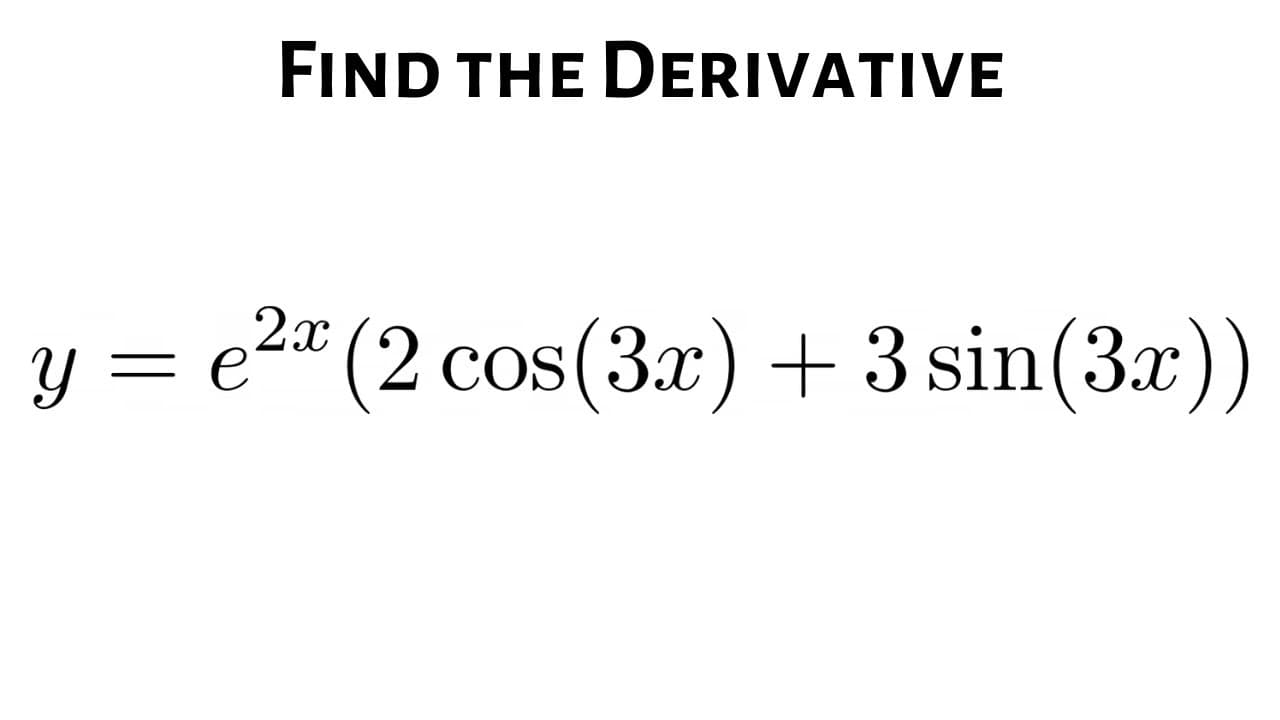
Learn How to Use the Product Rule from Calculus to Find the Derivative of y
TL;DR
Finding the derivative of a product using the product rule explained step by step.
Transcript
in this problem we're going to find dydx which is the derivative of this so we have a product we have e to the 2x times all of this stuff so we have two ways to do it we can just differentiate right away using the product rule we can distribute and use the product rule twice let's go ahead and just differentiate right away before we do let me refre... Read More
Key Insights
- 📏 Understanding the product rule in calculus is crucial for solving derivative problems involving products.
- 📏 The chain rule is essential when differentiating exponential functions like e^(2x).
- 📏 Applying the product rule involves differentiating each part of the product and combining the results to find the final derivative.
Install to Summarize YouTube Videos and Get Transcripts
Explore YouTube Video Summarizer or Get YouTube Transcript Extractor
Questions & Answers
Q: What is the product rule in calculus?
The product rule in calculus states that when differentiating the product of two functions, one must differentiate the first function, multiply it with the second function, and then add the product of the first function and the derivative of the second function.
Q: How do you differentiate e^(2x) using the chain rule?
To differentiate e^(2x) using the chain rule, remember that the derivative of e^x is e^x. So, for e^(2x), the result would be e^(2x) times the derivative of the inside function (2), giving 2e^(2x).
Q: How do you differentiate cos(3x)?
The derivative of cos(3x) is -3sin(3x) using the chain rule, where the derivative of the outer function, cos(x), is -sin(x), and the derivative of the inside function (3x) is 3.
Q: How do you simplify the final expression after applying the product rule?
To simplify the final expression after applying the product rule, combine like terms. In this case, combining 4e^(2x)cos(3x) and 9e^(2x)cos(3x) gives 13e^(2x)cos(3x) as the final answer.
Summary & Key Takeaways
-
The problem involves finding dy/dx by differentiating a product using the product rule.
-
The product rule states to differentiate the first function, multiply it with the second, and add the product of the first and second function's derivatives.
-
After applying the product rule and simplifying, the final answer for dy/dx is 13e^2x*cos(3x).
Read in Other Languages (beta)
Share This Summary 📚
Summarize YouTube Videos and Get Video Transcripts with 1-Click
Try YouTube Summary with ChatGPT & Claude or YouTube Transcript Generator
Explore More Summaries from The Math Sorcerer 📚



Summarize YouTube Videos and Get Video Transcripts with 1-Click
Try YouTube Summary with ChatGPT & Claude or YouTube Transcript Generator