How Can AI Transform Healthcare Responsibly?
TL;DR
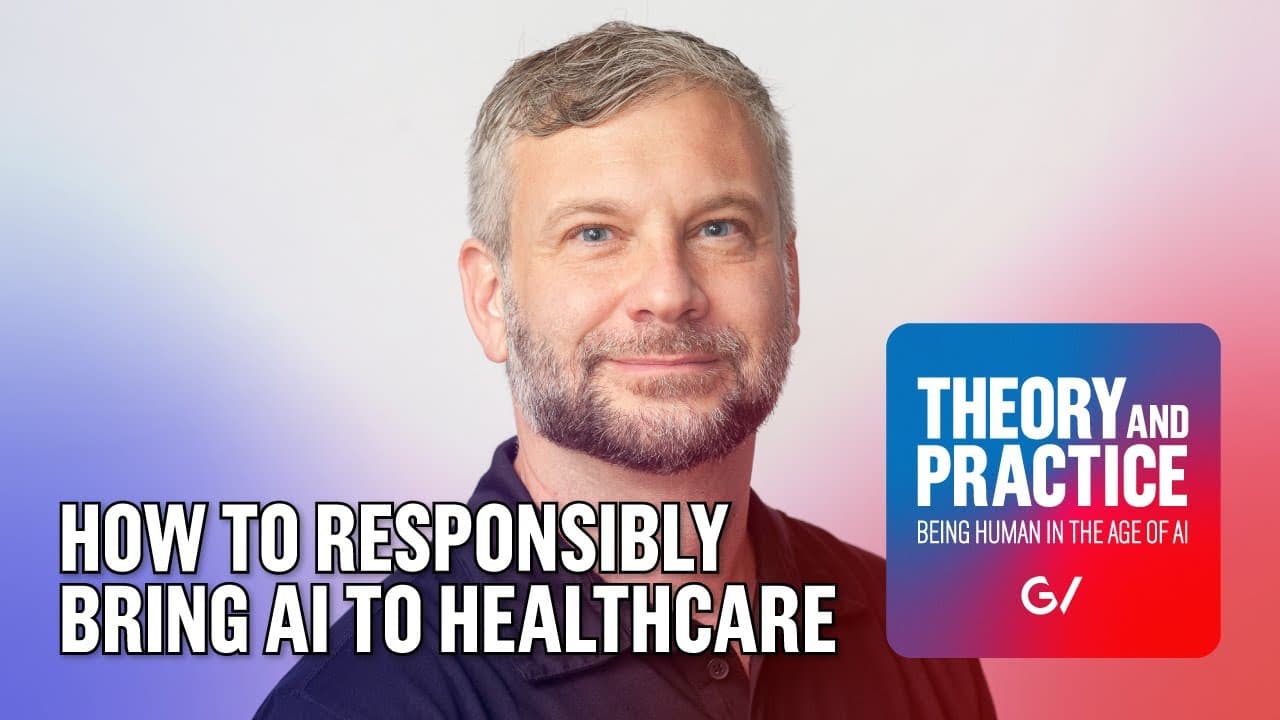
AI's rapid evolution is reshaping healthcare by introducing human-like capabilities in communication, vision, and decision-making. This series will explore AI's implications for human interaction in healthcare, focusing on bias, transparency, and ethical concerns while aiming for personalized and equitable care solutions.
Transcript
welcome to GB theory and practice series 4. I'm Anthony philipakis and I'm Alex walshko I'm incredibly excited to start off series four you know my friend I'm so excited to be doing this with you and I have to say this feels like a really special moment in time we're Midway through 2023 earlier this year the world was taken by storm with the rise o... Read More
Key Insights
- 🎰 The rapid development of AI is giving machines human-like capabilities, challenging our understanding of human existence.
- 🏑 Healthcare is one field where AI is transforming communication, vision, and decision-making processes.
- ❓ Bias in AI systems can result from biased training data, requiring careful evaluation and expansion to ensure fairness.
- 🏛️ Transparency and explainability are essential in building trust and understanding between humans and AI.
- 🪡 Ethical concerns related to privacy and autonomy need to be addressed when deploying AI in healthcare.
- 🥹 The future of AI in healthcare holds promises of more personalized care and equitable distribution of healthcare services.
- 🐎 The speed and responsible implementation of AI in healthcare should be carefully managed to avoid overselling and unrealistic expectations.
Install to Summarize YouTube Videos and Get Transcripts
Explore YouTube Video Summarizer or Get YouTube Transcript Extractor
Questions & Answers
Q: How is artificial intelligence advancing in the field of healthcare?
AI is being used in healthcare to detect diseases, manage risk, answer patient queries, and even determine gestational age. These applications showcase the potential of AI in assisting and extending human care.
Q: How does bias affect AI systems in healthcare?
Bias can be introduced into AI systems through the data they are trained on, leading to biased outputs and unequal representation. Mitigating bias requires evaluating training data, expanding datasets, and measuring biases in specific applications.
Q: What role does transparency and explainability play in AI systems?
Transparency allows users to understand how AI systems were built, their intended functionality, and performance metrics. Explainability refers to understanding the decision-making process of AI systems at an individual case level. Both are essential for building trust and collaboration between humans and AI.
Q: What ethical concerns arise from the introduction of AI in healthcare?
Privacy and autonomy are key ethical principles when deploying AI systems. Balancing privacy and utility becomes crucial, as well as ensuring individual choice in determining privacy levels. Issues such as data storage, access, and consent should be addressed to uphold privacy and autonomy.
Summary & Key Takeaways
-
The rise of artificial intelligence and its human-like capabilities is transforming various fields, including healthcare.
-
This series will explore the impact of AI on human existence, focusing on communication, vision, and decision-making.
-
It will delve into questions such as how AI replicates human functions, enhances human capabilities, and changes our understanding of ourselves.
Read in Other Languages (beta)
Share This Summary 📚
Summarize YouTube Videos and Get Video Transcripts with 1-Click
Try YouTube Summary with ChatGPT & Claude or YouTube Transcript Generator
Explore More Summaries from GV (Google Ventures) 📚






Summarize YouTube Videos and Get Video Transcripts with 1-Click
Try YouTube Summary with ChatGPT & Claude or YouTube Transcript Generator