Stanford CS224W: Machine Learning with Graphs | 2021 | Lecture 14.1 - Generative Models for Graphs
TL;DR
Graph generative models are used to generate synthetic graphs that closely resemble real-world networks, providing insights into network formation, prediction, and anomaly detection.
Transcript
um so for today's class what we are going to talk about is uh generative models for graphs right so far we were working under assumption or we talked about methods where a given where we said a graph is given and we want to do some modeling learning prediction community detection on top of it what we are going to look at for the next two lectures i... Read More
Key Insights
- 👻 Generative models for graphs allow researchers to generate synthetic networks that closely resemble real-world networks.
- 💁 Measuring properties such as degree distribution, clustering coefficient, connectivity, and shortest path lengths provides valuable insights into network formation and behavior.
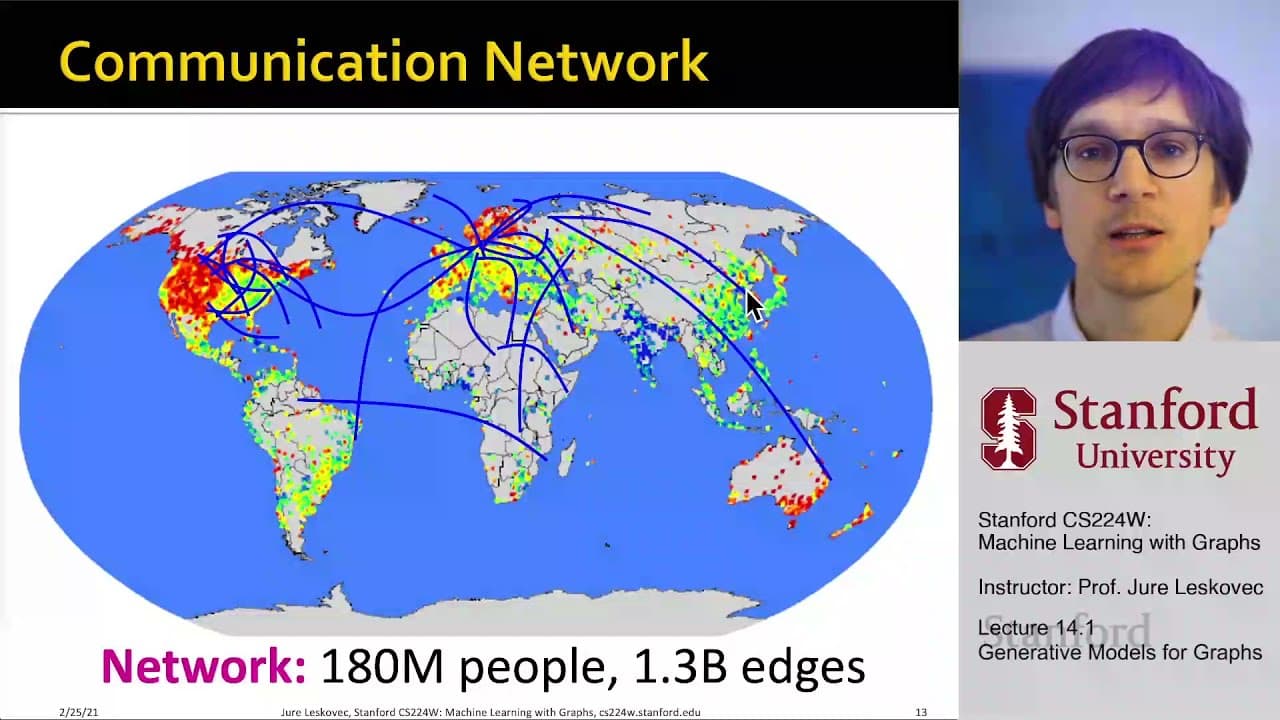
- 👤 The Microsoft Instant Messenger network, with 180 million users and 1.3 billion edges, demonstrates the use of these metrics to characterize a real communication network.
- 😘 Degree distribution often follows a power-law distribution, indicating a few highly connected nodes and a majority of nodes with low degrees.
- ✋ High clustering coefficient in social networks is a result of the triadic closure phenomenon.
- ❓ Connectivity analysis reveals a well-connected network with a dominant giant component.
- 🍰 The small-world phenomena is observed in the network, with short average shortest path lengths indicating high network efficiency.
Install to Summarize YouTube Videos and Get Transcripts
Explore YouTube Video Summarizer or Get YouTube Transcript Extractor
Questions & Answers
Q: Why is it important to generate synthetic graphs that resemble real-world networks?
Generating synthetic graphs provides insights into the processes behind real network formation, allows for future network evolution predictions, and serves as a benchmark for anomaly detection algorithms.
Q: What are the main properties used to characterize networks?
The main properties include degree distribution (probability distribution of node degrees), clustering coefficient (measure of how connected a node's neighbors are), connectivity (size of the largest connected component), and shortest path lengths (measure of how many steps it takes to reach one node from another).
Q: How can degree distribution be measured in a network?
Degree distribution can be measured by calculating the probability that a randomly chosen node has a given degree. This can be represented as a histogram or as a plot of degree versus fraction of nodes with that degree.
Q: What is the significance of the clustering coefficient in social networks?
A high clustering coefficient indicates a greater likelihood of triadic closure, meaning that friends of a friend are more likely to be friends as well. This phenomenon is prevalent in social networks and contributes to their high clustering coefficients.
Q: How can connectivity be measured in a network?
Connectivity is measured by determining the size of the largest connected component in a graph. This gives an indication of the level of connectedness in the network, with a larger connected component implying stronger connectivity.
Q: What does the average shortest path length represent in a network?
The average shortest path length measures, on average, how many steps it takes to travel from one node to another in a network. A low average shortest path length indicates a highly connected network.
Summary & Key Takeaways
-
The video discusses the concept of generative models for graphs, focusing on the process of generating synthetic social, economic, and communication networks.
-
The goal is to create realistic graphs that match real-world networks to gain insights into network formation, predict network evolution, and detect anomalies.
-
The content covers important network properties such as degree distribution, clustering coefficient, connectivity, and shortest path lengths, which can be measured to characterize networks.
-
Using the data from Microsoft Instant Messenger, the video demonstrates how to measure and analyze these properties in a real-world communication network.
Read in Other Languages (beta)
Share This Summary 📚
Summarize YouTube Videos and Get Video Transcripts with 1-Click
Try YouTube Summary with ChatGPT & Claude or YouTube Transcript Generator
Explore More Summaries from Stanford Online 📚

Summarize YouTube Videos and Get Video Transcripts with 1-Click
Try YouTube Summary with ChatGPT & Claude or YouTube Transcript Generator