Mendelian inheritance and Punnett squares | High school biology | Khan Academy
TL;DR
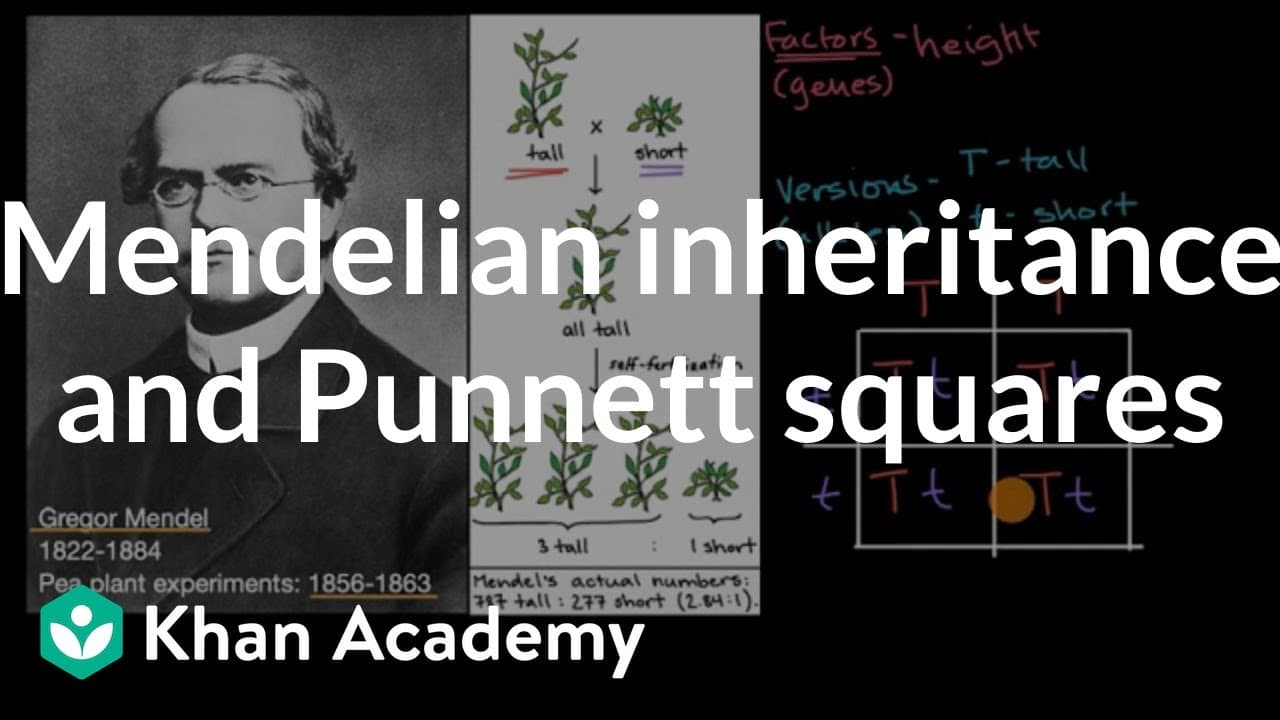
Gregor Mendel's experiments with pea plants revealed the principles of inheritance, disproving the mainstream blending theory and introducing the concepts of dominant and recessive traits.
Transcript
- [Narrator] This is a photo of Gregor Mendel, who is often known as the father of genetics. And we'll see in a few seconds why, and he was an Abbot of a monastery in Moravia, which is in modern day Czech Republic. And many people had bred plants for agricultural purposes for hundreds, if not thousands of years before Mendel, but he really gave us ... Read More
Key Insights
- 🙊 Gregor Mendel's experiments with pea plants from 1856 to 1863 revolutionized our understanding of inheritance.
- ❓ Mendel's observations challenged the mainstream blending theory and introduced the concepts of dominant and recessive traits.
- 🥺 His discoveries laid the foundation for modern genetics and led to the development of Punnett squares to understand the probabilities of offspring traits.
Install to Summarize YouTube Videos and Get Transcripts
Explore YouTube Video Summarizer or Get YouTube Transcript Extractor
Questions & Answers
Q: How did Mendel's experiments with pea plants challenge the mainstream blending theory of inheritance?
Mendel's experiments showed that blending did not occur when tall and short plants were bred together. This contradicted the belief that offspring traits were a blend of the traits of their parents.
Q: What did Mendel observe when he self-fertilized the plants?
By self-fertilizing the plants, Mendel noticed a ratio of approximately three tall plants to one short plant in the second generation. This suggested that traits could reappear and were not simply lost in the first generation.
Q: What did Mendel hypothesize about the inheritable factors responsible for traits?
Mendel hypothesized that specific inheritable factors, which he called genes, controlled traits. He also proposed that these factors could have different versions, known as alleles.
Q: How did Mendel explain the dominance of certain traits?
According to Mendel's hypothesis, certain versions of genes were dominant over others. Even if an organism had one dominant and one recessive allele, it would exhibit the dominant trait.
Summary & Key Takeaways
-
Gregor Mendel conducted pea plant experiments from 1856 to 1863, breeding 28,000 plants to study the inheritance of different traits.
-
He discovered that when tall parent plants were bred with short parent plants, all the offspring were tall, but in the second generation, a ratio of three to one for tall to short plants appeared.
-
Mendel hypothesized that inheritable factors, which we now call genes, controlled specific traits and came in different versions, known as alleles.
Read in Other Languages (beta)
Share This Summary 📚
Summarize YouTube Videos and Get Video Transcripts with 1-Click
Try YouTube Summary with ChatGPT & Claude or YouTube Transcript Generator
Explore More Summaries from Khan Academy 📚



Summarize YouTube Videos and Get Video Transcripts with 1-Click
Try YouTube Summary with ChatGPT & Claude or YouTube Transcript Generator