GMAT: Math 34 | Problem solving | GMAT | Khan Academy
TL;DR
This content discusses probability questions, finding the number of students in a math course, determining which values increase, and finding the greatest distance between points on a rectangular box.
Transcript
We're on problem 173. The probability is 1/2 that a certain coin will turn up heads on any given toss. Fair enough. If the coin is to be tossed three times, what is the probability that on at least one of the tosses the coin will turn up tails? So probability, at least one tails. That might seem really hard for you. How do I know which tails it is ... Read More
Key Insights
- ⁉️ Probability questions can often be solved by considering the opposite scenario.
- 🆘 Understanding fractions and using common denominators can help solve problems involving percentages or proportions.
- 😑 The behavior of mathematical expressions can be analyzed to determine whether the values increase or decrease.
Install to Summarize YouTube Videos and Get Transcripts
Explore YouTube Video Summarizer or Get YouTube Transcript Extractor
Questions & Answers
Q: How do you calculate the probability of at least one tails in three coin tosses?
The probability of at least one tails can be found by subtracting the probability of all heads (1/8) from 1, resulting in 7/8.
Q: How can you determine the number of students in a math course from grade fractions?
By adding the fractions for A, B, and C grades (19/20) and equating it to the remaining fraction for D grades (1/20). Solving for 1/20 equaling 10 grades gives the total number of students as 200.
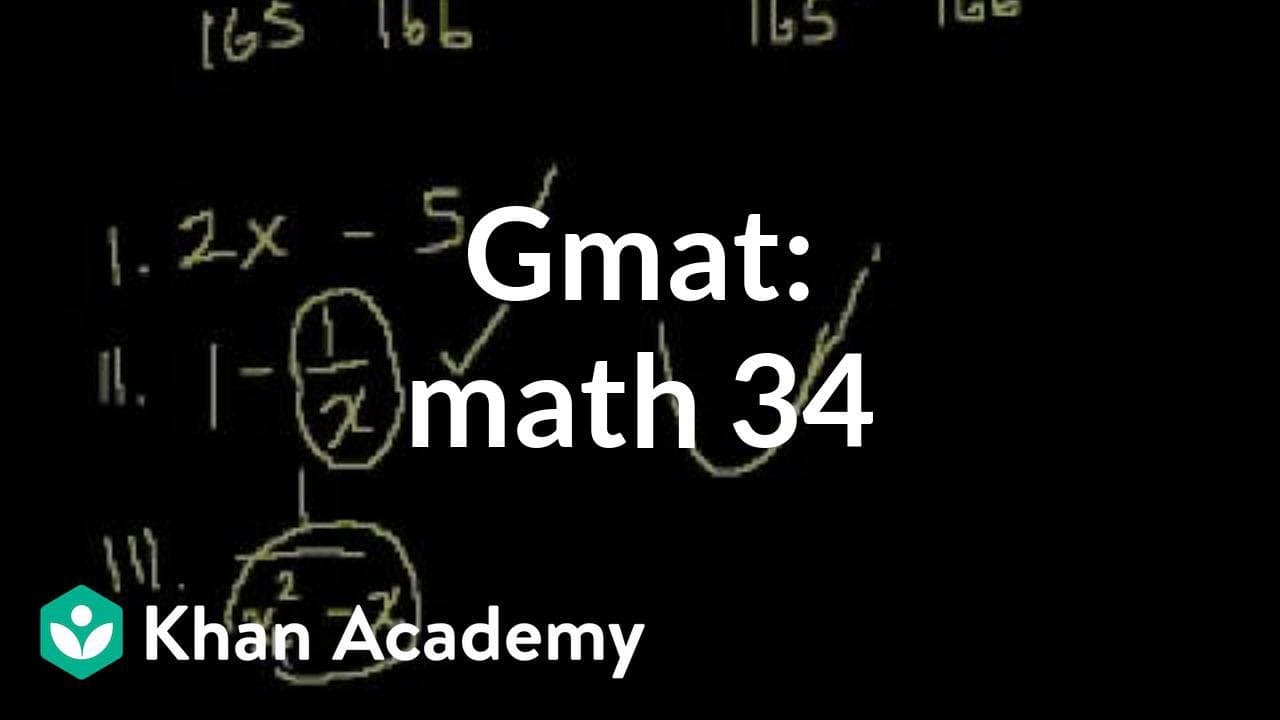
Q: Which values increase as x moves from 165 to 166?
Both 2x-5 and 1-1/x increase as x increases from 165 to 166. However, x^2-x does not increase.
Q: What is the greatest possible distance between two points on a rectangular box with dimensions 10x10x5 inches?
The greatest possible distance is determined by finding the three-dimensional diagonal, which can be calculated using the Pythagorean theorem. The distance is equal to the square root of (10^2 + 10^2 + 5^2), resulting in 15 inches.
Summary & Key Takeaways
-
The probability of getting at least one tails in three coin tosses is 7/8.
-
The number of students in a math course with different grade fractions is 200.
-
As x increases from 165 to 166, the values of 2x-5, 1-1/x, and x^2-x all increase.
-
The greatest possible distance between two points on a rectangular box with dimensions 10x10x5 inches is 15 inches.
Read in Other Languages (beta)
Share This Summary 📚
Summarize YouTube Videos and Get Video Transcripts with 1-Click
Try YouTube Summary with ChatGPT & Claude or YouTube Transcript Generator
Explore More Summaries from Khan Academy 📚



Summarize YouTube Videos and Get Video Transcripts with 1-Click
Try YouTube Summary with ChatGPT & Claude or YouTube Transcript Generator