Organelle overview
TL;DR
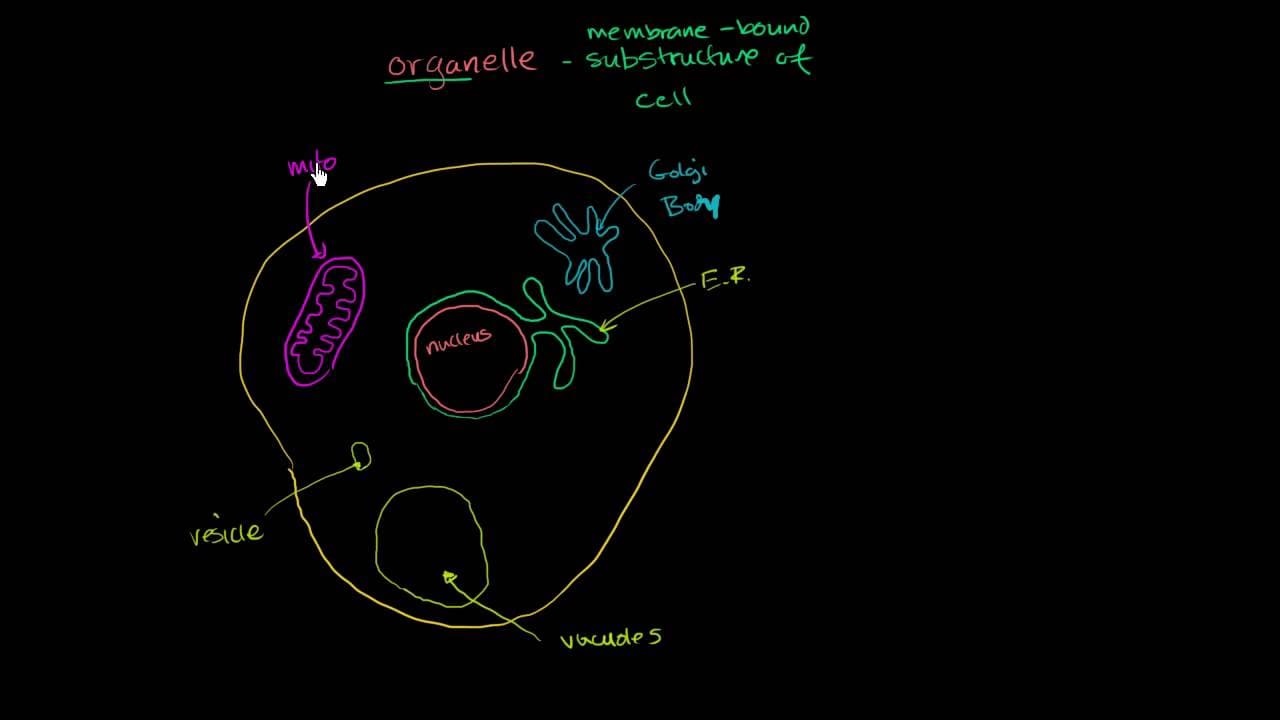
Organelles are substructures in a cell that are comparable to organs in a human body and can be membrane-bound structures or have their own DNA.
Transcript
What I want to do in this video is talk a little bit more about the concept of an organelle. And as you can see it contains the word organ, and that's because the idea of an organelle is related to the idea of an organ. If you're talking about a human being, if you're talking about me, I have a liver. A liver is an organ. I have lungs. I have a hea... Read More
Key Insights
- ❓ Organelles in a cell are comparable to organs in a human body, with specific functions and structures.
- ❓ Membrane-bound organelles include the nucleus, endoplasmic reticulum, Golgi bodies, vesicles, and vacuoles.
- 🧬 Mitochondria and plastids are examples of organelles with their own DNA, believed to have originated from independent prokaryotes.
- 🖐️ Organelles like mitochondria and plastids play crucial roles in energy production and photosynthesis.
- 🧬 The collaboration of independent prokaryotes within a membrane-bound structure is believed to be the origin of organelles with their own DNA.
Install to Summarize YouTube Videos and Get Transcripts
Explore YouTube Video Summarizer or Get YouTube Transcript Extractor
Questions & Answers
Q: What is the relationship between organelles and organs?
Organelles are like substructures in a cell, just as organs are substructures in a human body. They perform specific functions within the cell, similar to how organs perform specific functions in the body.
Q: What are some examples of membrane-bound organelles?
The nucleus, endoplasmic reticulum, Golgi bodies, and vesicles are all examples of membrane-bound organelles. They are enclosed by a membrane that separates their internal components from the rest of the cell.
Q: How do mitochondria contribute to cellular energy production?
Mitochondria are organelles that have their own DNA and are responsible for producing energy in the form of ATP. They convert sugars into ATP, which is a more usable form of chemical energy within the cell.
Q: What role do plastids play in plants?
Plastids are organelles found in plants, and the most well-known type is chloroplasts. Chloroplasts are responsible for photosynthesis, converting light energy into chemical energy in the form of sugars.
Summary & Key Takeaways
-
Organelles are substructures of a cell, similar to how organs are substructures of a human body.
-
They can be membrane-bound structures such as the nucleus, endoplasmic reticulum, Golgi bodies, and vesicles.
-
Some organelles, like mitochondria and plastids, also have their own DNA and play specific roles in energy production and photosynthesis.
Read in Other Languages (beta)
Share This Summary 📚
Summarize YouTube Videos and Get Video Transcripts with 1-Click
Try YouTube Summary with ChatGPT & Claude or YouTube Transcript Generator
Explore More Summaries from Khan Academy 📚



Summarize YouTube Videos and Get Video Transcripts with 1-Click
Try YouTube Summary with ChatGPT & Claude or YouTube Transcript Generator