What Is the Static Keyword in Java and Its Uses?
TL;DR
The static keyword in Java is a non-access modifier that allows variables, methods, blocks, and nested classes to be shared among all instances of a class. It enables the creation of global variables that can be accessed using the class name and eliminates the need for instance creation to call static methods. Static blocks are executed before the main method, making them useful for initializations.
Transcript
hello everyone and welcome to the next session of alsa in this we are going to discuss about a very important keyword that is static so let's get started first of all let's understand what is a static keyboard now when I say what is a static Kaval in short it is a keyboard so it has got a specific meaning in Java programming language so what is thi... Read More
Key Insights
- 🏛️ The static keyword is used in Java to create class-level data members that can be shared among instances.
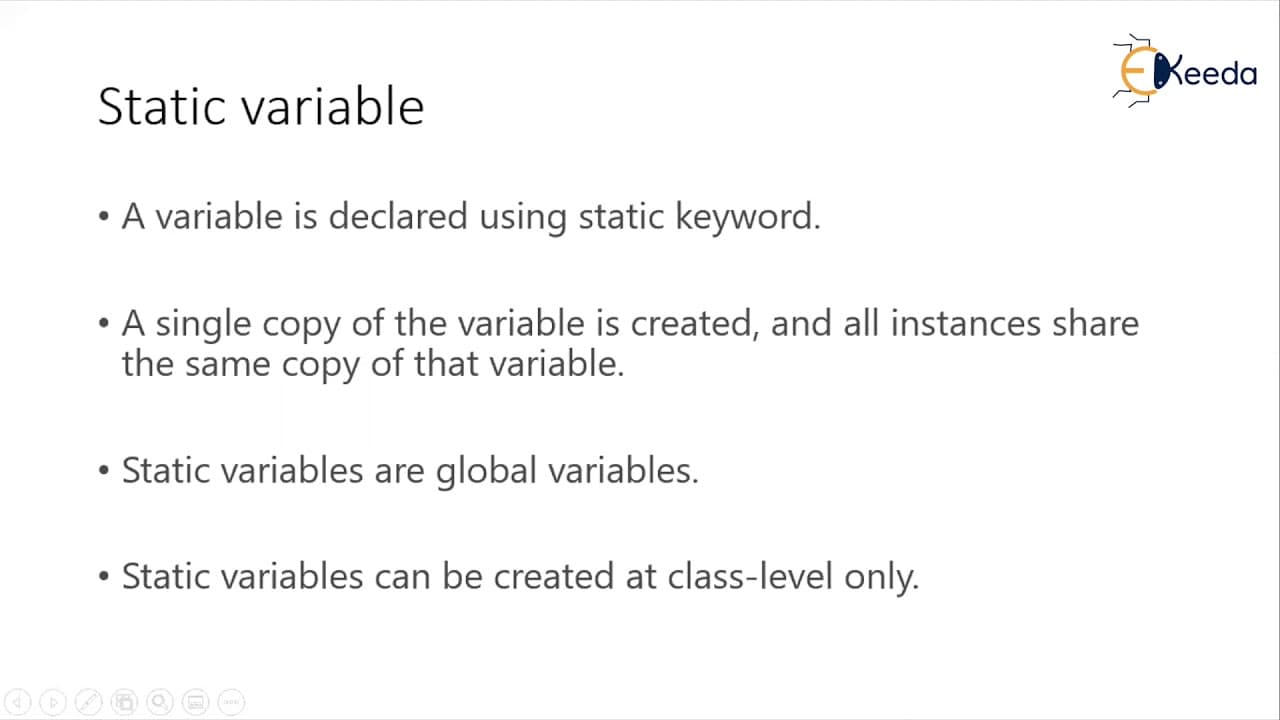
- 🌐 Static variables are global variables and have the same value for all instances of a class.
- 🏛️ Static methods can be accessed using the class name without creating an object.
- 🎭 Static blocks are executed before the main method and are used for initializing static variables or performing actions before the application starts.
- 🏛️ Local variables cannot be declared as static variables and must be declared at the class level.
- 🏛️ Static classes can be used for creating nested classes that do not require an instance of the enclosing class.
- 🏛️ The static keyword is useful when data or methods need to be accessible without object reference or when creating class-level functionality.
Install to Summarize YouTube Videos and Get Transcripts
Explore YouTube Video Summarizer or Get YouTube Transcript Extractor
Questions & Answers
Q: What is the purpose of the static keyword in Java programming?
The static keyword allows variables and methods to be shared among instances, making them global in scope. It helps in creating class-level data members that can be accessed without object reference.
Q: Can a static variable be accessed without creating an object?
Yes, static variables can be accessed without object reference as they belong to the class itself. They can be accessed using the class name followed by the variable name.
Q: How does a static block differ from the main method?
A static block is executed even before the main method in a Java application. Its purpose is to initialize static variables or perform actions that need to be executed before the application starts.
Q: Can a local variable be declared as a static variable?
No, local variables cannot be declared as static variables. Static variables must be declared at the class level and cannot be associated with a specific instance or method.
Summary & Key Takeaways
-
The static keyword in Java is a non-access modifier used to provide modifications to elements without specifying their scope.
-
It can be used with variables, methods, blocks, and nested classes to allow multiple objects to share the same variable or method.
-
Static variables are global variables, accessed using the class name, and have the same value for all instances of a class.
Read in Other Languages (beta)
Share This Summary 📚
Summarize YouTube Videos and Get Video Transcripts with 1-Click
Try YouTube Summary with ChatGPT & Claude or YouTube Transcript Generator
Explore More Summaries from Ekeeda 📚




Summarize YouTube Videos and Get Video Transcripts with 1-Click
Try YouTube Summary with ChatGPT & Claude or YouTube Transcript Generator