How Do You Perform Epoxidation of Alkenes?
TL;DR
Epoxidation of alkenes can be achieved by reacting them with peroxy acids like MCPBA or by converting halohydrins, obtained from alkenes and Br2 in water, into epoxides using sodium hydroxide. Reacting epoxides with H2O+ opens the three-membered ring, producing trans-diols and a racemic mixture.
Transcript
in this video we're going to go over the epoxidation of alkenes so let's start with this example let's react cyclohexene with mcpba so what do you think the major product of this reaction will be mcpba is a proxy acid it has the functional group r co3h and a proxy acid it looks like a carboxylic acid in a sense that it has a carbonyl group but inst... Read More
Key Insights
- 😒 Epoxidation of alkenes can be achieved through the use of peroxy acids or by converting halohydrins into epoxides.
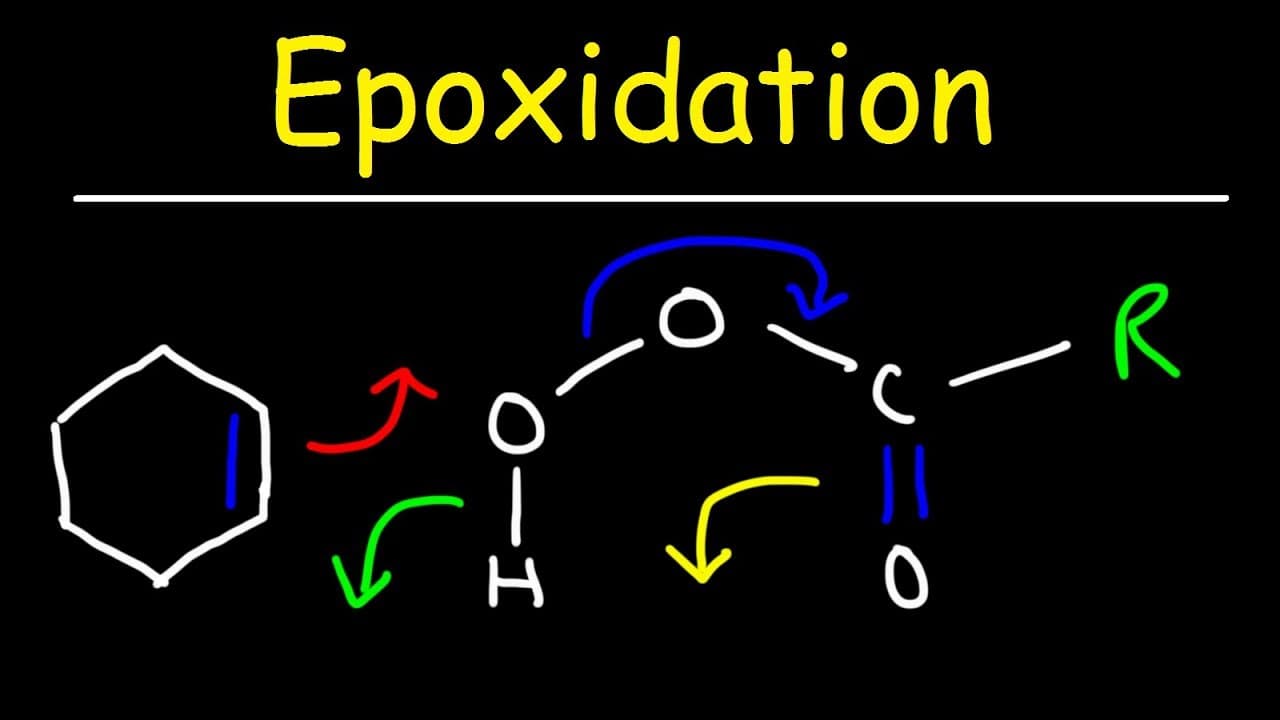
- 🫀 The mechanism of epoxidation using peroxy acids involves the transfer of an oxygen atom from the peroxy acid to the alkene, resulting in the formation of an epoxide.
- 💁 Halohydrins can be converted into epoxides by reacting them with sodium hydroxide, leading to the formation of a cyclic bromonium ion and subsequent expulsion of bromine.
Install to Summarize YouTube Videos and Get Transcripts
Explore YouTube Video Summarizer or Get YouTube Transcript Extractor
Questions & Answers
Q: What is the major product when cyclohexene reacts with MCPBA?
The major product of the reaction between cyclohexene and MCPBA is an epoxide, where the alkene is converted into an oxygen-containing three-membered ring.
Q: How does the mechanism of epoxidation using peroxy acids work?
The reaction begins by breaking the pi bond of the alkene and using it to connect the carbon and oxygen atoms of the epoxide. The sigma electrons between the oxygen atoms form a pi bond between oxygen and carbon. The pi bond between the carbonyl group of the peroxy acid is used to connect the oxygen and hydrogen, resulting in the conversion of the peroxy acid into a carboxylic acid.
Q: What is the alternative method for epoxidation using halohydrins?
Halohydrins can be converted into epoxides by reacting them with sodium hydroxide. Initially, the double bond attacks the bromine molecule, forming a cyclic bromonium ion. Water acts as a nucleophile, causing the bromine to be expelled and resulting in the formation of a halohydrin. Sodium hydroxide, acting as a strong base, then reacts with the halohydrin to form the epoxide.
Q: What happens when an epoxide is reacted with H2O+?
When an epoxide is reacted with H2O+, the three-membered ring of the epoxide opens. Water attacks one of the carbon atoms attached to the oxygen, breaking the sigma bond. This results in the formation of trans-diols and an enantiomeric mixture.
Summary & Key Takeaways
-
Epoxidation of alkenes can be achieved by reacting them with peroxy acids, such as MCPBA, resulting in the formation of epoxides.
-
Another method involves the conversion of halohydrins, obtained through the reaction of alkenes with Br2 and water, into epoxides using sodium hydroxide.
-
When epoxides are reacted with H2O+, the three-membered ring opens, resulting in the formation of trans-diols and an enantiomeric mixture.
Read in Other Languages (beta)
Share This Summary 📚
Summarize YouTube Videos and Get Video Transcripts with 1-Click
Try YouTube Summary with ChatGPT & Claude or YouTube Transcript Generator
Explore More Summaries from The Organic Chemistry Tutor 📚





Summarize YouTube Videos and Get Video Transcripts with 1-Click
Try YouTube Summary with ChatGPT & Claude or YouTube Transcript Generator