How to Build Machine Learning Models for Deployment
TL;DR
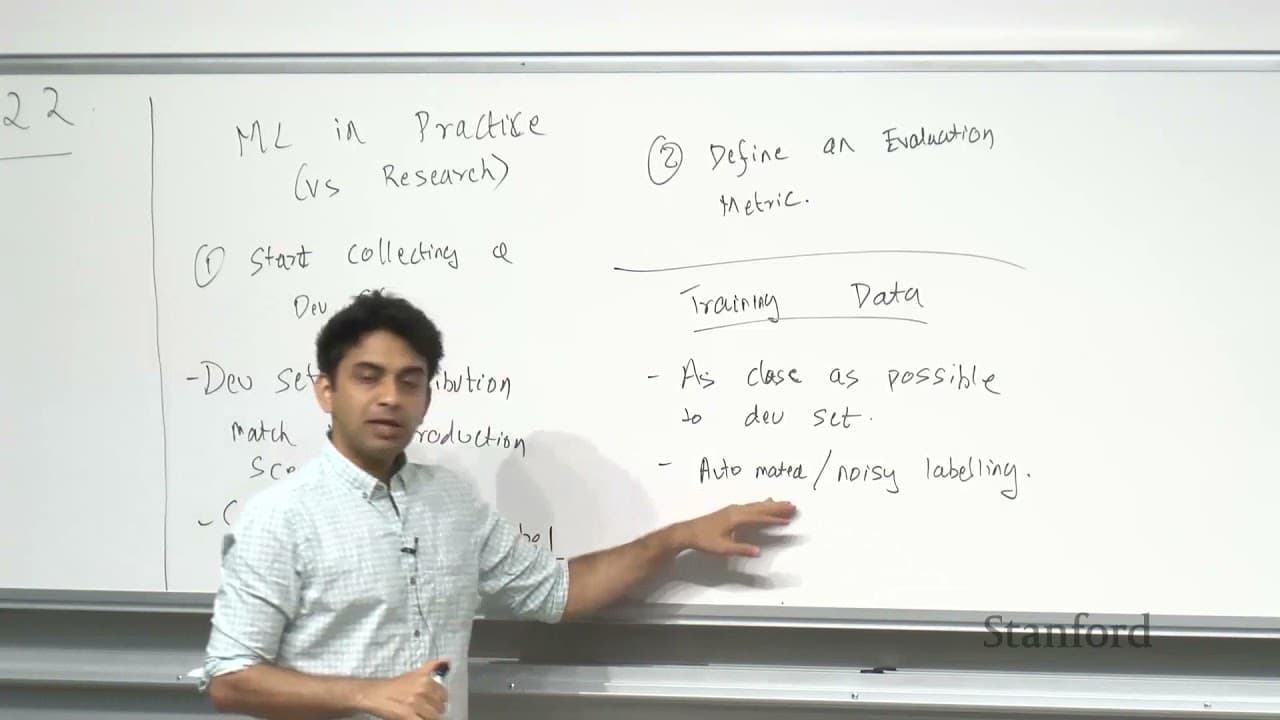
To effectively deploy machine learning models, start by collecting a development set that mirrors real-world scenarios and clearly define an evaluation metric. This ensures your model's performance is aligned with production goals. Additionally, consider automated labeling strategies to gather sufficient training data efficiently, while keeping in mind the importance of accurate labeling to avoid bias and distribution mismatches.
Transcript
topics for today are first we will uh so on on the last class we covered evaluation metrics and uh kind of like a continuation of that today we will talk about some practical tips for applying machine learning in practice uh especially if you want to you know build a machine learning model focused on a real world deployment and with that we're goin... Read More
Key Insights
- 👨🔬 Building machine learning models for real-world deployment requires a different approach compared to research-oriented models.
- 😫 Collecting a dev set that matches the production scenario is crucial to understanding how the model will perform in real-world situations.
- 🥅 Defining an evaluation metric helps measure model performance and align it with the product's goals.
- 🏛️ Obtaining training data can be expensive, but automated or noisy labeling techniques can be used to build larger datasets.
- 💦 The goal is to build models that work well in deployment by considering bias, variance, and distribution mismatches.
- 🕸️ It is important to be cautious about legal considerations when collecting data from the web.
- 😫 Spending time on labeling the dev set accurately can provide insights into the real-world distribution of data.
Install to Summarize YouTube Videos and Get Transcripts
Explore YouTube Video Summarizer or Get YouTube Transcript Extractor
Questions & Answers
Q: What are some practical tips for building machine learning models for real-world deployment?
Start by collecting a dev set that closely matches the production scenario, ensuring the data distribution aligns with real-world usage. Define an evaluation metric that reflects the product's goals and use it to measure model performance. Obtain training data, which can be expensive, by leveraging automated or noisy labeling techniques.
Q: Why is collecting a dev set important for building machine learning models?
Collecting a dev set allows you to have data that matches the production scenario, giving you a better understanding of how your model will perform in real-world situations. It helps ensure that your model's performance is aligned with the target users and their usage patterns.
Q: How should one define an evaluation metric for machine learning models?
Defining an evaluation metric requires understanding what is important for the specific product or application. It could be accuracy, precision, recall, or any other metric that aligns with the desired outcome. The evaluation metric should capture the key factors that matter for the success of the product.
Q: What is the role of training data in building machine learning models?
Training data serves as the foundation for building machine learning models. While collecting large amounts of labeled training data can be expensive, automated or noisy labeling techniques can be effective in creating datasets. The key is to ensure that the training data is as close as possible to the dev set and the production scenario.
Summary & Key Takeaways
-
The focus is on applying machine learning in practical settings, with tips for building models for real-world deployment.
-
A key step is collecting a dev set that matches the production scenario, ensuring the data distribution closely aligns with how the model will be used in the real world.
-
Defining an evaluation metric is crucial to measure model performance and align it with the product's goals.
-
Obtaining training data can be challenging and expensive, but automated or noisy labeling techniques can be effective in building large datasets.
Read in Other Languages (beta)
Share This Summary 📚
Summarize YouTube Videos and Get Video Transcripts with 1-Click
Try YouTube Summary with ChatGPT & Claude or YouTube Transcript Generator
Explore More Summaries from Stanford Online 📚

Summarize YouTube Videos and Get Video Transcripts with 1-Click
Try YouTube Summary with ChatGPT & Claude or YouTube Transcript Generator