Personal pronouns in academic English
TL;DR
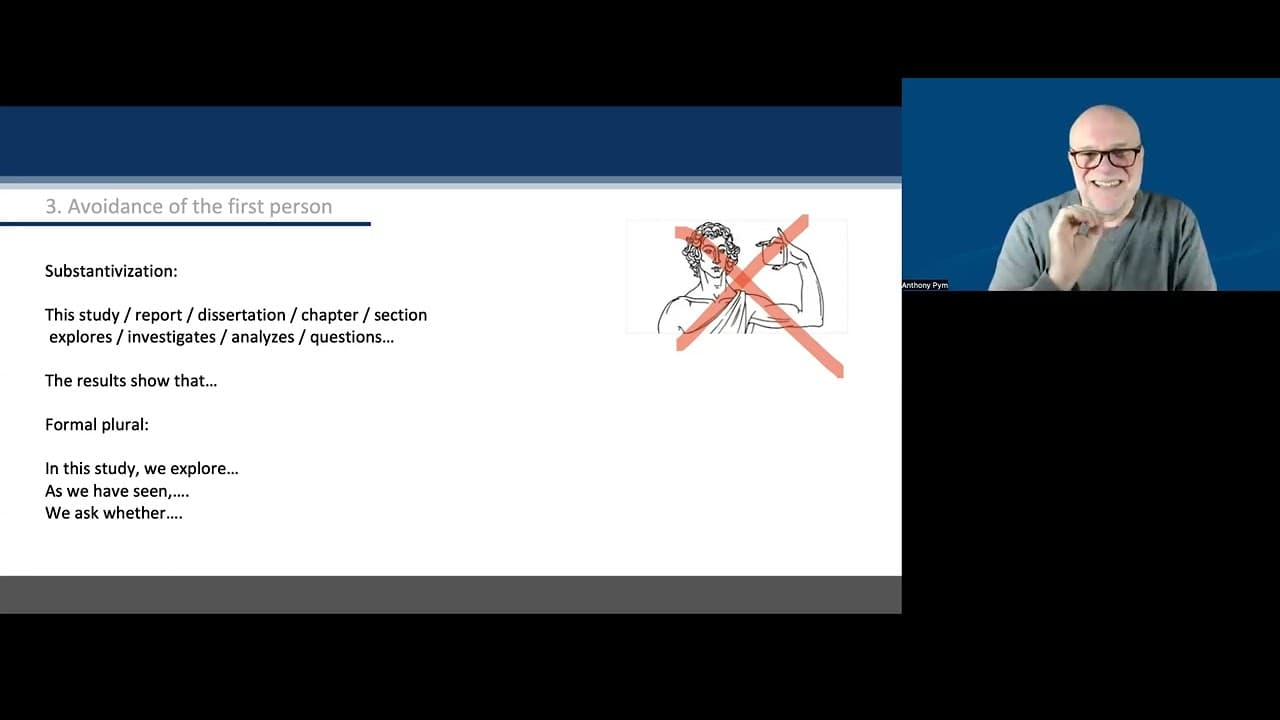
The traditional approach to English prose writing involves avoiding the use of the first person, but modern perspectives challenge this and embrace subjectivity.
Transcript
now I explained that the the ideals of the Enlightenment nature was truth and did not depend truth depended on nature it did not depend on the Observer these days in post-modernity we don't believe that generally we tend to believe that each Observer sees something different and so what we say depends on who we are and so the question of the classi... Read More
Key Insights
- 🧑 The traditional approach to English prose writing involves avoiding the first person and using substantivization, the "we" pronoun, and the passive voice to hide subjectivity.
- 😒 Nowadays, there is a shift towards embracing subjectivity and personal experiences in writing, allowing for the use of the first person.
- ✍️ The passive voice is a common technique to eliminate subjectivity in writing by hiding the doer of the verb.
- ✍️ Substantivization involves turning the verb into a noun to create a more objective tone in writing.
- ❓ The "we" pronoun can be used inclusively with the reader or as the Royal we in English prose writing.
- 😒 The use of the first person in writing can create a more personal and engaging tone for the reader.
- 👻 Embracing subjectivity in writing allows for the construction of personal stories and the exploration of individual perspectives.
Install to Summarize YouTube Videos and Get Transcripts
Explore YouTube Video Summarizer or Get YouTube Transcript Extractor
Questions & Answers
Q: Why is the first person often avoided in English prose writing?
The first person is often avoided in English prose writing to create an objective tone and eliminate subjectivity.
Q: What are some alternative ways to hide subjectivity in writing?
Substantivization, using the "we" pronoun, and employing the passive voice are all alternative ways to hide subjectivity in writing.
Q: Is it acceptable to use the first person in English prose writing?
While traditionally discouraged, the use of the first person has become more accepted in modern writing as it embraces subjectivity and personal experiences.
Q: How can the passive voice be used to eliminate subjectivity in writing?
The passive voice hides the doer of the verb, allowing for a more objective tone and the presentation of facts without assigning responsibility.
Summary & Key Takeaways
-
In traditional English prose writing, authors would use substantivization to hide their subjectivity and make the object the doer of the verb.
-
The use of the "we" pronoun, either as the Royal we or inclusive of the reader, was also common in the past.
-
The passive voice was another way to eliminate subjectivity in writing by hiding the doer of the verb.
Read in Other Languages (beta)
Share This Summary 📚
Summarize YouTube Videos and Get Video Transcripts with 1-Click
Try YouTube Summary with ChatGPT & Claude or YouTube Transcript Generator
Explore More Summaries from Anthony Pym 📚
Summarize YouTube Videos and Get Video Transcripts with 1-Click
Try YouTube Summary with ChatGPT & Claude or YouTube Transcript Generator