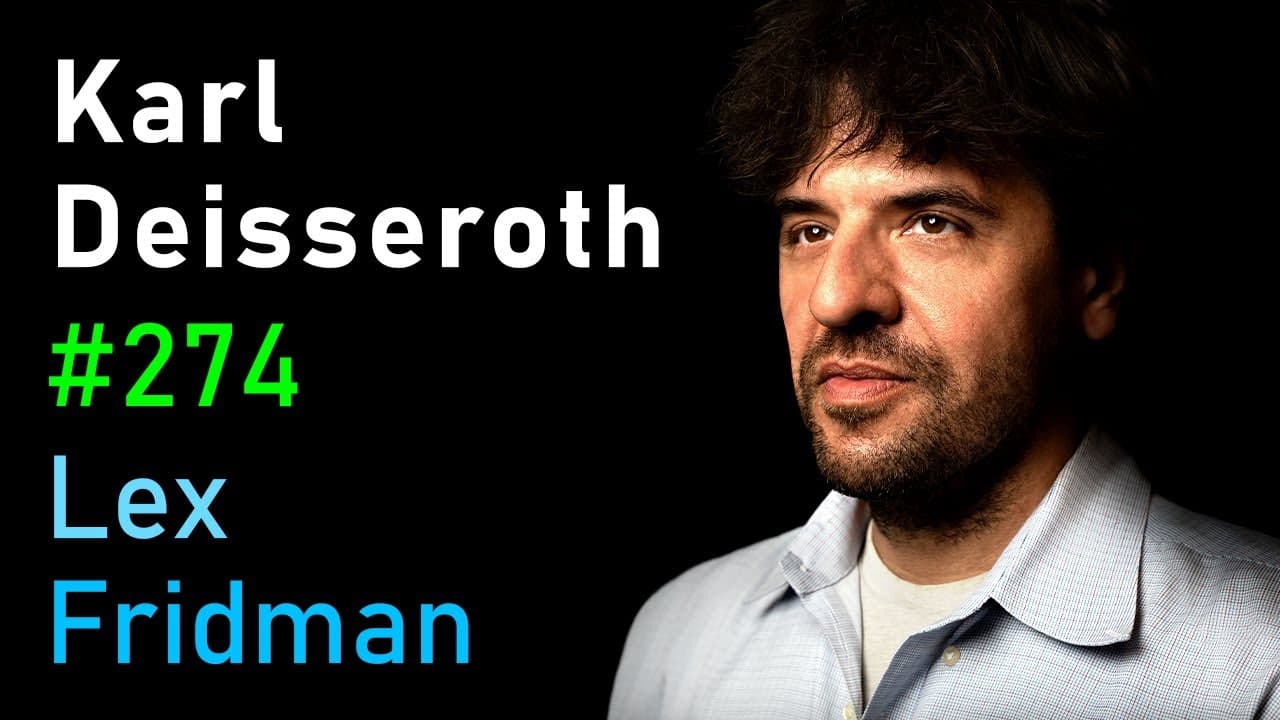
Karl Deisseroth: Depression, Schizophrenia, and Psychiatry | Lex Fridman Podcast #274
TL;DR
Studying psychiatric disorders reveals what the healthy mind is for, because when something breaks you can infer its original function from its dysfunction, just as a mutated gene exposes what a normal gene does. In this conversation, Stanford psychiatrist and neuroscientist Karl Deisseroth explains why he prefers the word "disorder," why psychiatry still lacks blood tests or scans, and why roughly 25% of people meet a lifetime psychiatric diagnosis. Read on for how he draws order from the mind's darkest places.
Transcript
where the darkest places you've ever gone in your life the following is a conversation with carl deisseroth professor of bioengineering psychiatry and behavioral sciences at stanford university he's one of the greatest living psychiatrists and neuroscientists in the world he's also just a fascinating human being we discuss both the darkest and the ... Read More
Key Insights
- 🤯 Dysfunction can provide insights into the original functions and mechanisms of the human mind, allowing us to infer true functions from dysfunction.
- 🪈 Psychiatry involves determining the impact of a condition on social and occupational functioning to distinguish disorder from order and dysfunction from function.
- ⚖️ Understanding psychiatric disorders requires a balance between scientific exploration and the vulnerability to offer personal experiences and insights.
- 🤯 Freud's psychoanalysis introduced the importance of the unconscious mind, while Carl Jung emphasized a broader view of the unconscious beyond libido-related aspects.
- 🎛️ Optogenetics, a technique developed by Deisseroth, enables precise control of neuronal activity, providing insights into the origins of behavior and function at a cellular level.
Install to Summarize YouTube Videos and Get Transcripts
Explore YouTube Video Summarizer or Get YouTube Transcript Extractor
Questions & Answers
Q: What can we learn about human beings from those who suffer from psychiatric disorders?
Deisseroth argues that when something breaks, you see what the original unbroken part was for. Just as a mutated gene turned up or down in strength reveals its normal function in genetics and biochemistry, dysfunction in the mind lets you infer its true function. Studying people for whom the fabric of the mind is "warped and raw" exposes the underlying scaffold of how the mind normally works.
Q: Is there a clear line between dysfunction and function, disorder and order in psychiatry?
No, and Deisseroth says this is debated more in psychiatry than in any other medical specialty. It is a spectrum: some acutely ill patients arriving in the emergency room clearly cannot continue as they are, while others function fine at work but suffer some small dysfunction, with everyone in between. Psychiatry only calls something a disorder when there is a disruption in social or occupational functioning.
Q: Why does Karl Deisseroth prefer the word "disorder" over "disease" or "dysfunction"?
He suggests using "disorder" because it gives license to capture the whole spectrum across conditions like schizophrenia, depression, and autism. He calls it the fairest and most inclusive term, since it captures the essence of the issue, that we need to talk about it when things are not working.
Q: How common are psychiatric disorders according to Deisseroth?
Based on population prevalence values for currently defined mental health disorders, he estimates the lifetime prevalence of having a psychiatric disorder approaches about 25%, and some studies put it higher. Because of this, he suggests nearly every member of the species experiences some disorder, and the real task is picking out which ones are debilitating for each person.
Q: What is Karl Deisseroth's book "Projections" about?
"Projections: A Story of Human Emotions" draws insights about the human mind for modern psychiatry and neuroscience. It opens with the metaphor of weaving, where structural warp threads anchored in the gorges of East Africa form a framework, and the cross threads of our moments and experiences give each individual personal grain and color. The book tells stories of that fabric fraying in those who are ill, while making the human mind itself the protagonist.
Q: Why doesn't psychiatry have definitive diagnostic tests?
Deisseroth notes that psychiatry has a long way to go in developing quantitative tests. Unlike other specialties, it has no blood draws and no imaging studies that can be used to diagnose. As a result, the line between order and disorder, function and dysfunction, is operational and of the moment, based on how things are working rather than on a lab result.
Q: Who is Karl Deisseroth?
He is a professor of bioengineering, psychiatry, and behavioral sciences at Stanford University, described in the interview as one of the greatest living psychiatrists and neuroscientists in the world. He still treats patients as a practicing psychiatrist and sees acutely ill people in the emergency room, which grounds his scientific views in direct clinical experience.
Summary
In this conversation with Carl Deisseroth, professor of bioengineering psychiatry and behavioral sciences at Stanford University, they discuss the darkest and most beautiful places of the human mind. They explore the insights gained from studying psychiatric maladies and the spectrum of function and dysfunction in human beings. They also touch on the power of love and vulnerability, and the role of language in bridging cultures.
Questions & Answers
Q: What is the significance of the book's title, "Projections: A Story of Human Emotions"?
The word "projections" has multiple meanings in the context of the book. In neuroscience, projections refer to long-range connections between different parts of the brain. The book explores the impact of these connections on human emotions. Projections also refer to reducing complex things into simpler representations, a skill often used in neuroscience. Additionally, projections can refer to the act of projecting our own feelings or understanding onto someone else, which plays a role in human interaction.
Q: How does studying psychiatric disorders help us understand human nature?
Studying psychiatric disorders allows us to see what the original unbroken state of certain traits or functions was for. In genetics and biochemistry, when a gene or chemical is mutated, we can infer its true function from the resulting dysfunction. Similarly, studying psychiatric disorders helps us understand the underlying functions of various aspects of human nature by seeing how they break down in certain individuals.
Q: Is there a clear line between disorder and order in psychiatry?
The line between disorder and order in psychiatry is a subject of ongoing debate. While there are clear cases where individuals are acutely ill and cannot function properly, there is also a spectrum of functioning and dysfunctioning individuals in between. Psychiatry defines a disorder when there is a disruption in social or occupational functioning, but this line is subjective and operational in the moment.
Q: How careful should we be in labeling someone with a psychiatric disorder?
Instead of using terms like "disease" or "dysfunction," it is more inclusive and fair to use the term "disorder" when discussing psychiatric conditions. This allows for a broader understanding of the spectrum of severity and acknowledges that nearly everyone experiences some level of dysfunction or disorder during their lifetime.
Q: How are prevalence numbers of psychiatric disorders determined?
Prevalence numbers for psychiatric disorders are determined through structured psychiatric interviews conducted by trained individuals. These interviews involve thorough assessments of symptoms and can be time-consuming. Self-reporting can also result in higher prevalence numbers, but rigorous studies with structured interviews provide the most accurate estimates.
Q: Can psychiatric disorders be diagnosed through lab tests or imaging studies?
Currently, psychiatric disorders cannot be diagnosed through lab tests or imaging studies. While these disorders have strong biological and genetic components, the field of psychiatry still relies on clinical observation and assessment of symptoms to make diagnoses. Research is ongoing to develop quantitative tests and biomarkers for psychiatric disorders.
Q: How biological are psychiatric disorders?
Psychiatric disorders have a significant biological basis, including genetic and neurobiological factors. Disorders like autism, bipolar disorder, and anorexia nervosa are heavily influenced by genetic factors. Interestingly, some of these disorders are positively correlated with measures of intelligence and educational attainment. This demonstrates the complexity of psychiatric disorders and their biological underpinnings.
Q: Does intelligence come with its own set of burdens?
While intelligence is often seen as a positive trait, it can also come with its own challenges. People who believe they are smarter than they actually are may encounter difficulties, and ignorance can sometimes lead to greater happiness. There is a delicate balance between reasoning and feeling, and the ability to feel and experience the world deeply can also be a form of intelligence.
Q: How does James Joyce's "Finnegans Wake" relate to schizophrenia and altered human thought processes?
"Finnegans Wake" contains elements that reflect the thought disorders and tangential thought processes seen in schizophrenia. The use of clang associations, neologisms, and loose associations in the novel overlaps with symptoms experienced by individuals with schizophrenia. Joyce's own experiences and his familial connection to schizophrenia suggest a deep understanding and representation of altered human thought processes.
Q: What inspired the writing style of "Projections: A Story of Human Emotions"?
The writing style of "Projections" varies throughout the book to capture the essence of each psychiatric disorder. Each chapter focuses on a different disorder and adopts a writing style that reflects the specific symptoms and experiences. The author drew inspiration from real patients and their stories, using their symptoms as the foundation for each chapter's writing style.
Q: How do love and vulnerability relate to the writing of "Projections"?
Love and vulnerability play a significant role in the writing of "Projections." Love is described as the strongest and most stable connection humans can form—a bridge between individuals that brings joy and a sense of survival. The author's vulnerability in sharing their own experiences and emotions adds depth and authenticity to the book. Love and vulnerability are intertwined themes throughout the work.
Takeaways
This conversation delves into the darkest and most beautiful aspects of the human mind, discussing topics such as psychiatric disorders, the role of love, and the power of vulnerability. Through studying disorders, we can gain insights into the origins and functions of various aspects of human nature. The book "Projections: A Story of Human Emotions" captures the complexity and spectrum of psychiatric disorders, highlighting the importance of understanding and empathy. The poetic language of James Joyce and Jorge Luis Borges adds depth and resonates with the exploration of the human condition. Language and translation also play a role in bridging cultures and preserving the richness of different literary traditions.
Summary & Key Takeaways
-
Carl Deisseroth's book, "Projections: A Story of Human Emotions," explores the human mind for modern psychiatry and neuroscience, offering insights into the stories of individuals with mental health disorders.
-
Dysfunction and function, disorder and order in psychiatry exist on a spectrum, where individuals can experience varying degrees of disruption in different areas of their lives.
-
The distinction between dysfunction and disease in psychiatry is debatable, as it depends on the impact of the condition on an individual's social and occupational functioning.
Read in Other Languages (beta)
Share This Summary 📚
Summarize YouTube Videos and Get Video Transcripts with 1-Click
Try YouTube Summary with ChatGPT & Claude or YouTube Transcript Generator
Explore More Summaries from Lex Fridman Podcast 📚

Summarize YouTube Videos and Get Video Transcripts with 1-Click
Try YouTube Summary with ChatGPT & Claude or YouTube Transcript Generator