Stem and Leaf Plots
TL;DR
Learn how to use stem and leaf plots to visualize data and gain insights into the distribution of numbers in a dataset.
Transcript
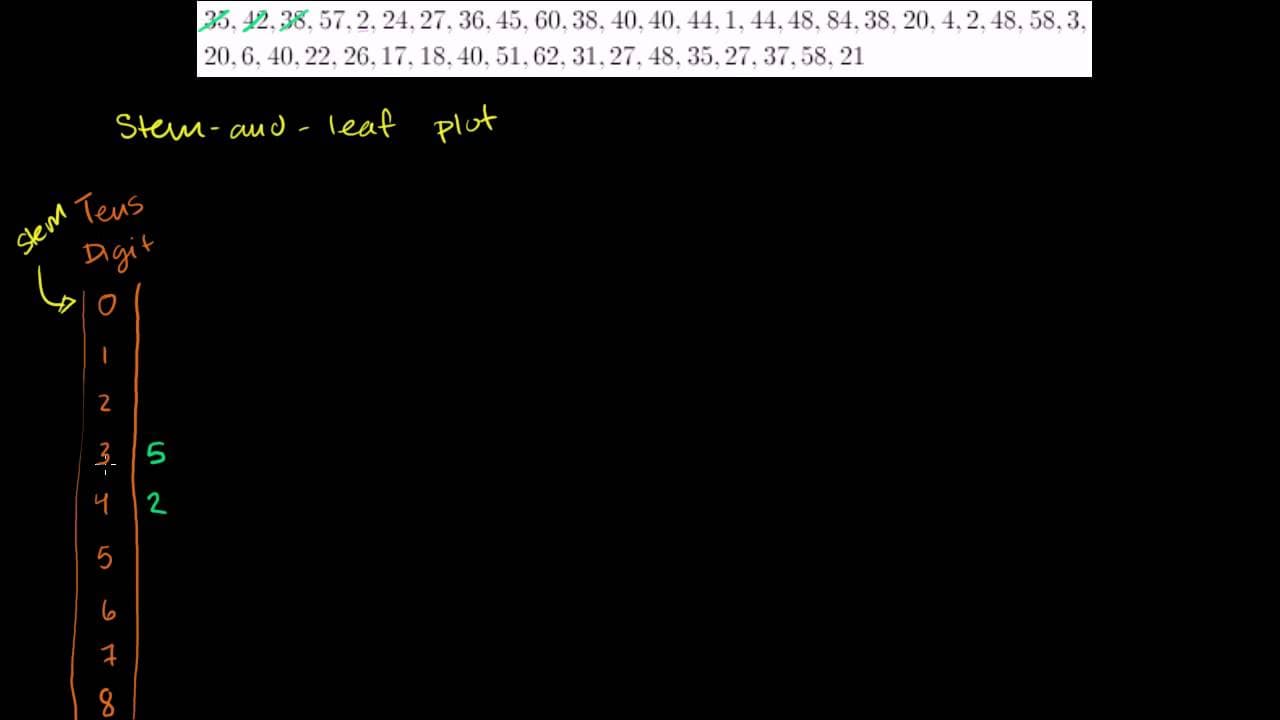
In this video, we're going to talk about how to visualize data. In particular, we're going to use something called a stem and leaf plot. And what's useful about this is it essentially allows you to show all of your data and show a lot of detail about all of the numbers in your data set, while at the same time having a good sense about how those num... Read More
Key Insights
- 👻 Stem and leaf plots allow for a detailed representation of data, showing the individual numbers in a dataset.
- 🧡 They provide insights into the distribution and concentration of numbers within different ranges.
- 🍀 Stem and leaf plots help in identifying the median, mode, and clusters of numbers in the dataset.
- 👾 They are a space-saving alternative to traditional numerical lists, reducing the need for rewriting long ranges of numbers.
- 🔶 Stem and leaf plots can handle datasets with varying ranges, accommodating both small and large numbers.
- 🧑🏭 The most significant digit (stem) acts as a grouping or categorization feature in the plot.
- 🍀 Stem and leaf plots are a helpful tool for visualizing data in mathematical and statistical analysis.
Install to Summarize YouTube Videos and Get Transcripts
Explore YouTube Video Summarizer or Get YouTube Transcript Extractor
Questions & Answers
Q: What is the purpose of using a stem and leaf plot in data visualization?
Stem and leaf plots are used to display all the numbers in a dataset and provide insights into their distribution. It helps in understanding whether numbers are clustered in certain ranges or evenly spread out.
Q: How are stem and leaf plots constructed?
Stem and leaf plots are constructed by listing the most significant digit (stem) and then writing the ones digit (leaf) next to it. Each stem represents a range of numbers, and the leaves show individual numbers within that range.
Q: What advantage do stem and leaf plots offer over traditional numerical lists?
Stem and leaf plots save space and ink by only requiring the ones digit to be written. They also provide a visual representation of the data's distribution, making it easier to identify trends and patterns.
Q: Can stem and leaf plots handle large datasets?
Yes, stem and leaf plots can handle large datasets by extending the stem to accommodate a wider range of numbers. This allows for the visualization of both small and large numbers in the dataset.
Summary & Key Takeaways
-
The video introduces stem and leaf plots as a visual tool for displaying data in a detailed and organized manner.
-
Stem and leaf plots allow you to show all the numbers in a dataset and understand their distribution better.
-
By grouping numbers based on their most significant digit (stem) and showing the ones digit (leaf), stem and leaf plots provide a comprehensive representation of the data.
Read in Other Languages (beta)
Share This Summary 📚
Summarize YouTube Videos and Get Video Transcripts with 1-Click
Try YouTube Summary with ChatGPT & Claude or YouTube Transcript Generator
Explore More Summaries from Khan Academy 📚



Summarize YouTube Videos and Get Video Transcripts with 1-Click
Try YouTube Summary with ChatGPT & Claude or YouTube Transcript Generator