Coding Challenge #60: Butterfly Generator
TL;DR
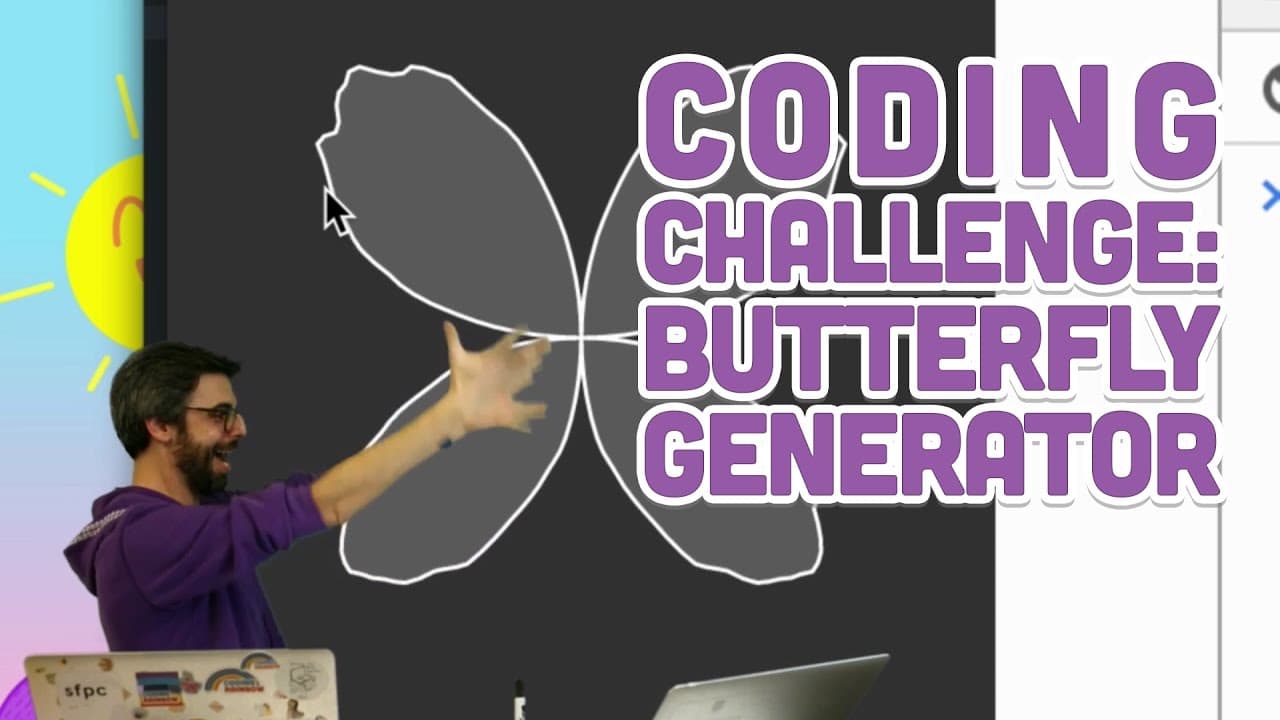
Learn how to generate butterfly wing patterns algorithmically using Perlin noise and trigonometry in p5.
Transcript
ah hello welcome to a coding challenge this coding challenge is called the moth wings butterfly wings coding challenge I'm going to look at how could we use what would be a technique to generate algorithmically the wings of a butterfly or the wings of a moth so this is inspired by a project by artist named Katy rose Pipkin I will include links to i... Read More
Key Insights
- 😘 Inspiration from Katy Rose Pipkin's Moths Generator project led to the creation of algorithmic butterfly wings.
- 😘 Symmetry, polar coordinates, and Perlin noise are essential techniques in generating unique wing patterns.
- 😘 Animation effects using additional dimensions and frame counts bring movement to the butterfly wings.
- 👨💼 The video demonstrates coding in p5.js, highlighting trigonometry functions like sine and cosine.
- 😘 Experimenting with various parameters like noise values, resolution, and shape iterations can enhance the wing design.
- ❓ Creative exploration and audience participation are encouraged to further develop the concept.
- 😘 Considerations for color, design, and optimization offer opportunities for improved wing diversity.
Install to Summarize YouTube Videos and Get Transcripts
Explore YouTube Video Summarizer or Get YouTube Transcript Extractor
Questions & Answers
Q: What inspired the creation of algorithmically generated butterfly wings?
The project by artist Katy Rose Pipkin, the Moths Generator, where algorithmically generated moths are tweeted with images and names, inspired the creation of butterfly wings.
Q: How can polar coordinates and Perlin noise be used to create unique wing patterns?
Polar coordinates help generate shapes symmetrically, allowing for symmetrical wing patterns, while Perlin noise adds randomness for variation.
Q: What programming techniques were demonstrated in the video?
The video showcased coding in p5.js to utilize trigonometry, polar coordinates, Perlin noise, and animation to create algorithmically generated butterfly wings.
Q: How did the creator introduce additional dimensions to the Perlin noise for animation effects?
By adding a second dimension with the frame count, the butterfly wings were animated to flap and wiggle, enhancing the visual representation of the wings.
Summary & Key Takeaways
-
Artist Katy Rose Pipkin's Moths Generator project inspires the creation of algorithmically generated butterfly wings.
-
Using polar coordinates and Perlin noise, different wing patterns can be created.
-
The video demonstrates the process of coding in p5.js to generate animated and unique butterfly wings.
Read in Other Languages (beta)
Share This Summary 📚
Summarize YouTube Videos and Get Video Transcripts with 1-Click
Try YouTube Summary with ChatGPT & Claude or YouTube Transcript Generator
Explore More Summaries from The Coding Train 📚


Summarize YouTube Videos and Get Video Transcripts with 1-Click
Try YouTube Summary with ChatGPT & Claude or YouTube Transcript Generator