How Does PoseNet Work for Real-Time Body Tracking?
TL;DR
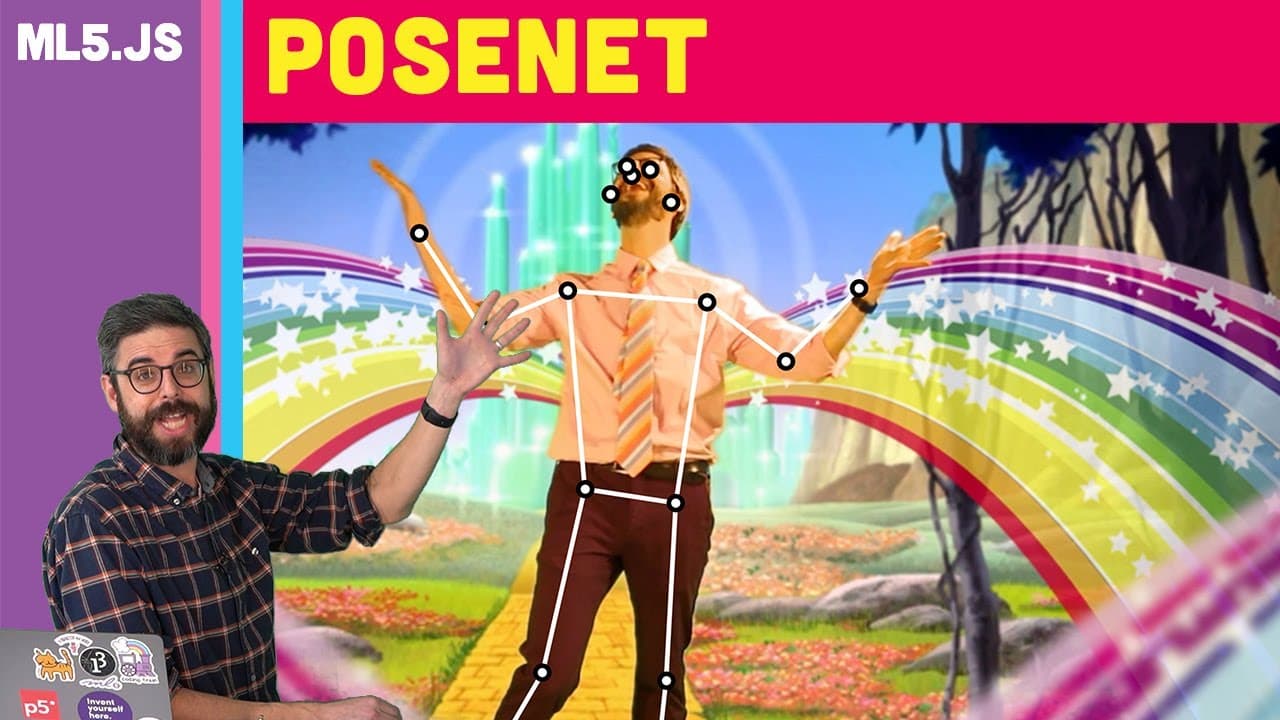
PoseNet estimates human poses in real time by processing webcam images, outputting 17 key points with XY coordinates and confidence scores. It likely uses the Coco dataset for training, allowing users to implement it easily with ML5 and P5.js for interactive projects. Developers can create custom pose classifiers by leveraging PoseNet's relative position data.
Transcript
hello and welcome to another beginner's guide to machine learning video tutorial in this video I am going to cover the pre trained model pose net and I'm going to look at what pose net is how to use it with the ml5 chess library with p5.js library and track your body in the browser in real time model as I mentioned that I'm looking at is called pos... Read More
Key Insights
- 💯 PoseNet provides XY coordinates and confidence scores for 17 key points on the human body.
- 🏷️ The training data for PoseNet likely includes the Coco dataset of labeled images for model accuracy.
- ⌛ Using ML5 and P5.js libraries, developers can implement PoseNet for real-time body tracking in interactive projects.
- 🧘 Developers can train custom pose classifiers with PoseNet's relative position data for versatility.
- 🔠 Understanding the model's inputs, training data, and implementation methods is crucial for successful utilization.
- 💯 PoseNet's use of confidence scores enables accurate tracking and estimation of key points on the body.
- ⚾ Experimenting with different environments and individuals can help refine and improve PoseNet-based projects.
Install to Summarize YouTube Videos and Get Transcripts
Explore YouTube Video Summarizer or Get YouTube Transcript Extractor
Questions & Answers
Q: What are the inputs and outputs of the PoseNet model?
The PoseNet model expects an image as an input and provides an array of XY coordinates with confidence scores for key points on a skeleton as the output. It estimates positions for 17 key points on the human body.
Q: How is the PoseNet model trained, and what is the significance of the Coco dataset?
The PoseNet model is open source, but the training code is closed source. The Coco dataset, with labeled images of people in various poses, likely influenced the model's training, though specifics remain uncertain.
Q: How can PoseNet be implemented for real-time body tracking in interactive media projects?
PoseNet can be easily integrated for real-time body tracking using the ML5 and P5.js libraries. By accessing the XY coordinates and confidence scores, developers can create interactive projects with relative ease.
Q: Can PoseNet be used to develop custom pose classifiers for different environments?
Yes, developers can train their own pose classifiers using the relative positions provided by PoseNet. By normalizing the data, classifiers can recognize poses across different environments and individuals.
Summary & Key Takeaways
-
Understand the PoseNet model's input and output, providing XY coordinates and confidence scores for key points on a skeleton.
-
Learn about the training data of the PoseNet model, such as the Coco dataset, and how it influences model accuracy.
-
Explore the implementation of PoseNet for real-time body tracking using ML5 and P5.js libraries in interactive media projects.
Read in Other Languages (beta)
Share This Summary 📚
Summarize YouTube Videos and Get Video Transcripts with 1-Click
Try YouTube Summary with ChatGPT & Claude or YouTube Transcript Generator
Explore More Summaries from The Coding Train 📚




Summarize YouTube Videos and Get Video Transcripts with 1-Click
Try YouTube Summary with ChatGPT & Claude or YouTube Transcript Generator